Plants & Balcony · Tool · 5 min ·
How many metres of string lights does your balcony need? Drape them and see
How many metres of string lights does your balcony need? It depends far more on how you hang them than on how big the balcony is. Set your width, depth and distance to the socket, then try a straight run, droopy swags or an overhead zigzag and watch the length change.
You also get the rule of thumb behind the number, what to measure first, and the difference between lit length and the length on the box.
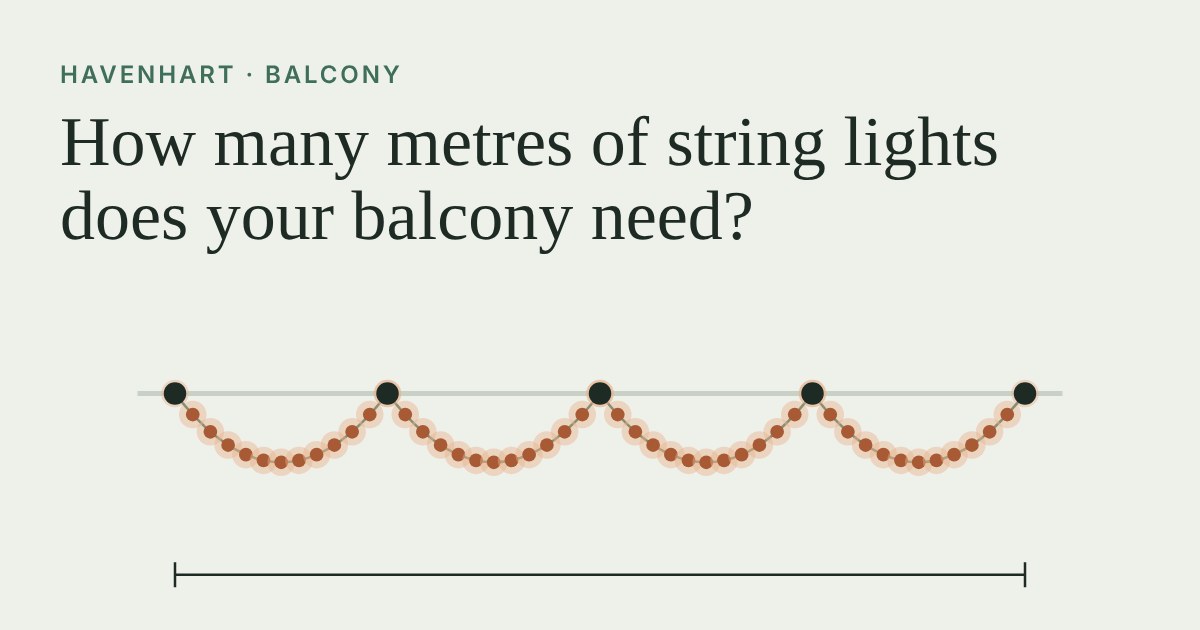
String lights are the quickest way to make a balcony feel like a small outdoor room after dark. They are also the thing people most often buy the wrong length of. Too short and the last swag ends in mid-air; too long and a tangle of spare cable lies under the chair. A tape measure and a bit of arithmetic fix both.
Three ways to hang them, three very different lengths
The same balcony needs a surprisingly different amount of cable depending on how you hang the lights:
- A straight run along the railing or wall uses exactly the width of the balcony. It is the shortest and tidiest option.
- Swags (loops that droop between hooks) look relaxed and festive, but the droop adds cable. Deeper loops and fewer hooks change the total more than most people expect.
- An overhead zigzag from the wall to the railing makes a glowing ceiling. It looks the most like a little room, and it needs several times the length of a straight run.
Try your own balcony below. Enter its width and depth in centimetres, pick a way of hanging, and watch the length change.
The rule of thumb behind the number
A straight run is just the width. A droop is where people get caught out. A hanging loop is close to a parabola, and its length is roughly the span plus 8 × droop² ÷ (3 × span). You do not need to calculate it, but the shape of the formula is useful: the extra cable grows with the square of the droop. Doubling the droop roughly quadruples the extra cable. A gentle 10 cm droop on a one metre span adds under 3 cm, while a 30 cm droop adds about 24 cm.
Fewer hooks means longer, deeper swags, so the total goes up even though the balcony has not changed. If you are short of cable, adding a hook usually costs nothing and saves more length than you would think.
For the overhead zigzag, the sum is simple: each pass is as long as the balcony is deep, and you add the gap each time the line turns around. A 400 cm wide, 150 cm deep balcony with a pass every 60 cm needs about 7 passes, so about 14 m of lit cable. That is why a canopy usually needs a long string, or two strings plugged end to end if the maker allows it.
When to break the rule: if you want a very relaxed, dense canopy, hang the passes closer together and accept the extra length. If you only want a soft glow, a straight run or a few swags along one side is plenty. Cosy is about warmth, not about covering every centimetre.
Lit length is not the length on the box
Most strings have a plain, unlit cable at the plug end, and sometimes a short one at the far end too. A pack that says 10 m may light only 8 or 9 m of it. Check the product page for the lit length, and for how long the lead cable is. If the listing gives only one number, assume the lit part is a little shorter. The tool above adds your distance to the socket separately, so the number it gives is the cable you need in total; check that the lit length plus the lead cable on the listing reaches it.
What to measure before you buy
- The width of the balcony along the railing or wall, and its depth from wall to railing, in centimetres.
- The height of your hooks or fixing points, so swags clear heads and furniture. Tall guests and parasols matter.
- The distance from the nearest outdoor-safe socket (or your battery or solar position) to the first hook. Measure along the route the cable will really take, not in a straight line.
Then use the tool and round up to the next length you can find. If you already own lights from a previous year, test them first: a string you have is a string you do not need to buy.
Power, weather and fixings
Choose lights marked for outdoor use. A rating such as IP44 means the casing is splash-proof, which is a sensible minimum for a covered balcony; a higher number such as IP65 copes better with open, rainy spots. Battery, USB and solar strings avoid the question of cable to a socket completely, though they need a good place to sit in the sun or a power bank in the dry. For a plug-in string, keep the plug and any connectors off the wet floor and out of puddles. If there is no outdoor socket and you would like one, that is a job for an electrician, not something to improvise.
In a rental, use clips, adhesive hooks, cable ties around the railing or clamps rather than drilling, and check your lease or building rules, because some blocks restrict what can be attached to a facade or railing. Balconies are windy places: tie the string at every hook rather than letting a long swag flap, and take lights down in a storm. Keep lights away from dry plants and fabric awnings, and switch them off when you go to bed.