Bedroom · Tool · 4 min ·
What bed size fits your room? Drag the bed and see
Bed sizes are sold by the mattress, but you live with the gaps around it. Pick a size, enter your room's measurements and drag the bed sideways to see how much walking space is left on each side and at the foot.
You get the rule of thumb (about 60 cm on each side, 75 cm if comfortable), when it is fine to break it, and what to measure before you buy a frame.
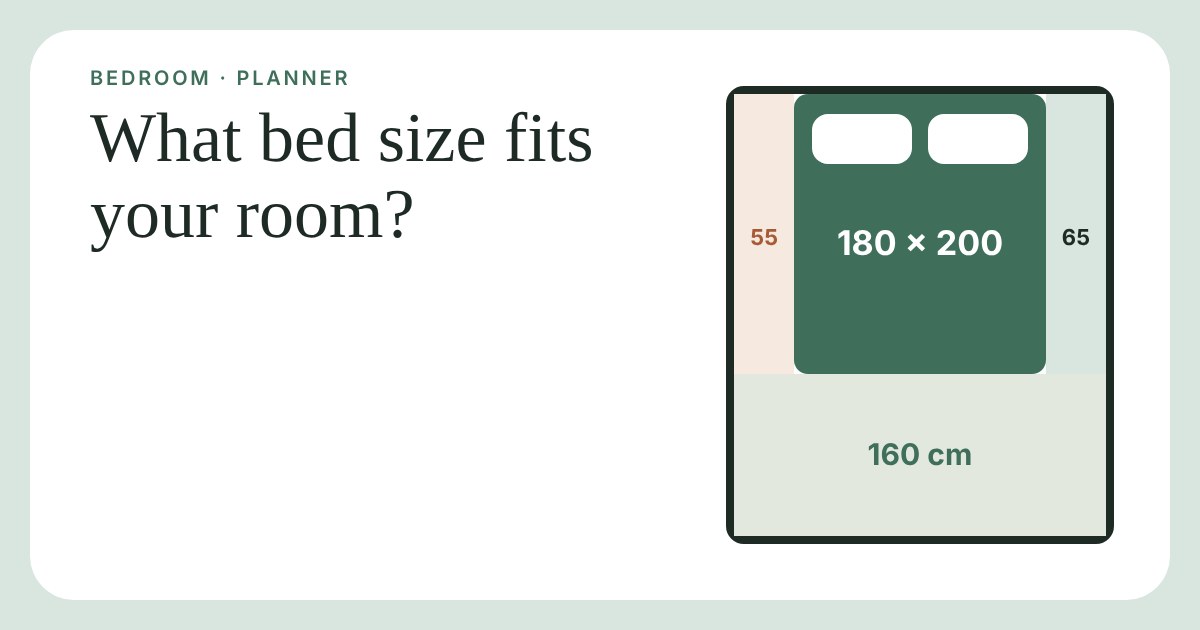
Bed sizes are sold by the mattress, but you live with the gaps around it. A bed that is a little too big does not just fill the floor: it squeezes the walkway, blocks drawers and makes a small room feel packed. This guide shows how to check the gaps before you choose a size.
Start with the mattress, then add the walking space
A mattress label gives width and length. The frame usually adds a few centimetres, and a headboard or footboard adds more, so always measure the frame you are considering, not just the mattress.
Common mattress sizes in the UK are small single 75 × 190 cm, single 90 × 190, small double 120 × 190, double 135 × 190, king 150 × 200 and super king 180 × 200. Many continental shops sell 90, 140, 160 and 180 cm widths, usually 200 cm long. Sizes vary a little between makers, so treat these as typical.
The simple rule of thumb: leave about 60 cm of clear floor on each side you get in and out of, and 75 cm if you want it to feel comfortable rather than merely workable. At the foot, 60 cm is enough to walk past, and more helps if a wardrobe or chest of drawers faces the bed.
Why the gaps matter more than the size
Try the 180 cm super king in a room that is 330 cm wide. It leaves 150 cm in total, so about 75 cm each side if you centre it. That works, but add a 40 cm bedside table and the gap on that side drops to about 35 cm. Furniture beside the bed eats the same floor you are measuring, so count it in.
Now try a 140 cm double in the same room. The extra 40 cm of floor often makes the whole room feel calmer, which matters more at night than a little extra mattress width.
When to break the rule
Against a wall is fine for one sleeper, and common in small rooms and rentals. You gain floor space and give up access on one side. For a child's room or a spare room, that is often a good trade.
Sleeping alone but want a big bed? A 150 cm king centred or pushed to one wall can feel generous without costing two walkways. If you share, the walkway on each side matters more than the width of the mattress.
Drawers and wardrobe doors are the other exception. They need room to open, usually more than 60 cm, so check them separately. A sliding wardrobe door needs less room than a hinged one.
Measure before you buy
Measure the room's width and length at floor level, because skirting boards and radiators take a few centimetres. Mark the bed's footprint on the floor with masking tape or newspaper, using the frame's outer size, and walk around it. Then check the route in: doorways, stairs and tight turns, so the headboard and base can actually arrive. Keep a note of where radiators, sockets and windows sit, because they may decide which wall the head can go on.
If you are on a budget, remember that a second-hand frame in a size that fits is often a better choice than a new one that does not. Check that the slat spacing suits your mattress type, and ask the seller for the frame's outer measurements.
What to look for
- Outer frame size: add the frame, headboard and any side rails to the mattress size, then compare it to your room.
- Walking space: aim for 60 cm on each side you use and at the foot, 75 cm if there is room.
- Delivery route: check doors, stairs and corners, and whether the bed comes flat-packed or assembled.