Bedroom · Tool · 4 min ·
Where should the bed go? Drag it around your room and see
Where the bed goes decides how a bedroom feels more than the bed itself. Enter your room size, pick a bed, and drag it around a to-scale plan to see the walking space on each side and at the foot.
You will also see whether the door can still swing open, plus rules of thumb for how much room you need and when it is fine to break them.
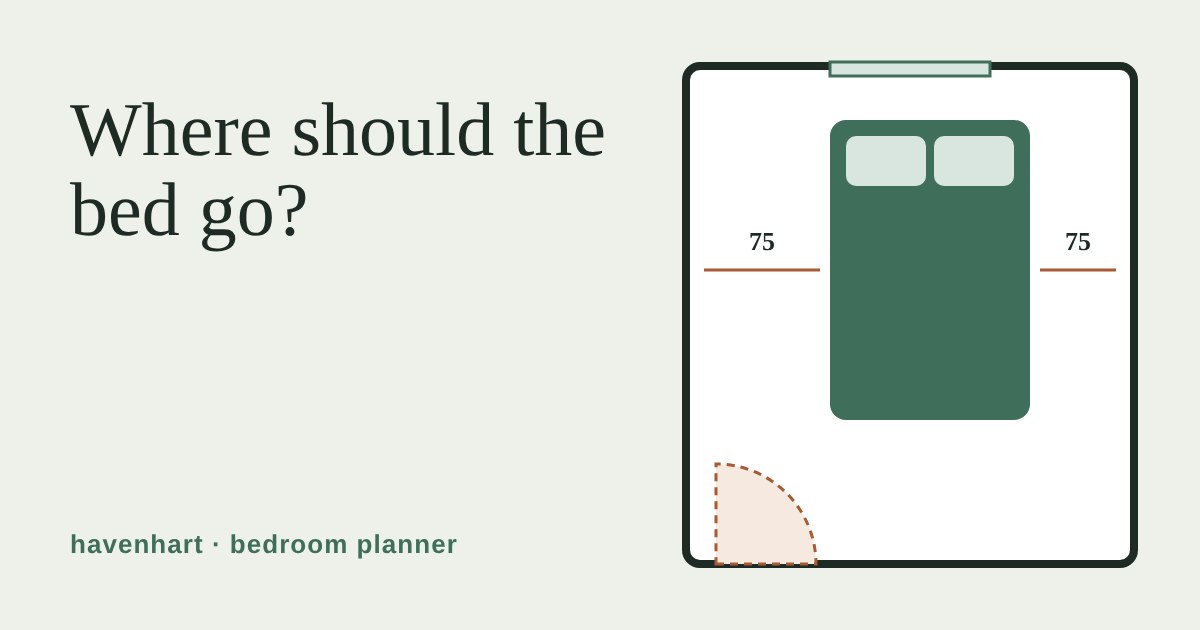
Before you buy a new bed, or drag the old one across the room, there is a cheaper question: where does it leave space to walk? A calm bedroom is mostly about the gaps around the bed, not the bed itself. Try your own room below.
Plan your bedroom
Enter your room size, pick a bed, then drag the bed around. The door swings into the room (the shaded quarter circle), so keep that clear too. The planner shows the free space on each side in centimetres and tells you what it means.
The numbers behind it
The planner uses common rules of thumb, not laws. Many bedroom guides suggest about 60 cm along each side you use, enough to walk, make the bed and open a bedside drawer. Around 75 cm feels comfortable rather than just adequate. At the foot, about 70 cm is useful where the route to a door, window or wardrobe passes the end of the bed. In front of a wardrobe with hinged doors, leave around 90 cm, measured with the doors open; sliding doors need less, roughly 60 cm.
Common European bed sizes are 90 × 200 cm for a single and 160 × 200 or 180 × 200 cm for a double, with 140 × 200 cm in between. Remember the frame, headboard and bedding add a little, so measure the actual bed, not just the mattress.
Where the bed usually goes
There is rarely one perfect spot, but a few placements work again and again. Head against the longest solid wall is the calmest start: it feels anchored, and it keeps the middle of the room open. Avoid putting the head directly under a window if you feel drafts or get early light, and avoid having the bed face the door squarely if you would rather not see the hallway from your pillow. These are comfort preferences, not rules; try them and keep what feels right.
In a narrow room, a single bed along one wall leaves a clear aisle on the other side. In a small room with a double, centring the head on the short wall gives both sides equal access, but only if there is at least 60 cm each side. If not, pushing one side to the wall and sleeping on the open side can win back a lot of floor.
Check these before you move anything
- Measure the room wall to wall at floor level, then note radiators, sockets and skirting boards.
- Measure the doorway and any stairs or turns the bed has to travel through, before you buy a new one.
- Mark the door swing and wardrobe doors with masking tape on the floor, then walk through the plan in your socks.
- Measure the window width and ceiling height if you plan to add curtains or a tall headboard.
If you are renting, rearranging costs nothing and leaves no marks. If you have a tall wardrobe or bookcase, anchor it to the wall with the fitting it came with; do not leave tall furniture free-standing where someone sleeps nearby.
When to break the rule
If you sleep alone, a bed pushed into a corner is a good use of a tiny room, even though one side is blocked. If you live in a studio, a bed placed along a wall as a daybed can free the middle. Cosy does not mean buying anything: a free afternoon, tape and a willing friend to help you lift is enough to find out what works.
What to buy, if anything
Nothing for this one. Rearranging first often shows you that the room was never the problem, and if you do decide on a new bed later, the measurements above tell you which size actually fits.