Textiles · Explainer · 5 min ·
Where should curtains end? Drag the hem and see
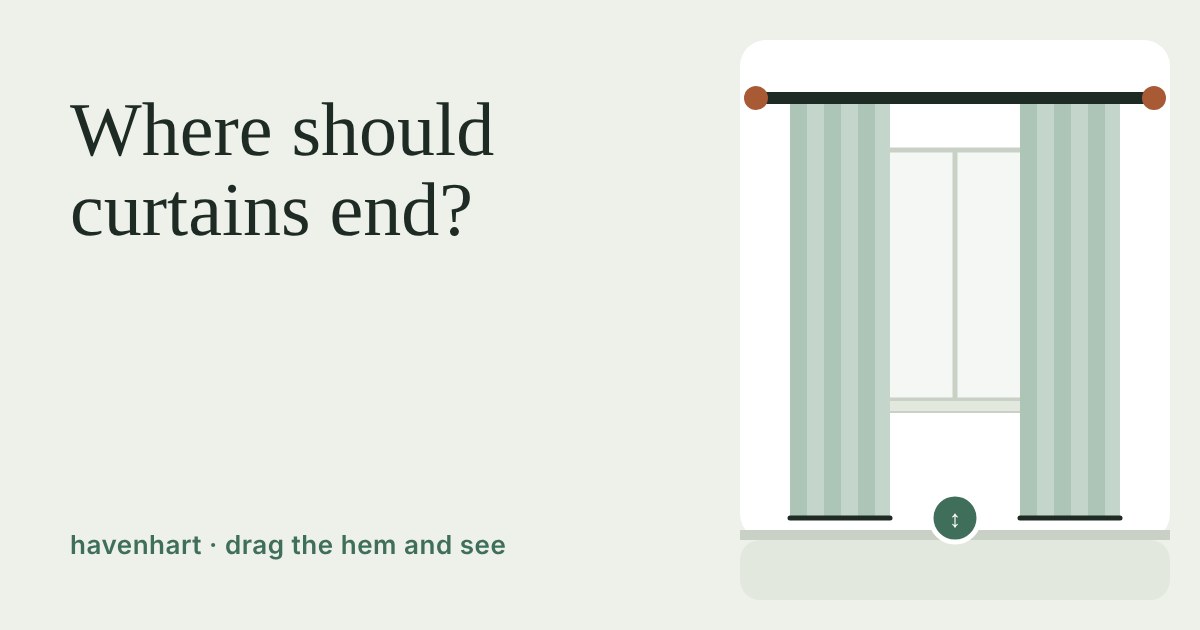
A curtain's hem is where the eye stops, and a few centimetres in the wrong place makes a whole wall look off. Drag the hem up and down a window wall and see where it lands: pooling, touching, floating just above the floor, sill length, or the awkward middle in between.
Change the pole height and sill height to match your room, try common ready-made lengths, and learn what to measure first, so you pick a length from your own numbers rather than from the shelf.
The hem is where the eye stops
People spend ages choosing a curtain fabric and then buy whatever length is on the shelf. But the hem, the bottom edge, is where the eye stops, and it decides whether a curtain looks planned or looks like it shrank in the wash. A hem a few centimetres off in the wrong place is more noticeable than a fabric you are not sure about.
There are really only a few good places for it to end: just below the window sill, just above the floor, touching the floor, or pooling on it. Everywhere in between is the awkward middle. Drag the hem below to see where each one lands on your wall.
The four places a hem can end
Just above the floor is the one most people mean by "floor length". A gap of roughly 1–3 cm lets the curtain hang straight and clear a rug or a bump in the floor, and it still looks like it goes all the way down. Just touching looks a little more tailored, but it is fussy: if the floor slopes, one side drags and the other floats.
Pooling, with extra fabric lying on the floor, is a style choice that takes more length than you would think and gets dusty. Skip it by doors and in busy corners. Sill length, ending a little below the window sill, is the practical one for windows with a radiator, a desk or a kitchen counter underneath.
Anything between those sits in the awkward middle, and that is where hems tend to land by accident. Notice how obvious it looks when you drag the handle to about half way down the wall.
Why the pole height matters as much as the hem
The drop is the distance from the pole down to the hem. Raise the pole and you need a longer curtain for the same gap at the bottom. Hanging the pole well above the window frame, closer to the ceiling than the glass, makes a ceiling look taller and gives the fabric room to fall. A common rule of thumb is a little way above the frame, but there is no single right height. Use the pole slider to see what it does to the length you need.
Ready-made curtains come in a handful of drops, and lengths of about 240–260 cm are common. If your pole is 235 cm from the floor, a 240 cm panel hung from rings may touch or pool; with a pole at 250 cm, a 240 cm panel leaves a 10 cm gap that looks short. Pick a length from the menu in the planner to see what happens on your numbers.
What to measure before you buy
- Pole to floor, where the pole will go. Mark the pole height on the wall first, then measure from that mark straight down to the floor with a tape measure.
- The floor at both ends and the middle. Floors are rarely level. Use the shortest of the three measurements if you want to avoid dragging, and keep in mind a rug underneath raises the floor.
- The hardware drop. Rings and hooks hang the curtain a little below the pole. Measure from the bottom of the ring or hook, or check how the maker measures the stated length.
- The sill and what sits under the window. If a radiator is there, sill length or a hem well above it is safer, since heat and fabric do not mix.
If a panel comes out a bit long, hem tape or a fabric hem on the curtain fixes it without sewing skills. If it comes out a bit short, lowering the pole a little or adding a band of fabric at the hem can rescue it. Neither needs a new curtain.
What to look for
Choose the length from your own measurements, not from the shelf. The aim is to see a gap of about 1–3 cm, or a sill length, on your own numbers.
- On a small budget: a ready-made panel in the right drop and a hem you shorten or let down yourself will beat a more expensive curtain of the wrong length.
- In the middle: check whether longer drops are offered in your fabric, and whether the hem has spare fabric folded inside so you can adjust it.
- When spending more: made-to-measure removes the guess, as the maker cuts to your drop. Weigh that against second-hand panels or shortening a pair you already own.
Cosy does not need a new set. A good hem on curtains you already have, with the pole raised or lowered a little, can change a whole wall. Check the length you have before you buy another.