Bedroom · Explainer · 4 min ·
Which pillow height suits you? Slide the loft and see
A pillow has one job: to fill the gap between your head and the mattress so your neck stays in line. That gap is large on your side, smaller on your back and almost nothing on your stomach, which is why one pillow rarely suits every position.
Choose how you sleep, set your shoulder width and the mattress, and slide the pillow height to see when the neck is level, too high or too low. Then see what "loft" on a label means and how to find your own number at home with folded towels.
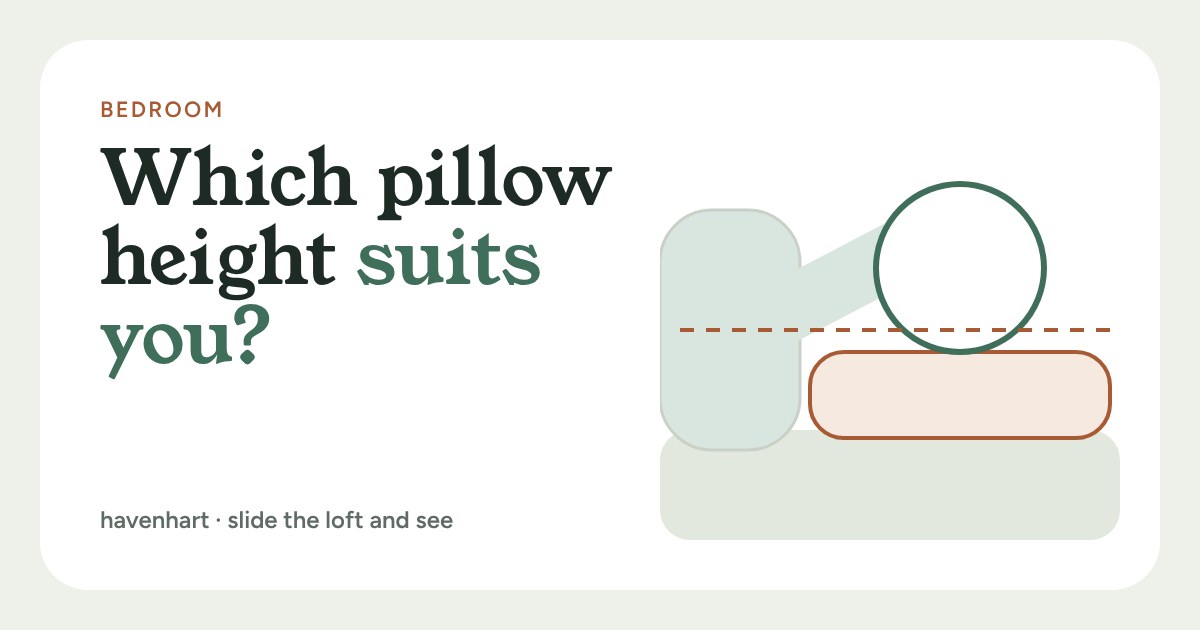
A pillow has one job
A pillow fills the gap between your head and the mattress so your neck stays roughly in line with the rest of your spine while you sleep. That gap is not the same for everyone, and it changes with the way you lie. On your side it is large, because your shoulder holds your body up off the bed. On your back it is small. On your stomach it is almost nothing.
So "a good pillow" really means "a pillow whose height matches your gap". Too high and your head is propped up and tipped; too low and it drops towards the mattress. Try it below. The picture is a simplified side-on drawing, not a medical tool, but it shows the idea well.
What "loft" means on the label
Loft is simply the height of the pillow, and some makers print it. Shops often group it as low (up to about 7–8 cm), medium (about 8–13 cm) and high (13 cm and up), but there is no fixed standard, so treat the bands as a guide. The number on the label is the unpressed height. Once your head is on it, it squashes, and soft fillings such as down and feathers squash more than firm foam or latex.
This is why a fat-looking pillow can still be too low for a broad-shouldered side sleeper, and why a pillow that feels fine for ten minutes of reading can feel wrong at 3 a.m.
Side, back or stomach
Side sleepers usually need the highest pillow, because the pillow has to fill the space between ear and shoulder. The wider your shoulders, the more height you need, which is why the slider above changes the answer so much. A softer mattress lets your shoulder sink in, so it lowers the height you need.
Back sleepers usually do best with a medium pillow that supports the curve of the neck without pushing the chin towards the chest.
Stomach sleepers need the lowest pillow, and some sleep better with none under the head at all, because a high pillow bends the neck backwards. If you change position through the night, a pillow with a filling you can add to or take out lets you set the height once and adjust it later.
Measure before you buy
You can find your own number at home for free. Lie in your usual position on your own mattress and stack folded towels or a thin pillow under your head. Ask someone to look at you from the foot of the bed, or take a photo from there, and adjust the stack until your head looks level with the middle of your body rather than tipped up or dropped down. Measure the height of that stack in centimetres: that is roughly the squashed height you need, so a pillow a little taller than that, as sold, is a good target.
Also measure the practical things. Check the size of the pillowcases you already own (common sizes vary by country, for example 50 × 75, 60 × 70 and 80 × 80 cm), and check how much width you have along the bed head if you want two pillows side by side.
Cosy without buying more
You may not need a new pillow at all. A flat pillow can be topped up with a folded towel or a second thin pillow, and a pillow with removable filling can be opened and adjusted. Shaking and turning a pillow, and washing it as the care label says, brings back some of its height. Take the odd stiff neck as information, not as a flaw in you or your bed, and if neck pain keeps coming back, mention it to a doctor or physiotherapist rather than relying on a pillow to fix it.
What to look for
Whatever you spend, the four things that matter most are the height range, whether the filling is adjustable, how firm it feels when you press it, and whether the cover can be washed. A simple adjustable fibre pillow often covers more positions than an expensive fixed one. If you do shop, check the stated height against the number you measured, and read the return policy so you can send it back if it does not suit you.