Living Room · Tool · 5 min ·
Will your sofa fit through the door? Roll it and see
A sofa does not go through a door the way it sits in the room: it goes through lengthwise, so only its two smaller sizes have to fit the opening.
Enter your sofa and doorway in centimetres and roll it to see whether it passes, with or without the legs. Then learn how to measure the whole route, from the clear opening to stairs and corners, and where a few extra centimetres can come from.
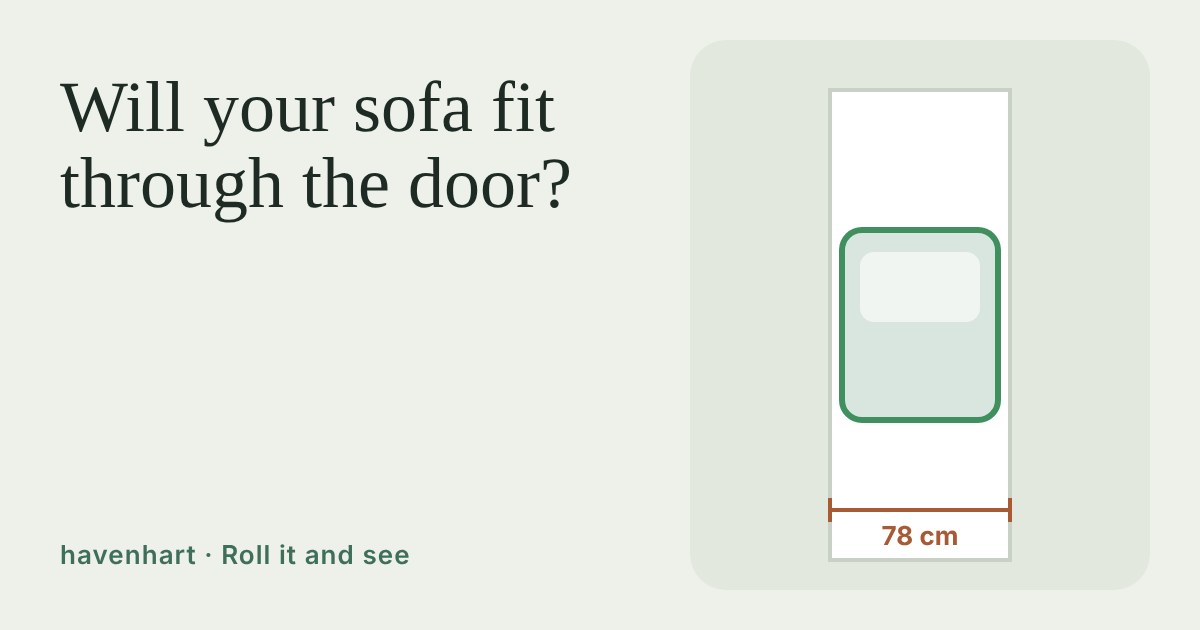
You fall for a sofa, it arrives, and it stops in the doorway. It is one of the most common delivery mishaps, and it is also one of the easiest to avoid with a tape measure and ten minutes. Most of us measure where the sofa will sit. Fewer measure the route it has to travel.
The sofa goes through the door sideways on
A sofa does not go through a door the way it sits in the room. It goes through lengthwise, like a long box, so what matters is its cross-section: the two smaller of its three sizes. For most sofas that means depth and height, and the long width is just how far it sticks out in front and behind.
So the question for the doorway is simple: can a rectangle of depth × height pass through a rectangle of door width × door height? You are allowed to roll it. A sofa that is too wide for the door when it sits upright may go through on its end or on its back, because that swaps which of its two sizes has to fit the width and which the height. Rolling it only part of the way does not help: a tilted rectangle takes up more room than a straight one, so the best positions are upright or turned a full quarter.
Try it with your own numbers
Enter your sofa's size from the shop page and your doorway below. Then drag the roll slider to see how the sofa sits in the doorway, or press the button to find the best roll. The starting numbers do not fit: try unscrewing the legs.
How to measure the doorway properly
Measure the clear opening, not the door leaf. Open the door as far as it goes and measure from the face of the frame stop to the nearest thing that sticks out: the door itself, a handle, a light switch. The door and its hinges usually take a few centimetres from the width. Interior doors are often somewhere around 70–90 cm wide, so those few centimetres matter.
Measure the height under the top of the frame, and check the floor: a raised threshold or thick carpet takes a little off. Then measure every other narrow point on the route in the same way: the front door, the hallway, a corner you have to turn, the stairs, a lift, a low beam or a stair-lift rail. The smallest gap on the route decides, not the door you checked first.
- Stairs: measure the width between the walls and the height at the lowest point, usually where the ceiling steps down above the stairs or where a landing turns.
- Corners: a long sofa needs room to swing round a turn. If the hallway is narrow, sketch it on paper and move a cut-out of the sofa's footprint round it.
- Lifts: use the inside size of the car and the door width, and ask the building whether delivery times are limited.
Where you can gain a few centimetres
If the numbers are close, there are small tricks before you give up on a sofa you love. Many sofas have legs that screw off, which can take around 10–15 cm out of the height. Some doors lift off their hinges for a couple of centimetres more width, but only do that if the door is yours to take down; in a rental, ask first. Some sofas also come in a modular or flat-pack version, or with removable arms or back, which gets round a tight turn entirely.
Soft cushions and padding give a little, but do not count on it. As a rule of thumb, aim for at least 5 cm spare in both directions so hands and knuckles have room. A result that is just a millimetre under is usually a scraped door frame, or a stuck sofa, in real life.
When it will not fit
You still have options that do not mean giving up on the room. Check whether the delivery team can take the sofa in another way: through a window or over a balcony are sometimes possible, but ask them first and check the cost, since that may need a crane or a lift. Look at sofas that arrive in boxes in pieces; you assemble them in the room. Or choose a smaller or more compact model. If you are weighing a second-hand sofa, the same check helps in reverse: measure before it comes in and before the van arrives, and be sure it can leave your old place too.
Always check the shop's returns policy for large items. Return rules on sofas that were delivered but would not fit vary a lot between shops and countries, and collecting a bulky item can cost money.
The five-minute check
- Find the sofa's width, depth and height on the shop page.
- Measure the clear opening of every door, hallway and stair on the route.
- Use the tool above with the tightest point on the route.
- Leave at least 5 cm spare, and plan for corners as well as doors.
- Keep the measurements with you when you order, and check the returns policy.