Plants & Balcony · Tool · 4 min ·
How much string light does a balcony need? Drape it and see
A string of lights always needs more length than the gap it spans, because it sags. Plan it before you buy: set your balcony width, the number of swags and how deep they hang, and see the lit length, bulb count, hooks and the set length to look for.
Drag the dot to change the dip, and see why more hooks with the same dip means more string. No picks here, just the measuring.
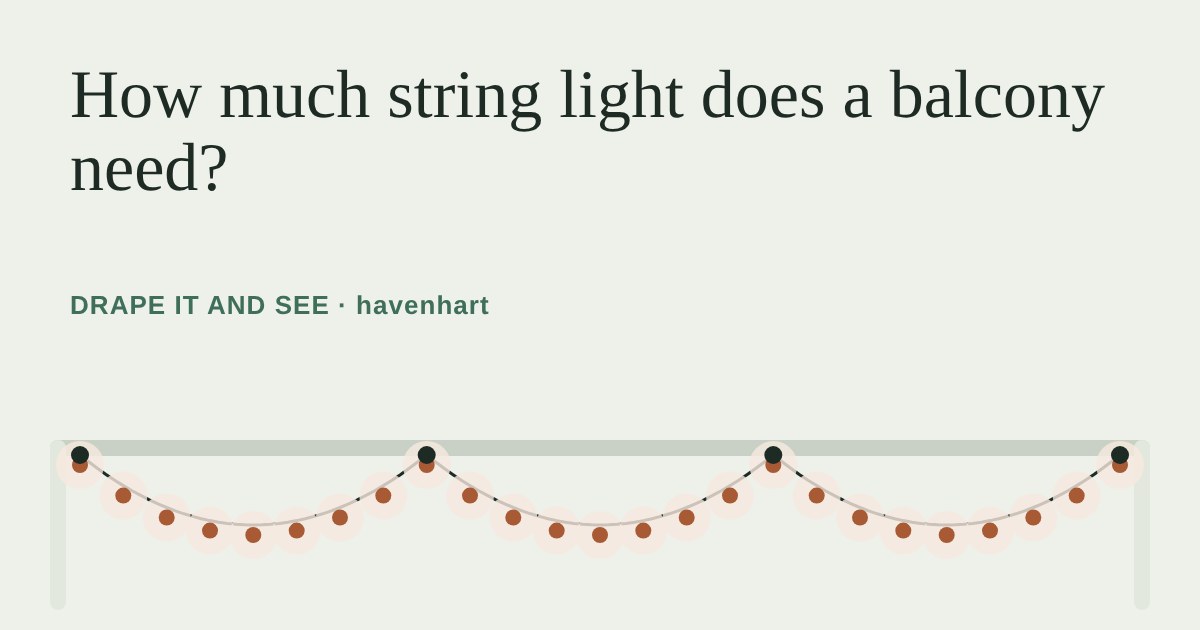
The string is always longer than the gap
Hang a string of lights between two hooks and it sags. That sag is the whole charm, and it is also why a string that matches your balcony's width on paper turns out short. A 3 m gap with a 30 cm dip needs about 3.1 m of string. Add a lead cable to the socket and a bit of slack at each hook, and the "3 m" set you nearly bought is already too small.
The planner below does the sums for you. Set your width, choose how many swags (the scallops between hooks), and drag the dot to set how deep they hang.
Why more swags cost more string
Set the width to 300 cm with a 30 cm dip. One swag needs about 3.1 m. Split the same gap into four swags with the same 30 cm dip and the total jumps to about 4 m, because each short swag still has to dip just as deeply. The dip matters more than the width of each scallop, so if you want lots of gentle scallops, shrink the dip with them.
A relaxed look tends to come from a dip of roughly a tenth of the swag's span; much deeper than a quarter of the span starts to look droopy. These are matters of taste, so drag the dot and trust your eye.
Warm light, low glare
String lights are for mood, not for seeing by. Pick warm white, around 2200–2700 K, the same cosy range as a lamp in the living room, and keep the bulbs dim. A few small bulbs at 30–50 cm spacing glow softly. Dense, bright strings at eye level start to glare and, after dark, can shine into your neighbours' windows too.
Powering them without drama
- Battery, USB and solar sets need no socket at all, so there is no lead cable to measure. Solar sets need a spot that gets daylight and will run dimmer through winter.
- Plug-in sets need a socket within reach of the lead. Use the planner's "lead" slider for the distance, and check the product listing for the lit length, since the cable before the first bulb is usually extra.
- Weather protection is shown by an IP rating on the packaging. IP44 means splash-proof, which suits a covered balcony; a fully exposed one deserves a higher rating. If a socket is missing outside, adding one is a job for an electrician, not a DIY wiring project.
Measure before you buy
- Measure the width of the balcony along the line the lights will follow.
- Decide where the hooks go. Adhesive hooks or clips on a railing or awning bar suit renters, and no drilling is needed. Check the weight limit and your lease.
- Measure the distance from the nearest socket (or the spot you will charge or place a battery pack) to the first hook.
- Measure the hook height, then check the lowest point of the drape stays clear of heads.
- Put the numbers in the planner and look for a set a little longer than the result. Strings are often sold in set lengths such as 5 m or 10 m, so you may need to round up, or use two shorter sets on separate swags.
Cosy does not need more. If you already have a string that's slightly too long, loop the extra over a hook or add a swag. A little extra length can be pleasantly slack, whereas a string that is too short cannot be fixed.
When to break the rules
A tiny balcony may only need one short, shallow swag across the door frame. A pergola or long terrace may suit a zig-zag overhead rather than scallops along one edge, which needs more string and more hooks. Use the planner as a starting point, then adjust to the space.