Small Spaces · Explainer · 4 min ·
Do legs make a small room feel bigger? Lift the furniture and see
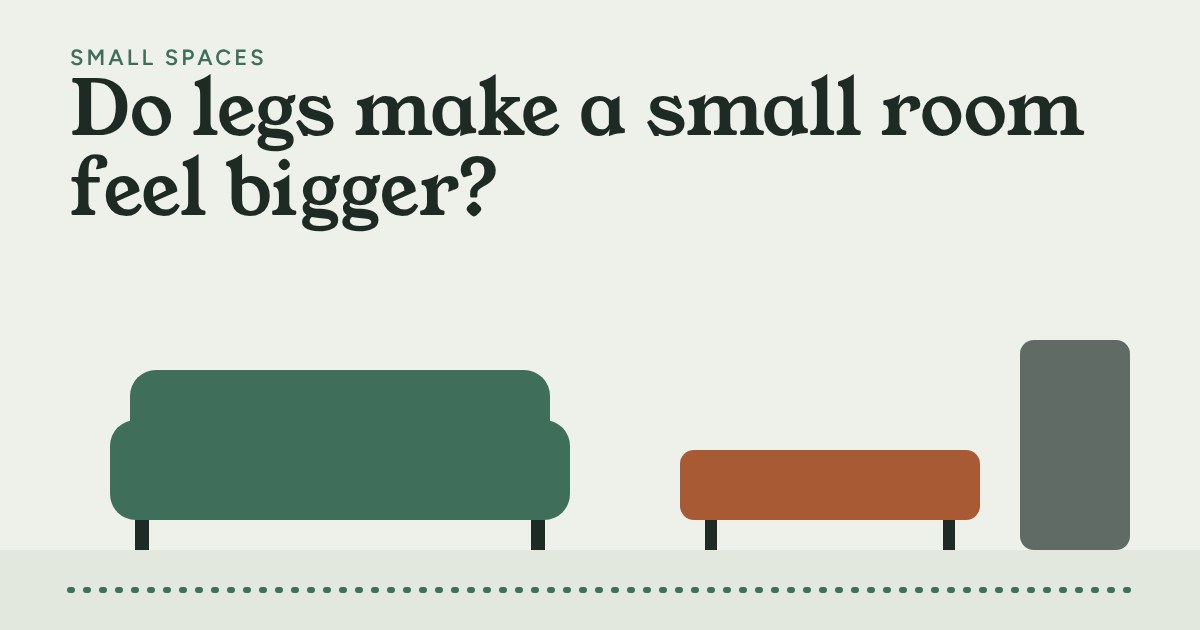
Furniture on legs lets you see the floor continue underneath, and designers often use that to make a small room feel lighter. It changes how the eye reads the space, not its size.
Put a sofa, sideboard and bookcase on legs or take the legs off, change the leg height and wall length, and watch how much of the floor line stays visible and what fits in the gap. Plus the trade-offs with storage, free ways to try it first, and what to measure before you buy.
Why does furniture on legs make a room feel bigger?
Walk into a small room where the sofa sits flat on the floor and the cabinet runs down to the carpet, and the eye meets a solid block at every turn. Swap those for pieces raised on legs and you can see the floor continue underneath. A designer's rule of thumb says this helps a small room feel lighter and more open. It is a visual effect, not a measurement, but it is easy to see for yourself.
The idea is the floor line: the strip of floor you can see along the base of a wall. Every solid-based piece interrupts it. A piece on legs lets it carry on beneath, so the room reads as one open surface instead of a row of boxes.
What the effect is, and what it isn't
Seeing more floor does not add a single centimetre. What it changes is how the eye reads the room: continuous floor suggests depth, and a lighter-looking base suggests the piece is less bulky. Designers often lean on this for small rooms, together with pale colours and keeping the middle of the room clear. Treat it as one tool among several, and as a matter of taste.
The gain is also biggest where the piece is large and the floor beneath it is plain. A sofa on legs over a patterned rug shows you a busy floor, so the open look is weaker. A tall, narrow bookcase gains little, because the eye goes up rather than down.
Legs or solid base: the trade-offs
Raised pieces show more floor, make sweeping and mopping underneath easier, and often feel lighter. Solid bases hide what is below, give a calmer, grounded look, and in some designs offer built-in storage drawers. If you rely on under-bed or under-sofa storage, keeping the base closed or adding flat boxes can matter more than the look.
The slider above shows the storage side of the same choice: a gap of roughly 15 cm swallows a pair of shoes or slim books, and about 30 cm fits a flat box. Check what you really own before you decide.
Measure before you change anything
You do not need to buy anything to test this. Prop a sofa on sturdy blocks, or use furniture risers if the piece allows it, and judge the room for a few days. Before you buy new pieces on legs, measure:
- The gap you would like under the piece, from floor to the lowest edge of the frame, with a tape measure.
- Anything you want to slide underneath, such as storage boxes or a robot or upright vacuum, measured at its tallest point. Product listings show leg height, so compare with your numbers.
- The wall length and the piece's width, and leave room to walk past. Leave a comfortable walkway.
- Doorways and stairs, because legs sometimes screw off and make carrying easier, and sometimes they do not.
Tall pieces such as bookcases and wardrobes should be fixed to the wall with anchors whatever the legs are like, since raised furniture can be a little less stable.
Cheap ways to get the same feeling
If the furniture you own sits flat, try these first. Move one big piece so a stretch of floor shows along a wall. Clear the floor around the sofa's base and keep boxes out of sight. Choose a rug in a plain colour close to the floor so the surface reads as larger. In a rental, adhesive felt pads and a set of clip-on risers change very little but cost very little too. Second-hand pieces on legs are common, and so are old legs that unscrew and swap for taller ones if you like.
A cosy room does not need you to replace anything. If your sofa is solid and you love it, a bit of visible floor next to it will do much of the work.
What to look for
- On a tight budget: change what you can for free, such as placement and clearing the floor, and consider replacement legs that fit your existing piece, after checking the thread and size.
- If you are buying: look for a leg height that suits what you want underneath, a stable frame, and a base colour that suits your floor.
- If you want storage: pick a closed base with drawers or a lower gap you can fill with flat boxes, rather than a tall open gap you will leave empty.