Colour & Walls · Explainer · 4 min ·
What is the 60-30-10 colour rule? Rebalance a room and see
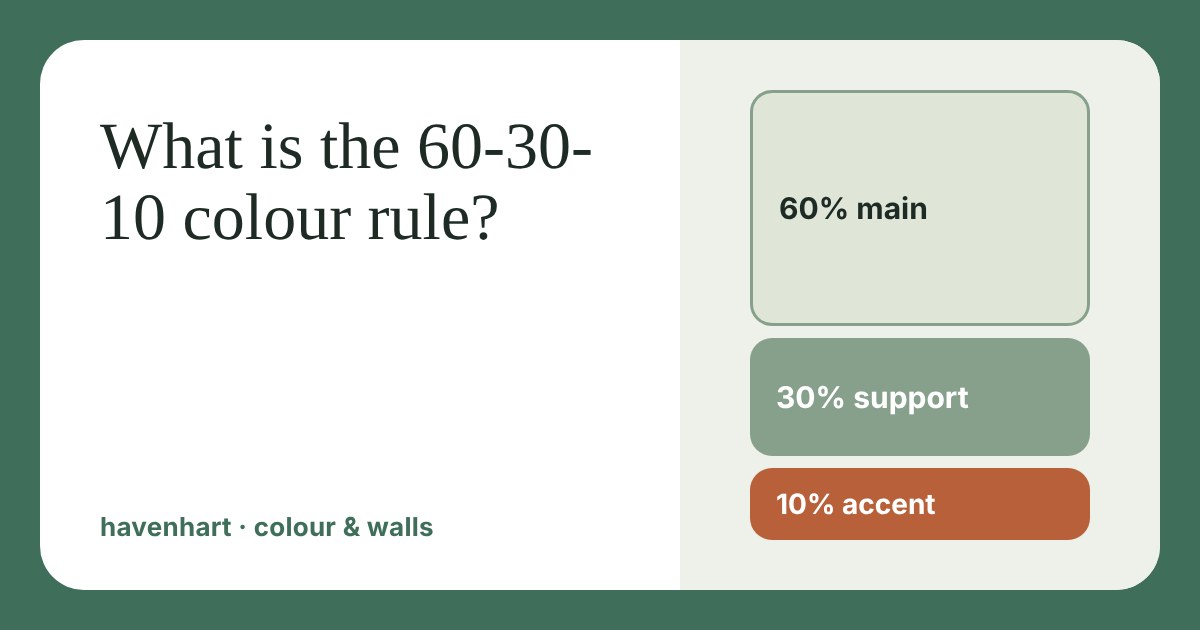
Three colours used equally can make a room feel restless. The 60-30-10 rule is a decorator's rule of thumb that gives them unequal jobs: about 60% main colour for walls and big pieces, 30% support for curtains and chairs, and 10% accent for cushions, lamps and art.
Recolour a small living room, tap each item to change its role, and watch the bars show whether it feels calm, flat or busy. Plus how to use what you already own, and when to break the rule.
You love three colours, so you use all three equally, and the room feels slightly restless without anyone being able to say why. Decorators have a simple fix for that: give the colours unequal jobs. It is called the 60-30-10 rule, and it is one of the easiest ways to make a mixed-up room feel settled.
What the rule says
Pick three colours and give them shares of what you see in the room. It is a widely used rule of thumb among decorators, not a law, and nobody owns it.
- About 60% main colour. The biggest surfaces: the walls, often a big rug or the sofa. This is the quiet background. It is usually the softest colour.
- About 30% support colour. The second-biggest pieces: curtains, an armchair, bedding, a rug. It adds depth next to the main colour.
- About 10% accent. The small, stronger things: cushions, a lamp, a vase, a picture. This is the spark.
Floors, ceilings, wood and the TV are usually treated as neutral and left out of the count.
Rebalance a room
This little living room has nine things you can recolour. Pick a palette, then tap an item (or its button underneath) to cycle it between main, support and accent. The bars show roughly how much of the room each colour covers.
Why it works
Designers usually explain it in terms of the eye. A room with one clear leader gives your eye a place to rest. A second colour adds depth so the room doesn't look flat. A small, stronger colour gives you a focal point: because there is only a little of it, it stands out. When three colours each take a third, nothing leads and nothing rests.
Using what you already own
You don't have to buy anything to apply it. Start by looking, not shopping.
- Find your main colour. Whatever your walls and biggest piece already are, that is it, whether or not you chose it. Renters can stop worrying about the wall colour: treat it as the main colour and build around it.
- Pick one support colour from something big you already have, like curtains, a rug or bedding.
- Choose the accent from a small thing you love, and repeat it in two or three places across the room, not just one. A cushion, a picture and a lamp shade in the same hue feel planned.
- Swap before you buy. Move a cushion in from the bedroom, borrow a throw, rehang a picture, or look second-hand for small pieces. Accents are the cheapest and easiest part to change.
When to break it
It is a starting point, so bend it. A dark main colour on the walls is a lovely cosy look, and so is a room that is nearly all one soft colour with texture doing the work, like linen, wool and wood. Patterns count as more than one colour, so a busy rug may need quieter neighbours. If your things already look good together, leave them. And if a room only has two colours, that is already calm.
If you do buy something new for the room, measure first: the wall or space it will go in, the doorways and stairs it must pass through, and the width of the window for curtains. A colour you love in a shop looks different at home, so hold a swatch or a fabric sample up in your own light before you commit.