Dining & Kitchen · Explainer · 4 min ·
How tall should a bar or counter stool be? Slide the seat and see
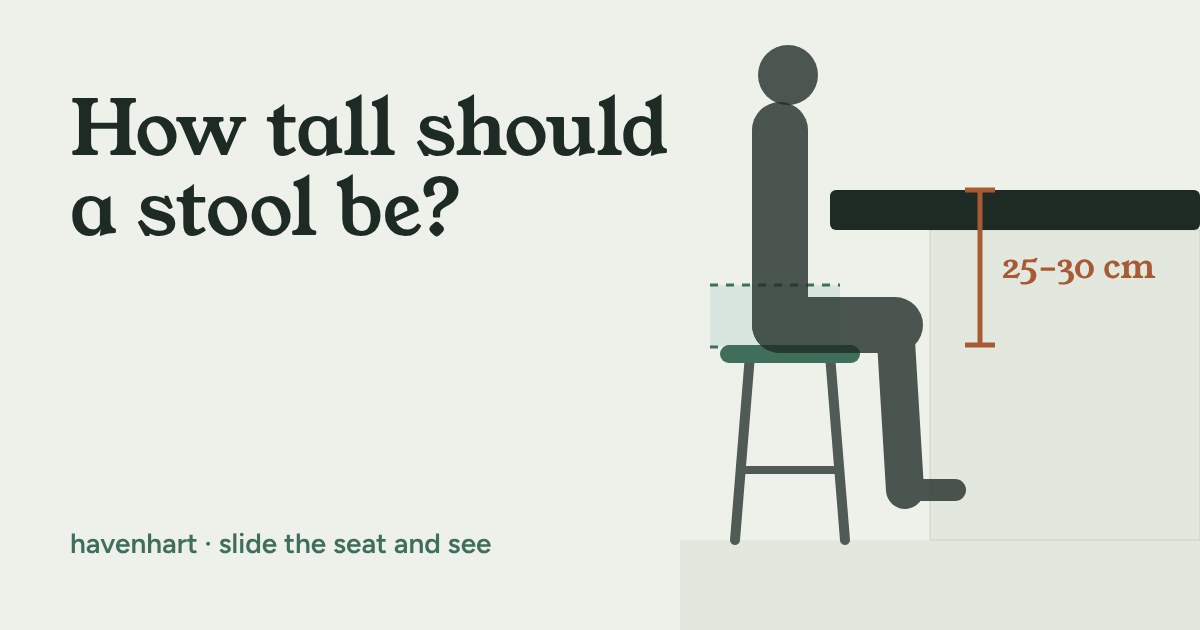
A stool can have the right look and the wrong height, leaving your knees jammed under the worktop or your elbows reaching up for the surface. The number that decides it is the gap between the seat and the top of the counter, usually about 25–30 cm.
Drag the counter height, worktop thickness and stool seat height, watch a seated person fit or not, and see a plain verdict. You'll get typical heights, how to measure your own counter and stool, and cheap fixes before you buy anything.
Why a stool can be the right look and still feel wrong
You can fall for a stool, check the colour, check the width, and still end up perched with your knees jammed under the worktop, or reaching up to your plate like a toddler at the grown-ups' table. The culprit is nearly always one number: the seat height compared with the height of the surface in front of it.
Seat height is measured from the floor to the top of the seat, not the overall height of the stool. Counter height is measured from the floor to the top of the surface. The gap between them is what your body feels, and it is easy to see before you spend anything.
The rule of thumb
Most buying guides land on roughly 25–30 cm between the top of the seat and the top of the counter. Less than that and your thighs press into the underside of the worktop; more and your elbows float up to reach the surface. Some guides measure to the underside instead, and quote a slightly smaller gap of around 23–26 cm. Either way you're aiming for the same thing: room for a thigh, but not so much that you stretch.
The slider above also checks the space under the worktop. A thick slab eats into your legroom even when the gap to the top looks fine, which is why thickness is a slider. A thigh is very roughly 15 cm deep, so if the clearance under the worktop drops below about 18 cm, you'll feel it.
Typical heights, and what they suggest
| Surface | Usual height | Seat to aim for |
|---|---|---|
| Dining table | around 75 cm | around 45 cm (a normal chair) |
| Kitchen worktop | around 90–92 cm | around 60–66 cm |
| Island or raised worktop | around 93–98 cm | around 65–74 cm |
| Bar | around 100–110 cm | around 75–84 cm |
These are common ranges, not a standard: worktop heights vary by country, by kitchen and by who fitted it. That's why the next section matters more than the table.
How to measure before you buy
Use a tape measure and write the numbers down.
- Counter height: from the floor to the top of the surface where you'll sit. Measure at the spot itself, since floors and worktops aren't always level.
- Worktop thickness: from the top of the surface to its underside at the edge you'll sit at.
- Knee space: the overhang under the surface. If your knees don't fit, the stool will sit out in the walkway instead of tucking in. Sit on a chair at the spot and check.
- Stool seat height: floor to the top of the seat, from the maker's listing. Look for the seat height, not the total height including the back. If a listing only gives the total, treat it as unknown.
Then subtract 25–30 cm from the counter height. That's your seat height range. Adjustable stools with a gas lift cover a wide range, which helps if the household has people of different heights, or if you may move house.
When to bend the rule
Tall people and short people sit differently, so shift the number a few centimetres. A thick cushion compresses, a swivel seat sits a little lower once you're on it, and a footrest changes how a high stool feels because your feet have something to rest on. Without one, long sitting on a high stool gets tiring. Backs and footrests also matter for children: tall stools are a fall risk for small ones, so choose one with a back and a low footrest, and stay close by.
Cheap or free fixes first
Before buying anything, test what you have. Sit on a dining chair at the counter with a cushion or a folded towel underneath and see where the gap feels right. Then compare with a chair you already own: if a chair works when it's a bit higher, that's your target seat height. If a stool is slightly too tall, felt pads or removing a thick cushion can drop it a little; if it's slightly too low, a firm cushion can lift it. Second-hand stools are common and easy to measure in person. And if the counter is only used now and then, an ordinary chair with a bit of a stretch may be all the seating it needs.