Dining & Kitchen · Tool · 4 min ·
What size dining table fits your room? Drag it around and see
A dining table that fits the room on paper can still feel cramped, because you need space around it for chairs and for walking past. Most guides suggest about 60 cm of table edge per person and at least 90 cm from the table to the nearest wall, with around 105 cm if people walk behind the chairs.
Put in your room's size, pick a round or rectangular table and drag it around to see the gap on every side, how many people it seats, and where it gets too tight.
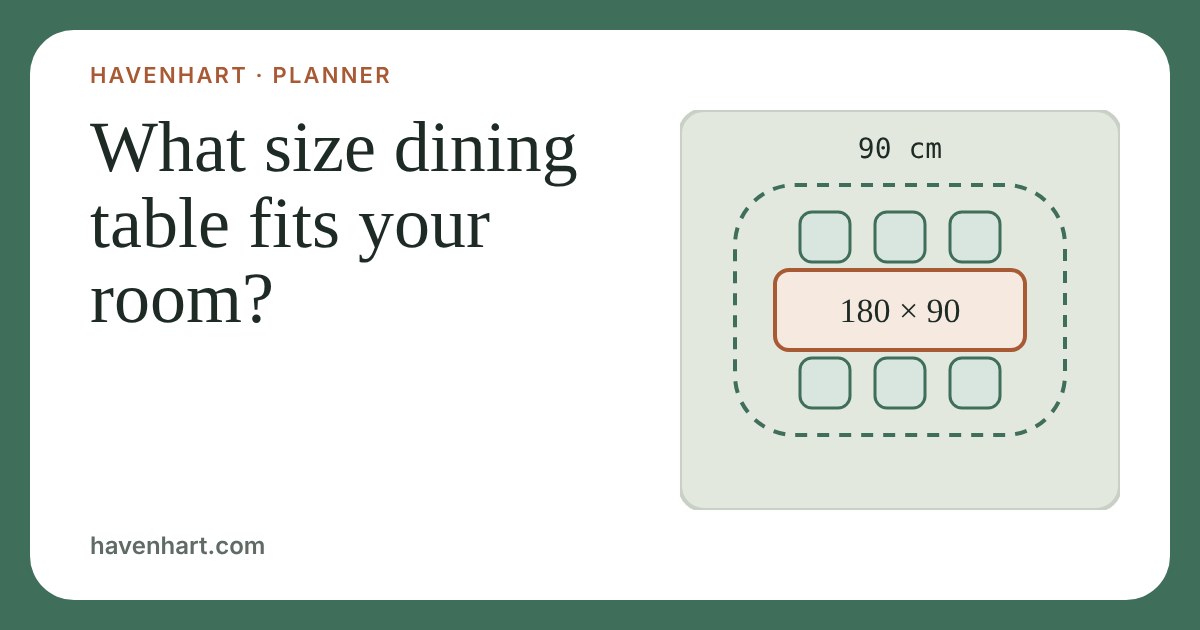
A dining table looks fine in the shop and then swallows the room at home. The table itself is rarely the problem. The trouble is the space you need around it, so a chair can slide back and someone can still walk past. This planner shows that space for your own room.
The rules of thumb
Most furniture guides land on the same few numbers. Each person needs about 60 cm of table edge (55 to 65 cm for a place setting, 70 cm or more if you like elbow room). Between the table edge and the nearest wall or furniture, keep at least 90 cm where people sit. That is enough to pull a chair out and sit down. If someone needs to walk behind seated guests, aim for around 105 cm, and around 120 cm for a main walkway or a busy open-plan room.
The idea behind it is simple. A chair is about 45 cm deep, and when you sit it moves back from the table. Add a person standing up, or squeezing past, and you quickly need most of a metre.
How many people fit
Divide the table edge you can seat along by 60 cm. A 180 cm table has two long sides of 180 cm, so three people each side, plus one at each end if the ends are free: eight in total. A round table of 120 cm across has an edge of about 377 cm, which seats six at 60 cm each. Round tables lose less to corners, but they need a roomy square of floor, because the circle takes the same space in every direction.
The planner counts seats this way. Treat the number as comfortable seating, not the most you can squeeze in for a birthday.
What the gap numbers feel like
Try dragging the table toward a wall and watch the readout. Roughly:
- 120 cm and more: people can walk behind seated guests without anyone standing up.
- 105 cm: a comfortable room. You can slip past a seated person sideways.
- 90 cm: the usual minimum. Chairs move freely, but passing behind someone is tight.
- Under 90 cm: it can still work on a side where nobody needs to pass, especially with a bench, but it gets awkward quickly.
A bench along the wall side is a good trick for small rooms: it slides under the table, so that side needs far less than 90 cm.
When to break the rule
These numbers suit a table people sit at for a whole meal. You can bend them in a few cases. A side that faces a wall with no door or walkway needs only chair room. A table pushed against a wall for everyday use and pulled out for guests can be sized for daily life, not for the biggest dinner. A drop-leaf or extending table lets you live with a small table and gain extra seats when needed. And a shorter table with a round shape often feels better than a long one in a narrow room.
Cosy is not about the biggest table you can fit. A table that leaves the room easy to walk through usually feels better than a bigger one that leaves you turning sideways.
What to measure before you buy
- The room, wall to wall in both directions, in cm. Note radiators, sideboards and anything else that sticks out.
- Doorways and where doors swing, and the route people take through the room.
- Your chairs: width and how far they stick out when pulled back. Chairs with arms need more room.
- The delivery route: stairs, hallway and door widths, if you are buying a table that arrives in one piece.
Mark the table on the floor with masking tape or newspaper, then put your chairs around it and sit down. Walk through the room a few times. It costs nothing, and it tells you more than any number. If a table is a little too big, a second-hand smaller one or an extending model is often the better choice than moving the whole room around.