Dining & Kitchen · Tool · 5 min ·
Round or rectangular table? Seat the guests and see
A table that "seats six" can still leave your elbows colliding. What decides it is how much table edge each person gets, and the shape of the table changes that a lot.
Pick round or rectangular, enter your table's size and slide the edge-per-person figure to see where the chairs go, how many seats fit, and how much floor the whole set needs. Includes what to measure before you buy and cheaper ways to seat extra guests.
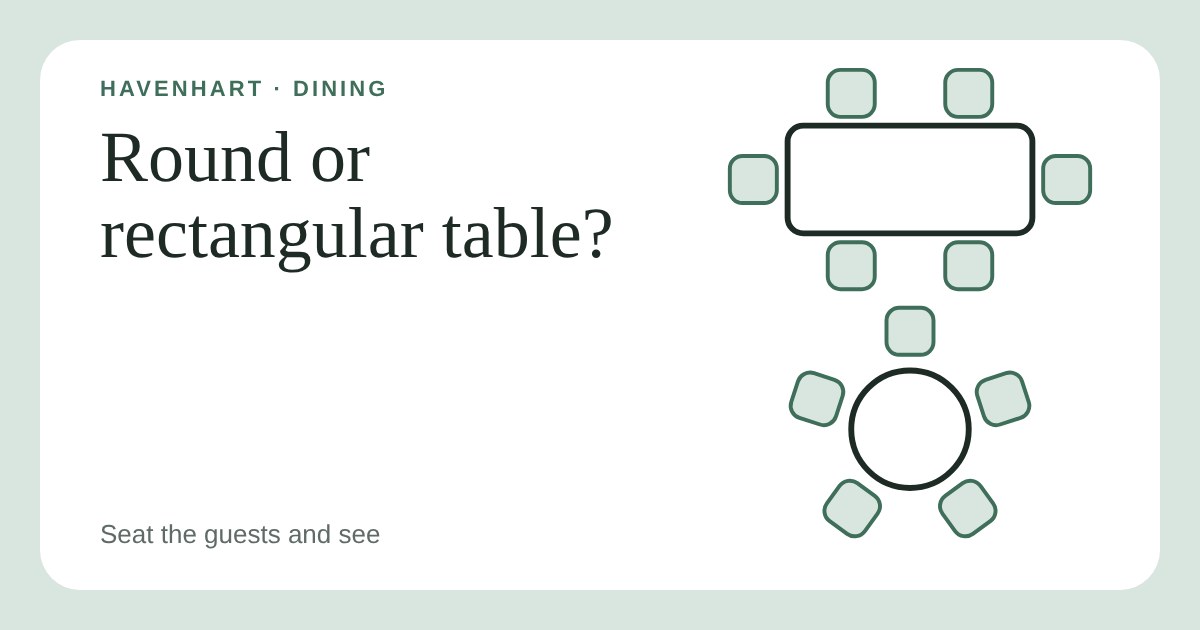
Seating is the part of a dining table that is easy to get wrong in a shop. The label says "seats six", the photo shows six chairs, and then at home the elbows collide. The reason is simple: people need a certain stretch of table edge each, and the shape of the table decides how much edge you actually get.
Seat people around your table
Pick a shape, enter your table's size and choose how much edge each person gets. The plan shows where the chairs go, how many fit, and how much floor the whole set needs once chairs are pulled out. Try 120 cm round against 160 × 80 cm rectangular to see how differently they behave.
The number that matters: edge per person
Most guides agree on about 60 cm of table edge for each person as a minimum, and around 70 cm if you like space for big plates or elbows. That is the whole idea. A table's length, or its circumference if it is round, divided by that figure gives the number of people who can sit without bumping.
The width of the table matters too. Plan on at least 40 cm of depth per place setting, so a table that is 80 cm deep works for two people facing each other, with a little room left in the middle for dishes. Much narrower, and plates start to meet.
Round or rectangular: what changes
A round table has no corners, so everyone sits at an equal distance and conversation is easy. It also wastes no length: a 120 cm round table seats about four to five, according to common guidance, and a larger one around 160 cm seats seven or eight. The catch is the floor. A round table is as wide as it is long, so a big one can be hard to fit in a narrow room, and it is awkward to push against a wall.
A rectangular table seats people along its two long sides, and the ends are a bonus. A 160 × 80 cm table seats six with a chair at each end, or four if you leave the ends free. It slides against a wall for everyday use, which helps in a small room or a rental. The corners can be a bit annoying for knees, so chairs near them need a little more room.
Whichever shape you choose, count the legs and the base as well. A table with legs at the corners or a single central pedestal leaves more of the edge usable than one with legs set inward.
Before you buy: measure first
- The room. Measure the width and length of the space the table will stand in. Leave around 90 cm all round so chairs can be pulled out and someone can pass behind them. Where one side is against a wall, that side can be tighter.
- The doorway and stairs. A large tabletop does not bend. Measure doors, hall turns and stairs along the route it must travel, and ask whether the top can be lifted off the base.
- The chairs. Measure the width of the seats you own or like. Chairs that are 50 cm wide use up more of the 60 cm each person gets than slim ones.
- The light above. If a lamp hangs over the table, the table's centre should line up under it. A wall socket for the lamp is a job for an electrician, so leave the wiring alone.
Small rooms and second-hand options
You do not need a bigger table for a bigger crowd. A drop-leaf or extending table can be small day to day and open up when guests come. A second-hand table is a good way to try a shape before you commit; markets and local listings often have solid wooden ones at a fraction of the new price. If you already own a table, borrow two stools or a bench for the occasional extra guest. A bench can tuck under the table and give two or three people a place with less floor than separate chairs.
Renting and unsure? Try a taped outline on the floor at the table's real size, put your chairs round it and walk behind them. It takes ten minutes and shows you what the planner above cannot: your own room.
What to look for
- Edge per person: aim for 60 cm at least, 70 cm if you host often.
- Shape for the room: round for a squarish space, rectangular for a long or narrow one.
- Leg position: legs set at the corners or a central base keep the edge free.
- Extra flexibility: an extending leaf or a bench helps if the guest list changes.
These are guidelines, not laws. If your family likes to sit close, a tighter edge is fine; if you love long dinners, go for the roomy end.