Small Spaces · Explainer · 4 min ·
Does a mirror make a small room bigger? Move it and see
A mirror will not give you an extra square metre, but it can give a small room a second view. The glass shows a copy of the room, and your eye reads that copy as more space.
Move a mirror around a simple room plan, drag yourself to your usual seat, and see what the glass shows, where the window light lands, and why what the mirror faces matters more than how big it is. Includes safe hanging, rental-friendly leaning, and what to measure first.
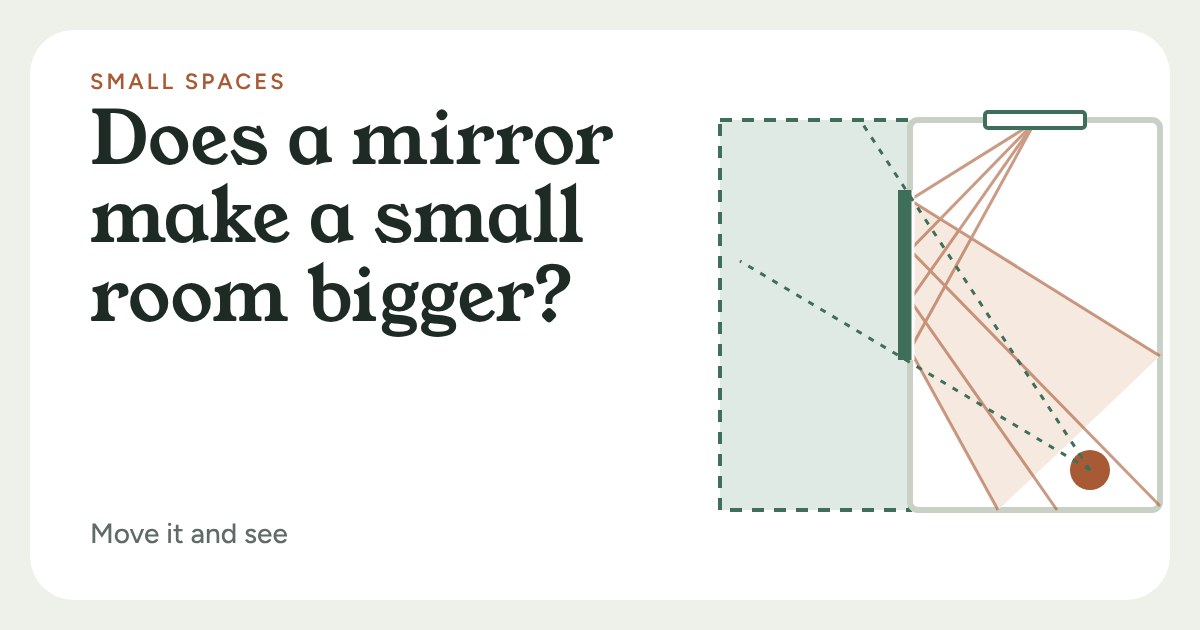
A mirror will not give you an extra square metre. What it gives you is a second view: the glass shows a copy of the room, and your eye reads that copy as more room. Whether that feels spacious or just busy depends on where the mirror hangs, what it faces and how big it is. The plan below lets you test all three.
What a mirror does to a room
A flat mirror makes everything in front of it appear as far behind the glass as it really is in front. Stand 2 m from a mirror and your reflection looks 2 m behind it, so 4 m from you. The wall the mirror hangs on seems to open into a second room, the same depth as yours.
A mirror also sends back most of the light that hits it. Unlike a framed print, it can move daylight around the room, but only in the direction the angle allows.
Where to hang it
Put the mirror beside the window, on a side wall, and it catches daylight at an angle and throws it deeper into the room. Try the right wall: the peach fan shows where the light lands, and in this room it reaches the far end. Directly opposite the window, the light bounces back toward the glass, so you gain a doubled view of outdoors and not much extra brightness. A mirror on the window wall gets no direct window light and only shows the room behind you.
The plan is flat, so treat the fan as a guide to direction. Real light also bounces up and down, and a net curtain or a tree outside changes how much arrives at all.
What it faces matters more than where it hangs
A mirror doubles whatever stands opposite it. A lamp, a plant, a shelf you like or a pale wall all gain from being doubled. A pile of laundry, a bin or a switched-off TV does not. Walk in through the door, or drag the dot to your usual seat, and check what sits inside the dashed area: that is the view you will actually live with.
How big, and how high
Drag the width slider and the dashed area widens: a bigger mirror shows more of the second room, and one large mirror usually looks calmer than several small ones that chop the view up. A common rule of thumb is a mirror about two-thirds the width of the furniture under it, such as a console, sideboard or sofa. Hang it so the centre sits near eye level for the people who use the room. A tall mirror leaned against the wall reads like a doorway and needs no drilling, which suits a rental.
Hang it safely
Glass is heavy. Check the weight the maker states, and use fixings rated for it and for your wall type, because plasterboard, brick and stud walls each need different ones. Avoid hanging a heavy mirror over a bed or the head of a sofa. If you lean a tall mirror, fix it with an anti-tip strap or wall anchor, especially with children or pets. Second-hand mirrors are easy to find, and an old one with a few spots in the silvering often looks better in a cosy room than a flawless new one.
Measure before you buy
Measure the free stretch of wall between furniture, and the height from the top of the furniture below to the ceiling or picture rail. Measure the doorways, stairs and corners the mirror has to pass on its way in, because a tall mirror can get stuck on a tight turn. Mark the outline on the wall with masking tape for a day first. If it looks right from your sofa and from the doorway, it will look right on the wall.