Colour & Walls · Tool · 5 min ·
How much paint does a room need? Size it up and see
How much paint does a room really take? Put in your room's length, width and ceiling height, add the doors and windows, and see the painted area, the litres for one, two or three coats and a sensible tin combination.
The sum is short: wall area, minus openings, times coats, divided by what the tin says one litre covers, plus a little spare. We also cover when to round up (bare plaster, big colour changes, rough walls) and ways to need less paint.
Standing in the paint aisle with a tin in each hand is a bad time to do sums. Buy too little and you risk running out halfway up the last wall, with a second tin that may not match exactly. Buy far too much and you carry a half-full tin around for years. The good news: the sum is short, and once you see where the number comes from, you can do it on a phone in a minute.
Try it with your own room
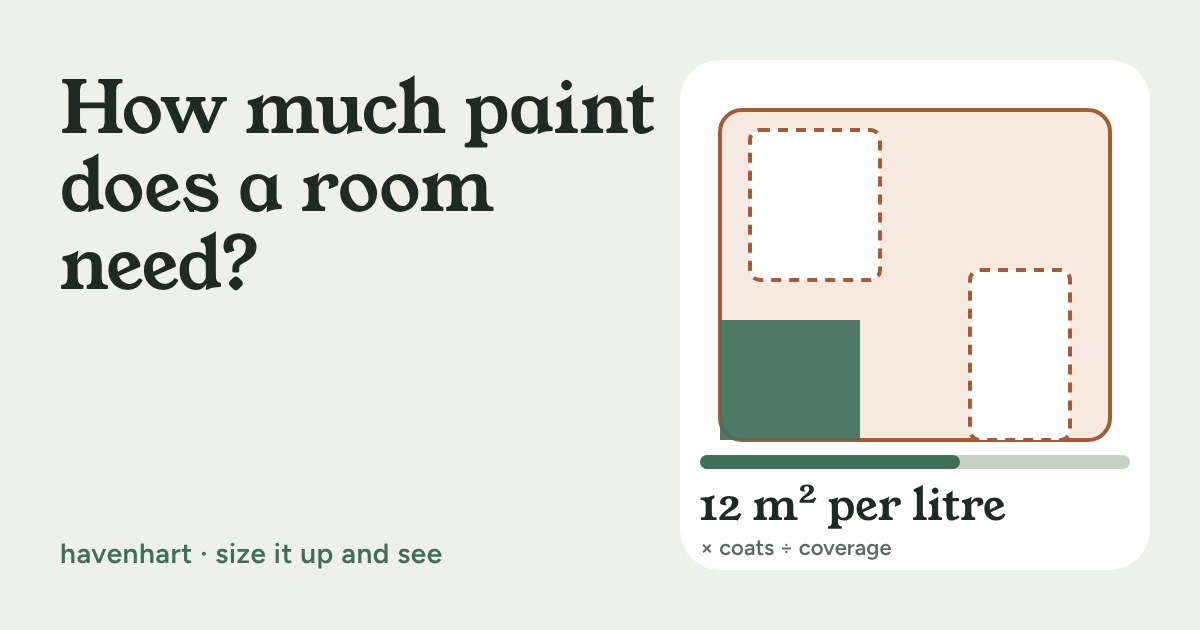
Put in your room's measurements and watch the painted area change. The four walls are drawn flat, as if you unrolled the room. Doors and windows are left white because you won't paint them.
The sum behind it
Paint is sold by the litre, and every tin states how many square metres one litre covers in a single coat. Most ordinary wall paint (emulsion) says around 12 to 14 m² per litre; a few thicker or very matt paints say less. The tin always knows better than a rule of thumb, so use its number if you have it.
- Wall area. Walk round the room and add up the four wall lengths (this is called the perimeter). Multiply by the ceiling height.
- Subtract what you won't paint. A door is roughly 1.7 m², a medium window roughly 1.5 m². Small openings can be ignored if you want a little spare anyway.
- Multiply by the number of coats. Two is the normal answer for walls.
- Divide by the coverage on the tin, then add about 10% for touch-ups and for the paint that stays in the roller and tray.
For the room above that is roughly 4.2 + 3.5 + 4.2 + 3.5 = 15.4 m of wall, times 2.5 m high, about 38 m². After a door and two windows it is closer to 34 m², which is around 5.6 litres for two coats, or about 6 litres with a little spare. Playing with the sliders shows how fast the number moves: an extra 10 cm of ceiling height barely matters, while a second coat or a ceiling doubles the work.
When to buy more than the sum says
The sum assumes the paint behaves. These are the situations where it won't, so round up instead of down:
- Bare plaster or filler patches. New or repaired surfaces soak up the first coat. A primer (or a thinned first coat, if the tin says so) helps, and the first coat can take somewhat more paint than the second.
- Dark over light, or the other way round. A big colour change often needs a third coat. A dark colour on a pale wall usually covers sooner than a pale colour on a dark wall.
- Rough or textured walls. The surface is bigger than the flat measurement and drinks more paint.
- Deep, strong colours. They tend to need more coats whatever the wall, and are mixed to order, so a second tin mixed later may differ slightly. If you need 8 litres, buying a 10 litre tin gives you a margin for the same batch.
Tins and leftovers
Tins usually come in sizes like 1, 2.5, 5 and 10 litres, though the exact range depends on the brand and the shop. Often one bigger tin is better value than several small ones, but only if you will really use it: a half-empty tin of a colour you've tired of is not a bargain.
Mixing all the paint for one wall in a single tin (or pouring the tins together in a bucket) keeps the colour even. Keep the last cupful in a clean, labelled jar for scuffs and touch-ups; it stores better in a small, full container than in a large, half-empty one. If you rent, check what your landlord allows before you start, and whether you're expected to return the walls in their original colour.
Ways to need less paint
Cosy does not need a whole new room of colour. One feature wall is about a quarter of the sum above, and a pot of paint can refresh a door, a shelf or a tired skirting board for next to nothing. Wiping, filling and cleaning a wall before you paint often improves it more than an extra coat. And if the old colour is only a little different, one good coat may be enough.
Measure before you buy: ceiling height, the four wall lengths, and the doors and windows. A tape measure and ten minutes beat a guess at the shop.
A quick safety note: sanding old paint in an older home can release lead dust, so if the house is very old, check how to test and prepare it safely before you sand. Ventilate well while you paint and while it dries.