Textiles · Tool · 3 min ·
How big should a hallway runner be? Slide the gaps and see
Why do some hallway runners look right and others look like an afterthought? It mostly comes down to two gaps of bare floor, at the sides and at the ends.
Enter your hallway size, slide the gaps and see the runner change to scale, with the usual guides to check yourself against, plus what to measure and how to keep it from sliding.
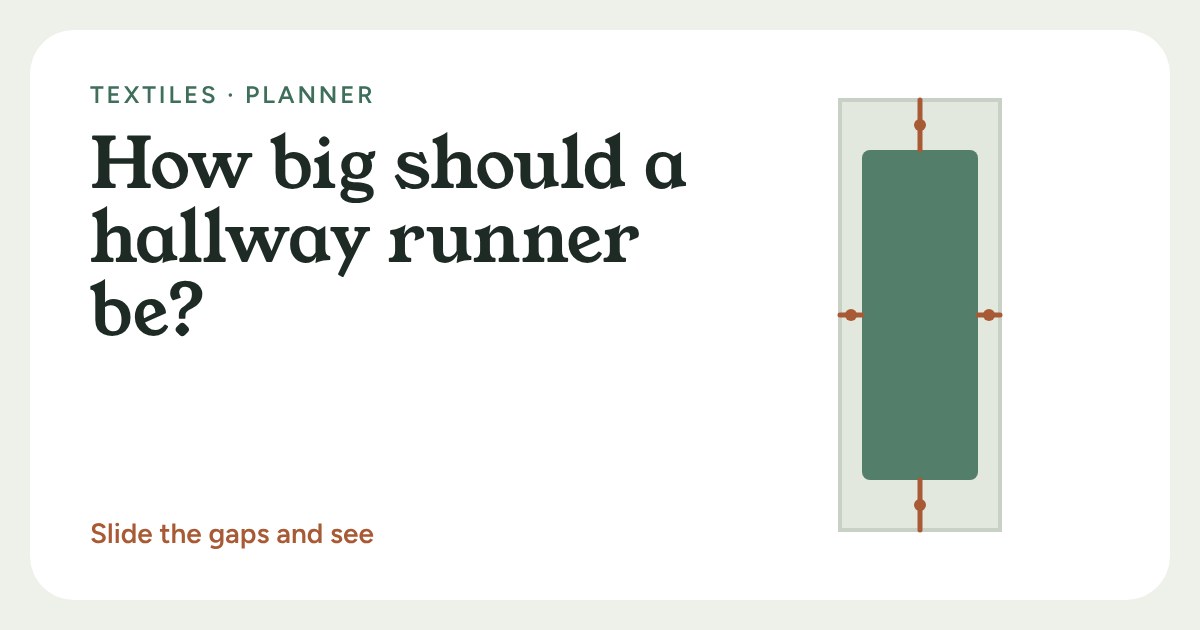
A hallway is the first thing you walk into and the last thing you notice you never decorated. A runner, the long, narrow rug, can make it feel warm and finished. It can also look like a doormat that wandered off, or a strip of carpet squeezed from wall to wall. The difference is almost entirely in the gaps you leave.
The two gaps that matter
A runner should look like it was placed on purpose, not that it was the only size that fit. That comes from two margins of bare floor:
The sides. Leave roughly 10–15 cm of floor visible along each long side, with the runner centred so both gaps match. Less than that and the runner looks jammed in; much more and it looks like a thin ribbon floating in the middle.
The ends. Rather than running right up to the wall, stop the runner a hand or two short at each end. Designers commonly suggest about 15–30 cm from each end wall. Another handy test: the runner should cover at least about three-quarters of the hallway's length, or it starts to read as a mat.
These are guides, not laws. A very narrow hallway may only have room for the smaller gap, and a long one with doors along it often needs a shorter runner so doors can swing.
Measure before you buy
Use a tape measure and write these down before you look at a single rug:
- Hallway length, from the front door to where the floor changes or the hallway ends, not into the next room.
- Hallway width, at the narrowest point. Skirting boards, radiators and doorframes often make it less than you expect.
- Door swing. Open every door that opens onto the hallway, and note where it sweeps. A thick runner can catch a door or a door mat; mark the planned spot with masking tape and swing the doors to test.
It also helps to know which way you walk. A runner lined up with the main route from the door feels natural; one that stops short of where you actually step can feel pointless.
Safety and staying put
A runner in a hallway is walked on, often in socks or in a hurry, so it must not slide or curl. A non-slip underlay under the rug keeps it in place and adds a little cushioning, and flat, low-pile rugs are less likely to catch a toe. If an edge curls up, fix it before anyone trips on it.
When to break the rule
In a very narrow hallway, you might have only a few centimetres to spare on each side, and that can still look tidy if the gaps match. In a short hallway, two or three smaller rugs or doormats can sometimes work better than one stretched runner. And if you already own a rug that is a bit too short or wide, try it before buying: it may look good enough, and it costs nothing. Second-hand runners are common and often cheaper than new.
What to look for
- The right width first: your hallway width minus about 20–30 cm leaves the side gaps.
- A length that stays about three-quarters of the hallway or more, with clear space at each end and at every door.
- A low, flat pile that doors can pass over and feet will not catch on.
- A non-slip underlay and, if you have pets or muddy shoes, a material you can wipe or wash easily.