Colour & Walls · Tool · 4 min ·
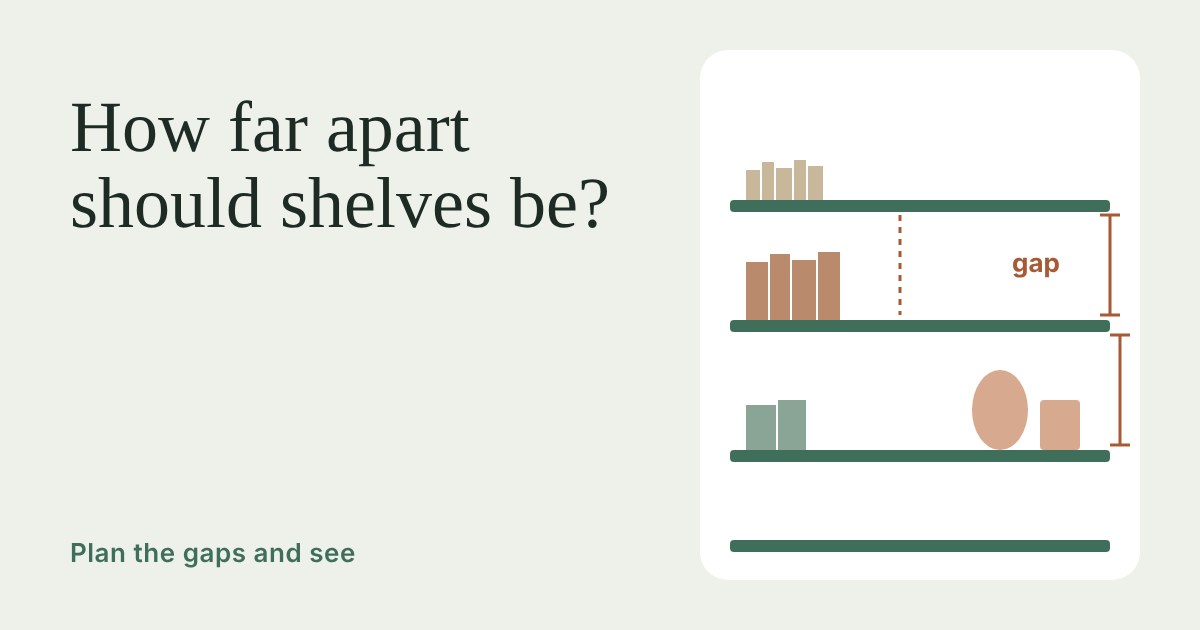
How far apart should shelves be? Plan the gaps and see
Shelves look wrong when the gaps are wrong. Enter your wall height, choose what each shelf holds, and see whether it all fits, to scale.
The rule is simple: each gap is the tallest item plus a little finger room, plus the board thickness. We show the numbers behind it, when to break it, and what to measure before you drill, including ideas that need no holes for renters.
Why shelf spacing matters more than shelf style
Most wall shelves look off for one boring reason: the gaps are wrong. Too tight and you can't slide a book out; too loose and the wall looks like a ladder with nothing on it. Get the gaps right and even a plain white board looks deliberate, which is why this belongs with colour and walls: shelves are part of how a wall reads.
The trick is to decide what each shelf will hold before you mark a single hole. The planner below does that sum for you. Enter the height of the wall space you have, choose what each shelf holds, and watch whether it fits.
The rule behind it
Each gap is the height of the tallest thing on that shelf plus a few centimetres of finger room, so you can tip a book out or lift a vase without scraping the board above. The numbers most shelving guides give are roughly 20–25 cm for paperbacks, 25–30 cm for hardbacks, and 35–40 cm or more for large coffee-table books. General display shelves usually land around 30–35 cm.
Add the board thickness for each shelf and the total tells you how many shelves your wall space can take. That is all the planner is doing: sum the gaps, add the boards, compare with your height.
Two ways to make it look calmer
Vary the gaps on purpose. A run of identical gaps is tidy but dull. Putting one tall gap for big books or a plant between shorter ones gives the wall a rhythm, and the planner lets you try that: tap a shelf to swap its contents and see what the wall does.
Leave breathing room. If you have a few centimetres to spare, put them under the bottom shelf or above the top one rather than spreading them thin. Empty wall around shelves is part of why a room feels restful rather than crowded.
Before you mark the wall
- Measure the space. Floor to ceiling, or to a window, a door frame or a socket you want to keep clear. Measure at both ends, since floors and ceilings are rarely level.
- Measure what goes on them. Hold your tallest book or vase against a tape measure instead of trusting the table above; your own books may be taller.
- Check depth too. Shelves for paperbacks and display pieces can be shallow, but folders and large books need more room, and a deep shelf sticks out further into a narrow hall.
- Match the fixings to the wall. Brick, concrete, plasterboard and stud walls need different fixings, and each fixing and bracket has a load rating from its maker. Books are heavy, so check the rating against what you'll actually load.
- Secure tall units. A tall bookcase should be anchored to the wall, especially if children or pets are around.
- Rent? Check your tenancy agreement before drilling. Freestanding shelves, leaning ladder shelves, or a bookcase against the wall use the same spacing maths with no holes at all.
When to break the rule
Break it when you're displaying rather than storing. A shelf of small framed pictures and a candle holder can sit in a much shorter gap, and a single statement object can have a tall gap all to itself. If you are filling shelves from what you already own, second-hand shops and what you've got in a cupboard make perfectly good displays: cosy comes from a wall that feels lived in, not from buying more.
Whatever the layout, try it first: stick paper rectangles of the gap heights to the wall with low-tack tape, step back, and live with them for a day before you drill anything.