Colour & Walls · Tool · 4 min ·
How high should you hang a picture? A height-and-gap planner
Most pictures get hung too high. Galleries centre a picture about 145 cm above the floor, roughly eye level, and over a sofa they leave a 15-25 cm gap and keep the art around two-thirds of the sofa's width.
Drag a frame up and down on a wall of your own size, see the numbers change, and get a clear nudge up or down. No shopping needed.
The one number worth remembering
Galleries and museums hang art so that the centre of the picture sits about 145 cm (57 inches) above the floor. That is roughly eye level for an average adult, which is why a picture hung there feels natural and "just right" without anyone knowing why. Some people use 150 cm, and a few designers go a bit higher. The point is the centre of the picture, not the top, and not the hook.
Most pictures end up too high for a simple reason: we hang them while standing and looking at the wall, but we live with them while sitting on a sofa or walking past. A picture floating near the ceiling stops feeling like part of the room and starts feeling like something stuck on it.
Over a sofa, the furniture sets the rule
The 145 cm rule is for an empty wall, a hallway or a spot beside a door. Once there is furniture underneath, the picture should belong to it, so two other measurements matter more:
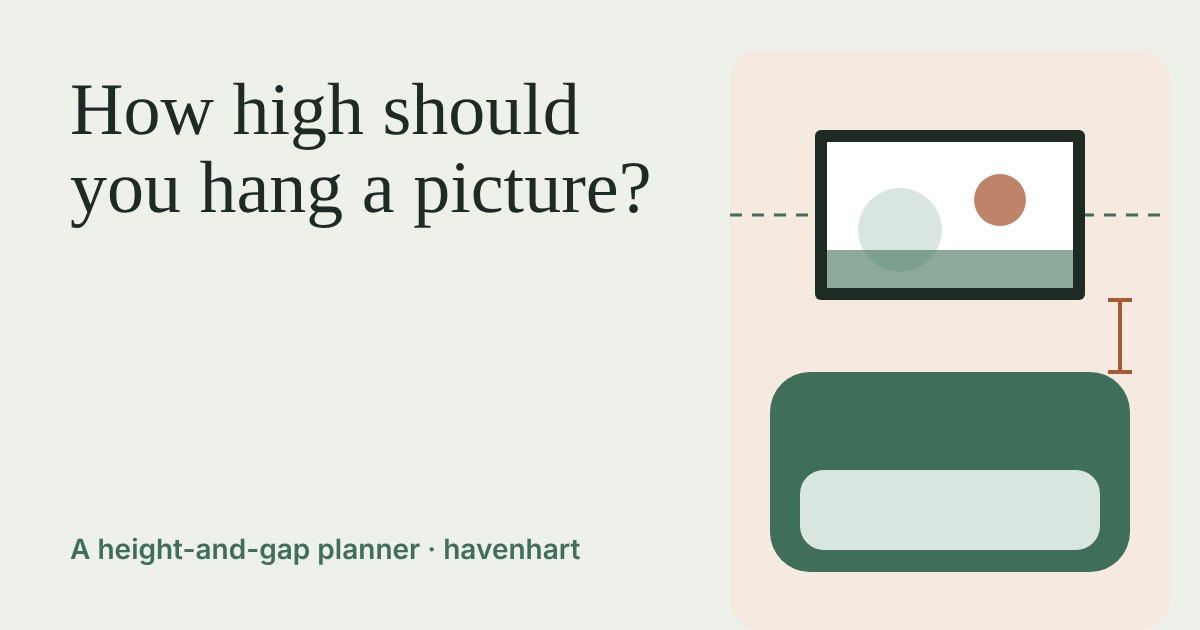
- The gap. Most guides suggest leaving about 15–25 cm (6–10 inches) between the top of the sofa and the bottom of the frame. Closer than about 10 cm feels crowded, and further than about 30 cm and the picture seems to drift away.
- The width. Aim for a picture, or a group of pictures, around two-thirds the width of the sofa, up to about three-quarters. Much smaller looks lost, and nearly as wide as the sofa looks heavy.
Try it below. Drag the frame up and down, or use the slider, and change the numbers to match your own wall.
Why the sofa version is different
If you hang a big picture at 145 cm above a sofa with a tall back, it can end up almost touching the cushions. The gap rule fixes that: you measure up from the furniture, not down from the ceiling. That is also why the same picture can sit at 145 cm in a hallway and at 165 cm over a sofa and look right in both places.
The same idea works for a console table, a sideboard or a bed headboard. Measure the top of the furniture, add your gap, and hang from there.
Groups and gallery walls
Treat a group of frames as one big picture. Lay the frames out on the floor first, keep roughly 5–10 cm between them (smaller gaps look tidier and more deliberate), then hang the whole block so its centre lands at the height you want. Use the planner above by entering the width and height of the whole block.
A gallery wall in a hallway where people mostly stand is happy near the 145 cm centre line. Over a sofa, keep the lowest frame at least 15 cm above the back.
When to break the rule
- High ceilings. A little higher (or a bigger picture) stops a small frame looking stranded.
- Rooms where you mostly sit, such as a dining room or a reading corner. Many people like the centre a little lower so it lines up with seated eye level.
- Mixed-height households. Hang for the people who spend the most time looking at it.
- A very tall or very low sofa. Trust the gap, not the 145 cm.
Measure before you drill
The hook is not at the centre of the picture, so do one measurement first: pull the wire or hanging loop taut, as it will sit on the hook, and measure from there down to the bottom of the frame. Then work backwards from the height you want.
- Cut a paper template the size of the frame and tape it to the wall. Step back, look at it from the sofa, and nudge it.
- Mark the hook position through the template, then remove it.
- Measure from the floor (or from the sofa top) with a tape, and check with a spirit level.
Renting? Adhesive picture strips and small hooks are kind to walls for light frames, but check the weight rating, and check your tenancy for what is allowed. Heavy mirrors and big frames need proper wall plugs or fixings suited to your wall type. Before drilling anywhere, check for hidden cables and pipes with a detector, and if you are unsure, ask someone who knows.
Nothing here needs buying. The cosiest change is often moving what you already own a hand-width lower.