Colour & Walls · Explainer · 4 min ·
Matt, eggshell or satin? Slide the light across a wall and see
Two walls in the same colour can look completely different, depending on the finish. A matt wall hides flaws and feels soft; a gloss wall shows every dent and roller line.
Pick a finish, slide a light across a wall with a filled hole, a roller ridge and a crack, and see which flaws show. Then get a simple guide to which finish suits which room, and how to test paint before you commit.
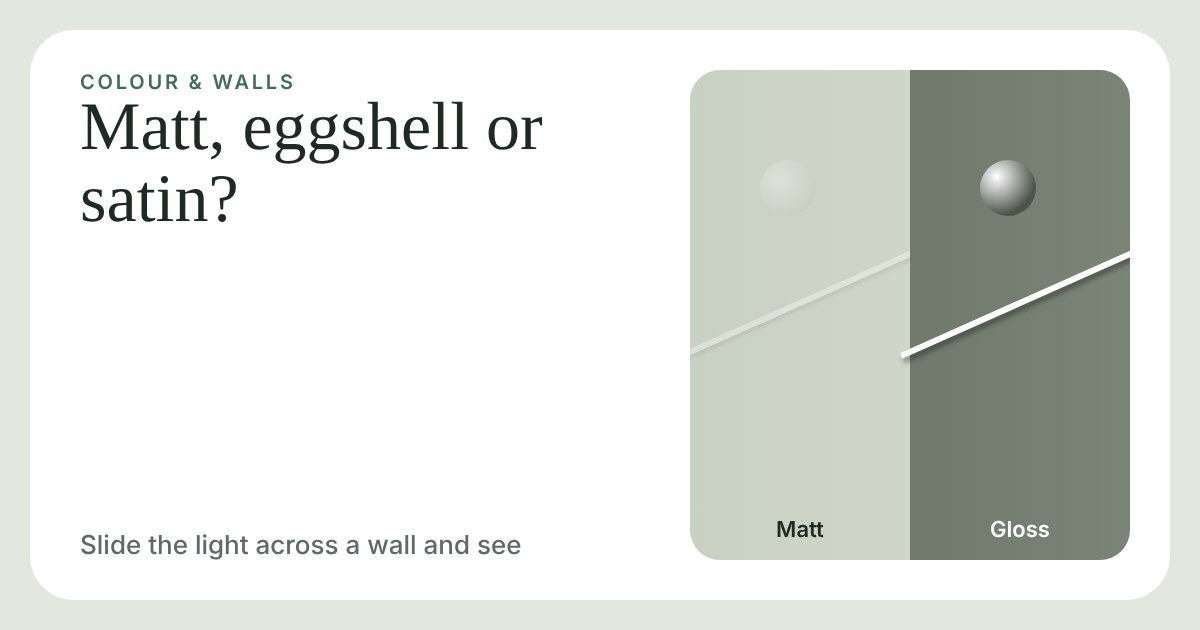
You can paint two walls the exact same colour and have them look like different rooms. One looks soft and even; the other shows every roller line and filled hole. The difference is the finish, also called the sheen: how much of the light that hits the wall bounces straight back at you instead of scattering.
Slide the light across a flawed wall
This wall has the usual flaws of a lived-in home: a filled hole, a roller ridge and a hairline crack. Pick a finish, then slide the light from straight-on to a low angle from the side, like late sun through a window.
What "sheen" actually means
Paint finish is about the surface at a microscopic level. Matt paint has a slightly rough surface that scatters light in all directions. Gloss paint has a smooth, hard surface that reflects light like a mirror. Manufacturers measure this as how much light bounces back at a set angle (usually 60°), but you don't need the numbers: the names on the tin, from matt up through eggshell and satin to gloss, run from least shiny to most.
That is why the slider matters. Head-on light flatters almost any wall. Light that skims along the surface, from a window beside the wall or a lamp placed low, throws tiny shadows from every bump, and shiny paint adds bright highlights on top of those shadows.
What each finish is good at
| Finish | Hides flaws | Wipes clean | Often used for |
|---|---|---|---|
| Matt | Best | Weakest | Living rooms, bedrooms, ceilings |
| Eggshell | Good | Fair | Hallways, kids' rooms |
| Satin | Fair | Good | Kitchens, bathrooms, woodwork |
| Gloss | Poor | Best | Doors, skirting, trim |
Many modern matt paints are labelled washable, so check the tin rather than assuming. A wipeable matt in a busy hallway can be a better choice than a satin that shows every dent in an old plaster wall.
A cosy-room rule of thumb
Soft, low-sheen walls make a room feel calmer, because they don't throw glare back at you in the evening when your lamps are on. If you love the look of a glossier finish, try it where it has a job to do: on a door, a window frame or a small piece of furniture, not on the largest wall in the room.
It also helps to know where your light comes from. Walls beside a window or lit by a low floor lamp are the ones that will show flaws, so a lower sheen helps most there. A wall facing the window is lit head-on and forgives much more.
Before you open a tin
- Test a big patch. Paint a sample about the size of a sheet of paper (or paint a sheet of card and tape it up). Look at it in the morning, at midday and with your lamps on in the evening.
- Prep shows more than the paint. Fill holes, sand them flush and wipe off dust. A shinier finish makes poor prep obvious; a flatter one is kinder, but it won't hide a big dent.
- Use up what you have. Leftover paint, mis-tinted tins and sample pots can cover a small wall or one feature, and cost you nothing new.
- Renting? Ask your landlord before painting anything. Many will say yes to a plain, light colour, and some prefer you stick to the original sheen.
- Older home? Very old layers of paint can contain lead. If your building is old, check before you sand, and don't dry-sand it.
The short version
If you only remember one thing: choose a low sheen for big walls, a higher sheen for places that get touched or scrubbed, and let the real light in your room decide the rest. A plain matt wall in a lived-in room is not a compromise. It is usually the cosiest choice.