Living Room · Explainer · 5 min ·
How high should you hang a TV? Slide it to eye level and see
Most TVs are hung too high, so the whole household watches with a tilted-back neck. The fix is one idea: put the centre of the screen near your eye height as you sit on your sofa.
Drag a TV up and down a wall, change the screen size, how you sit and how far away you are, and watch the angle your head has to tilt. Then learn how to find your own number in two minutes, what to do about a screen above a fireplace, when to break the rule, and what to check before you drill.
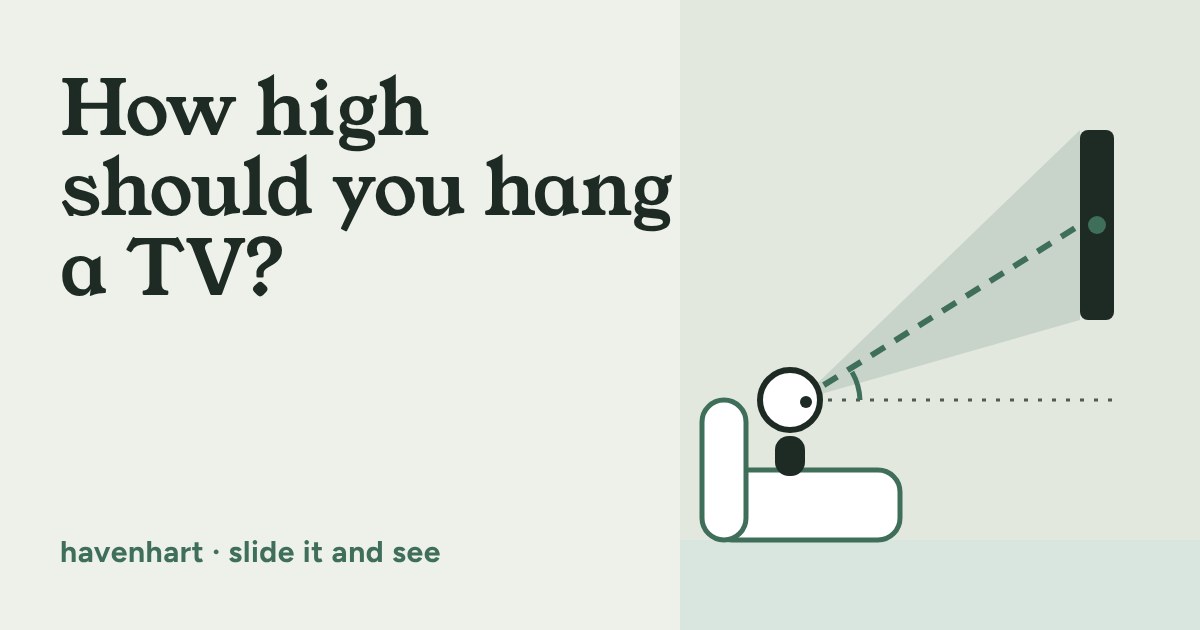
Most TVs are hung too high. It usually happens for a sensible-sounding reason: people mount the screen where they would hang a picture, or above a fireplace, or simply "up and out of the way". Then the whole household spends the evening with their chin pointing at the ceiling.
The fix is one idea. Sit on your sofa, relax, and notice where your eyes point when you look straight ahead. The centre of the screen should be close to that spot. Drag the TV up and down below and see how the angle changes.
Why the centre, and why eye level
When you look straight ahead with your head upright, your eyes sit at a fairly fixed height. A screen centred there means you barely move your neck. Raise it, and your head tips back; the muscles at the back of your neck hold that angle for as long as the film lasts. Looking slightly down is far easier than looking up, which is why a screen a little below eye level is not a problem.
A rough rule of thumb: the middle of the screen at about the height of your eyes while you sit, often somewhere around 100 to 110 cm from the floor on a normal sofa. Your own number depends on the sofa. A deep, soft sofa that you sink into puts your eyes lower than a firm, upright one, and the slider above shows that.
How to find your number in two minutes
Sit where you normally sit, in your normal slouch. Ask someone to hold a tape measure against the wall straight in front of your eyes, and read the height from the floor. That is your eye height. Write it down, then add or subtract a few centimetres depending on whether you prefer the screen at eye level or slightly below.
Then check two more things. Distance matters for the angle: the closer you sit, the steeper the same height feels, so a TV that is fine from across a big room may be too high in a small flat. And screen size matters because a bigger screen puts its top edge higher even when the centre is right. Measure the top edge too, not only the middle.
Above a fireplace, and other awkward spots
A chimney breast is a popular place for a TV because the wall is already the focus of the room. It is also the spot where the screen is most often much too high. If it is the only wall that works, there are ways to make it kinder: a mount that tilts the screen down, a mount that pulls the screen lower when you watch, or a smaller screen that you move to a lower spot. Heat from a real fire is another reason to check what the fireplace maker and TV maker say before mounting anything above one.
Not sure? Stick the screen's outline on the wall with painter's tape, or cut a piece of cardboard to its size, and sit on the sofa for a few minutes. It costs nothing, and it is much easier to change than holes in the wall.
When to break the rule
If the screen is mostly a background for cooking or a quick look at the news, a slightly higher spot is fine. If you watch lying on a bed, the eye height is lower, so a lower or tilting position works better. If different people sit at different heights, such as children on the floor, aim at the one who watches the most. And if you rent, a TV on a low unit or a stand needs no holes at all and often lands in the comfortable range.
Safety and what to measure
A wall-mounted TV is heavy and a fall can hurt someone. Check what your wall is made of, use the fixings and bracket made for that wall type and the weight of your screen, and ask someone to help you lift it. If you are unsure about the wall, or there may be pipes or cables behind it, ask a professional. Never drill without checking first, and leave any mains wiring to an electrician.
Before you buy a mount or a unit, measure: the eye height when seated, the distance from your eyes to the wall, the height and width of the screen, and the wall space available. Add them up with the sliders and you will know where the screen should be.