Plants & Balcony · Tool · 5 min ·
How tall should a balcony privacy screen be? Drag it and see
Whether a neighbour can see you on the balcony comes down to one straight line from their eyes to yours. Wherever that line crosses the screen is the height you need.
Drag the top of the screen in the side view, sit down or stand up, move your seat, and change how far away and how high the neighbour's window is. You will see why a normal railing hides you when you sit but not when you stand, and why a window overhead is the hard case. It ends with what to measure and lighter ways to get cover, from plants to a free-standing screen, with a note on wind.
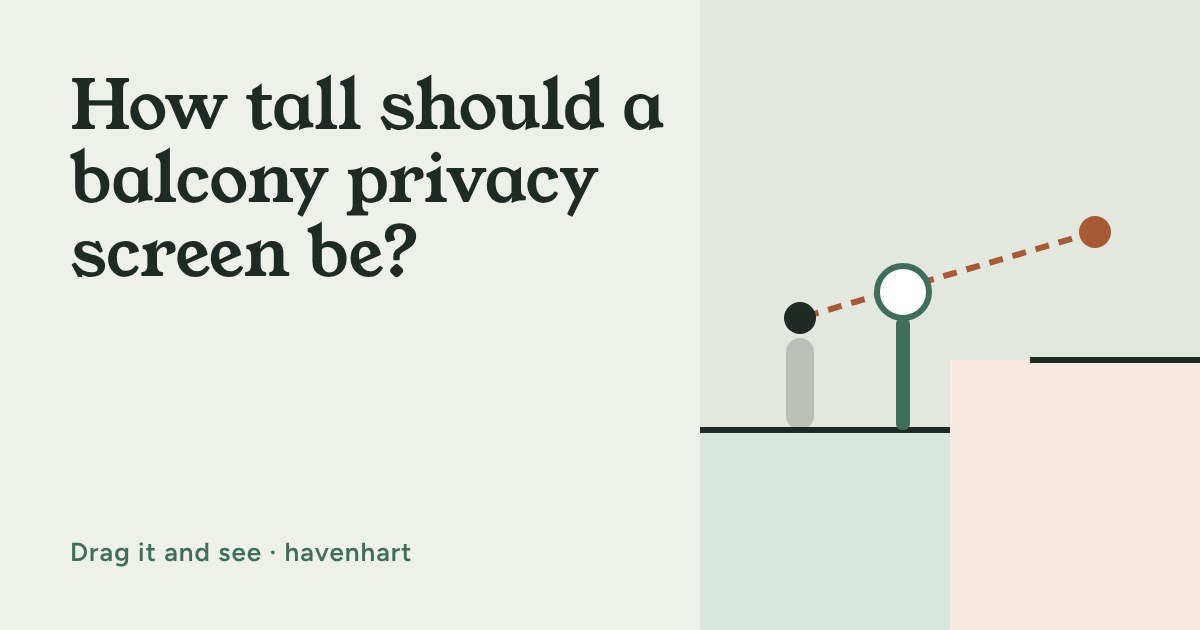
You sit down on the balcony with a coffee, and the flat opposite has a window right at your eye level. A screen fixes that, but how tall does it need to be? Most people guess by feel and end up with a panel that is either too short to matter or taller than the railing wants to carry.
The answer is a piece of school geometry, and it takes about one minute to see it.
Privacy is a straight line
Someone can see you only if a straight line runs from their eye to yours without hitting anything. Put a screen on that line and you are hidden. So the height you need is simply the height at which that line crosses the screen.
Three things set that line: how high your eyes are, how far behind the screen you sit, and how far away (and how much higher or lower) the other person's eyes are. Sit right behind the screen and the line crosses it at about your own eye height. Sit further back and the crossing point drifts towards the neighbour's eye height.
What moves the answer
Try the default set-up: you are sitting 1 m behind the screen, the neighbour is 4.5 m away on the same level. The line crosses the screen at about 124 cm. A standard railing, often around 100 to 110 cm, leaves you visible from the chest up. Standing up, the same screen is nowhere near enough: your eyes are at 160 cm, so you need 160 cm.
Sit close to the screen if the other window is higher than your eyes. Slide the seat from 1 m back to 2 m back and the needed height goes up, because the further you sit from the screen, the more the line is set by the neighbour's eye height instead of yours. Tucked right up behind the screen, the line crosses at roughly your own eye height. It works the other way round for a neighbour below you: there, sitting further back lowers the height you need.
A neighbour on the floor above is the hard case. Choose "One floor above" and the line tilts steeply downwards. At the default seat you need about 173 cm, and pushing the seat in close to the screen brings that down a long way. The other fix is cover from above (an awning, a pergola with climbers, or a parasol), because a vertical screen alone has to do a lot of work against a window overhead.
A neighbour below is easy. The line tilts upwards towards your eyes, so at the default seat you need only about 75 cm, and a normal railing with a solid base is often enough when you sit. Standing is another story, and the floor above still sees you, so check each direction you care about.
What to measure before you buy or build
- Your seated eye height. Sit on the chair you actually use and measure from the balcony floor to your eyes. Typical adult seated eye height above the seat is roughly 70 to 86 cm, plus the seat height, so a low lounger sits far lower than a dining chair.
- Distance to the window that bothers you. Pace it out or use a tape from the railing to the facade. Do this for the one or two windows that matter, not every window in sight.
- Railing height and width. Screens are usually fixed to the railing, so you need its height, its total length and how it is attached.
- Floor to floor. Roughly 250 to 300 cm in most homes; the slider covers it if you know yours.
Wind, landlords and lighter ways to do it
A tall solid panel behaves like a sail. Balcony railings are designed for people leaning on them, not for a large flat area catching a gust, so before fixing anything big to a railing, check your lease or ask the landlord or building manager. Screens with slats, mesh or gaps let some wind through and are gentler on the fixings. Heavy planters on the floor and anything tall that can topple need to be stable in wind too.
You do not need to buy a panel at all. A trellis in a deep planter with a climber, a row of tall grasses, a bamboo or reed roll hung from the railing, or an outdoor curtain on a rail all put something on the line. Plants take a season to fill out, so if you want cover this summer, start with something fast and reuse what you already own.
If you live in a rented flat, a free-standing screen behind the railing, or a tall planter box on the floor, leaves the railing alone and can be taken with you when you move.
When to break the rule
This model protects one seat from one window. If you move around, you will be seen when you stand, and no screen will make a balcony feel private from every angle. Often the cosiest answer is to cover only the seat you use, leave the view open elsewhere, and let a bit of daylight and air in.