Bedroom · Explainer · 4 min ·
How tall should a headboard be? Set your mattress and see
The number on a headboard's product page is measured from the floor, but what you see and lean on is the part above the mattress. Many guides suggest letting roughly 60–80 cm show.
Set your own headboard height, bed base and mattress thickness, add a window behind the bed, and watch how much actually shows. Then learn how to measure before you buy, when to break the rule, and cheap renter-friendly ways to get the look.
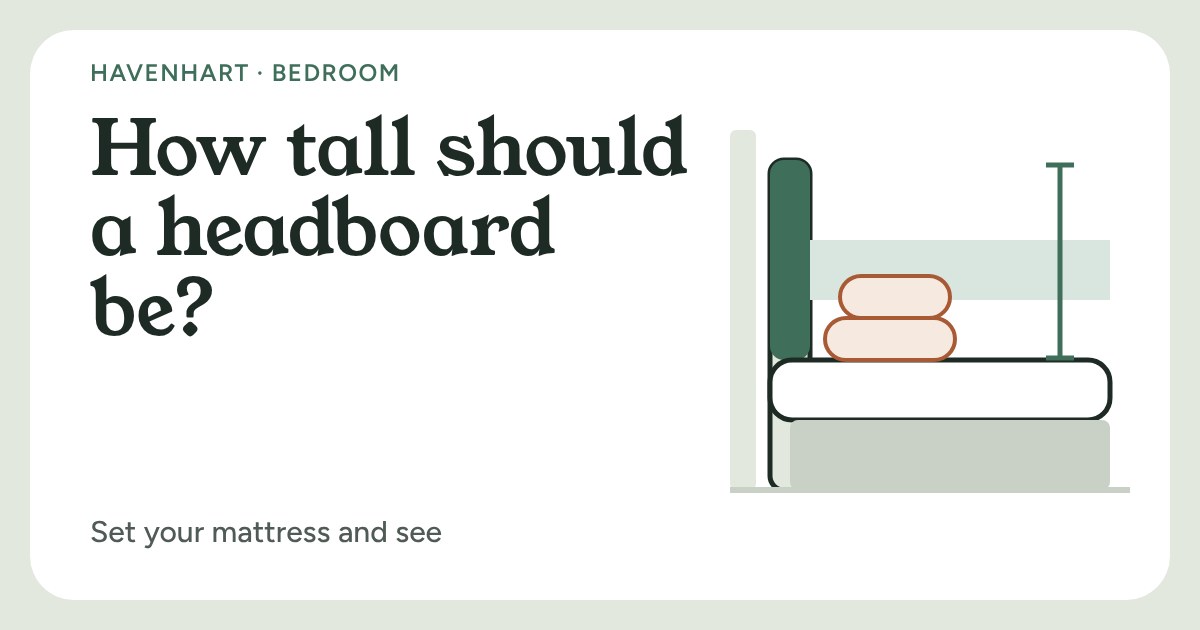
A headboard that is too short leaves you leaning on the wall with a cold patch behind your shoulders. One that is too tall can crowd a window, swallow a small room, or look like it belongs to a different bed. Most of the confusion comes from one thing: the height on the product page is measured from the floor, but what you actually see and lean on is the part above the mattress.
The number that matters
The visible height is simple subtraction:
visible headboard = total headboard height − (bed base height + mattress thickness)
A 130 cm headboard on a low frame with a thin mattress might show 80 cm. The same headboard on a tall frame with a deep mattress might show only 55 cm. Same headboard, very different look and support. Many retailers' guides suggest letting roughly 60–80 cm show above the mattress, which is enough to clear a stack of pillows and support your back when you sit up to read. Treat that as a starting point, not a law.
Why 60–80 cm, and when to ignore it
The range is a rule of thumb that gives two things. First, clearance above your pillows: a couple of stacked pillows can easily reach 30 cm, so a headboard needs to rise well above that to look intentional. Second, support when you sit up: if you read or scroll in bed, you lean on the headboard, and a very short one means your shoulders rest on the wall instead.
Break the rule when it makes sense. A low headboard (or none at all) suits a sloping attic ceiling or a minimalist room, and a rented room with a wall you cannot drill into might be better served by a wall-hung panel or a big piece of art placed at the right height. Taller works in a room with high ceilings, as long as it stays in proportion with the bed.
Check the window and the wall
If the bed sits under a window, compare the headboard top with the sill, as the planner above shows. A headboard that rises above the sill hides part of the glass and can leave an awkward gap with curtains. Also check for radiators, sockets, wall lights and shelves behind the bed, and keep any head-height wall lamp clear of the headboard.
Measure the wall height too. Leave a few centimetres of breathing room under a sloping ceiling, and if the headboard is attached to the wall, use fixings that suit your wall type and check where cables and pipes run before drilling.
How to measure before you buy
- Mattress top: measure from the floor to the top of your mattress as it sits on the frame, not the bare frame. That is your starting line.
- Headboard height: check whether the listing gives the height from the floor or from the mattress, and whether it is adjustable with struts. If a frame has a recess, the mattress may sit lower than you think.
- Width: match the bed's width, or a little wider for a statement look.
- Space behind the bed: some headboards stand a few centimetres off the wall. Add that to your bed-position plan.
Cheap and renter-friendly ways to get there
You do not need to buy a headboard to get the effect. A tall piece of art, a wide mirror or a painted band on the wall behind the bed can add the same visual height. A secondhand frame or a headboard from a different bed might fit if you check its measurements first. Rearranging the bed against a different wall can also solve a short-headboard problem. Cosy comes from how the bed feels, not from how much you spend.
What to look for
If you do decide to buy, keep these in mind: visible height above your own mattress, a width that matches the bed, an upholstered or padded surface if you often sit up, and stable fixings. On a tight budget a simple fixed-height headboard that clears the window is plenty; paying more mostly buys material and finish rather than comfort.