Bedroom · Tool · 4 min ·
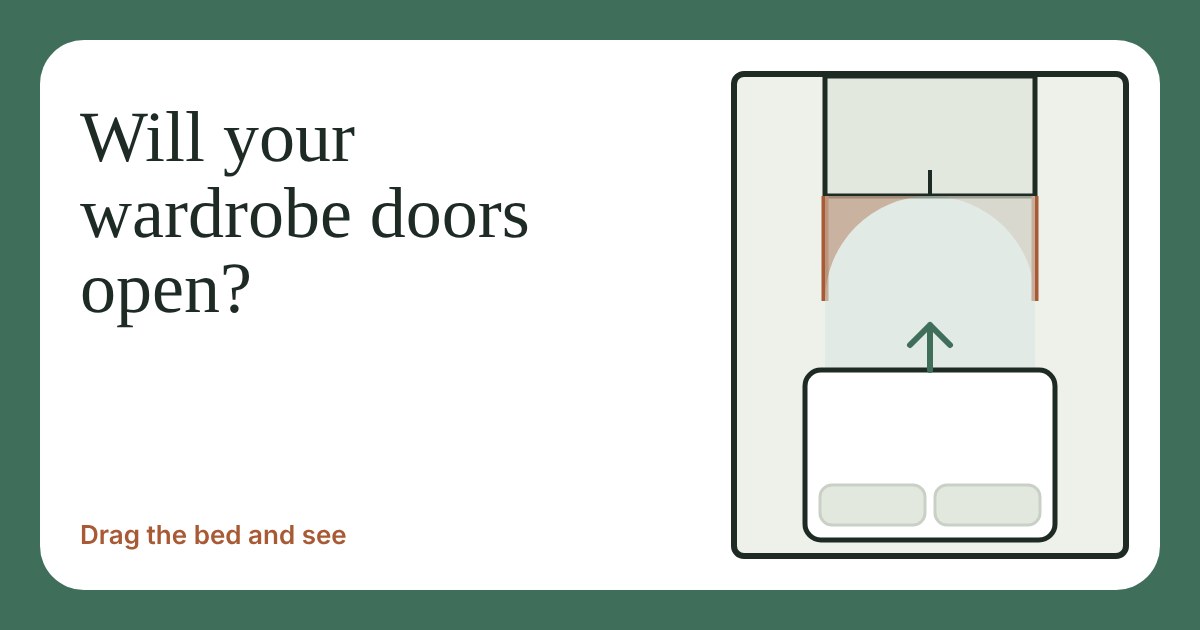
Will your wardrobe doors open? Drag the bed and see
A wardrobe is sold by its width, but you live with the floor in front of it: hinged doors swing out, drawers slide out, and you need room to stand.
Pick hinged doors, sliding doors or drawers, then drag the bed towards the wardrobe and watch the doors sweep open. You'll see how much clear floor each type needs, why sliding doors save space, and what to try before buying anything new.
A wardrobe takes more floor than it looks
A wardrobe is sold by its width, height and depth, but you also live in the space in front of it. Hinged doors swing out into the room, drawers slide out, and you need somewhere to stand while you choose a jumper. Add those up and a wardrobe that is 58 cm deep can quietly claim well over a metre of floor.
It is easy to miss on a plan, where the furniture fits and the doors are thin lines. In real life the doors stop against the end of the bed, and you end up wearing the same three things because the rest is hard to reach. This guide lets you test that before you buy or rearrange anything heavy.
Open the doors and see
Below is a top-down plan of a bedroom. The wardrobe is on the top wall. Pick hinged doors, sliding doors or drawers, then drag the bed (or focus it and use the arrow keys) towards the wardrobe. The terracotta fans are the doors swinging open, the dashed box is where drawers slide out, and the pale green area is the room you need to stand in. The bed turns terracotta when it gets in the way.
The rule of thumb behind the numbers
For hinged doors the space you need is the width of one door leaf, because an open door sweeps a quarter circle that size, plus room to stand. A wardrobe 100 cm wide with two doors has leaves about 50 cm wide, so with 50 cm to stand in you want roughly 100 cm clear in front. That lines up with the figure of 90 to 100 cm that furniture makers often quote for opening wardrobe doors fully.
Drawers do not swing, but they pull out about as far as the wardrobe is deep, and you still need to stand beside them. Sliding doors need no swing at all, so you only need a comfortable standing and reaching space, which for a small room is about 60 cm. Makers of modular wardrobes say the same thing in plain words: sliding doors save floor space, and hinged doors need more room to open.
Other gaps matter too. A common guide for bedrooms is at least 60 cm on both long sides of the bed, a little more if you can, and about 80 cm for the main walkway. If your wardrobe wall is also the way into the room, keep that walkway clear as well.
When to break the rule
The rule is a comfort target, not a law. You can often stand beside an open door instead of in front of it, so a bed corner that clips the edge of the fan may be fine if you only open one door at a time. Narrower leaves help a lot: a door half as wide sweeps a quarter of the area. Some ranges offer leaves as narrow as 25 cm. A curtain on a rail, or no door at all, costs no floor space, and it is a renter-friendly way to hide a rail of clothes.
Before buying anything, try the cheaper fixes. Turn the bed a quarter turn, move it a hand's width, or swap which wall the wardrobe stands on. A second-hand wardrobe is just as good as a new one if it fits, so run the same test on it.
How to measure before you buy
Measure the room's width and length, and the distance from the wardrobe wall to the nearest bed edge. Check the door leaf width, not the wardrobe width, and the true depth including handles. Allow for skirting boards, radiators and sockets on the wall. For a tall frame, check the maker's minimum ceiling height, and measure doorways, stairs and corridors the pieces must travel through.
Then test it for real. Lay painter's tape on the floor in a quarter circle the size of one door leaf and stand in the clear area. If you can reach in without shuffling, the plan works. Whatever you choose, fix a tall wardrobe to the wall with the anchors the maker supplies, so it cannot tip if a drawer or door is loaded.