Living Room · Tool · 4 min ·
Should your sofa float or sit against the wall? Slide it and see
Should your sofa float in the room or sit against the wall? The answer is mostly a question of the gap behind it: a few centimetres reads as "against the wall", about 60 cm is a tight squeeze, and 75–90 cm is a path you'll actually use.
Slide a sofa away from the wall in a top-down plan, add a console table, and enter your own room depth to see what's left for walking and for the seating area. Rearranging costs nothing, so try it before you buy.
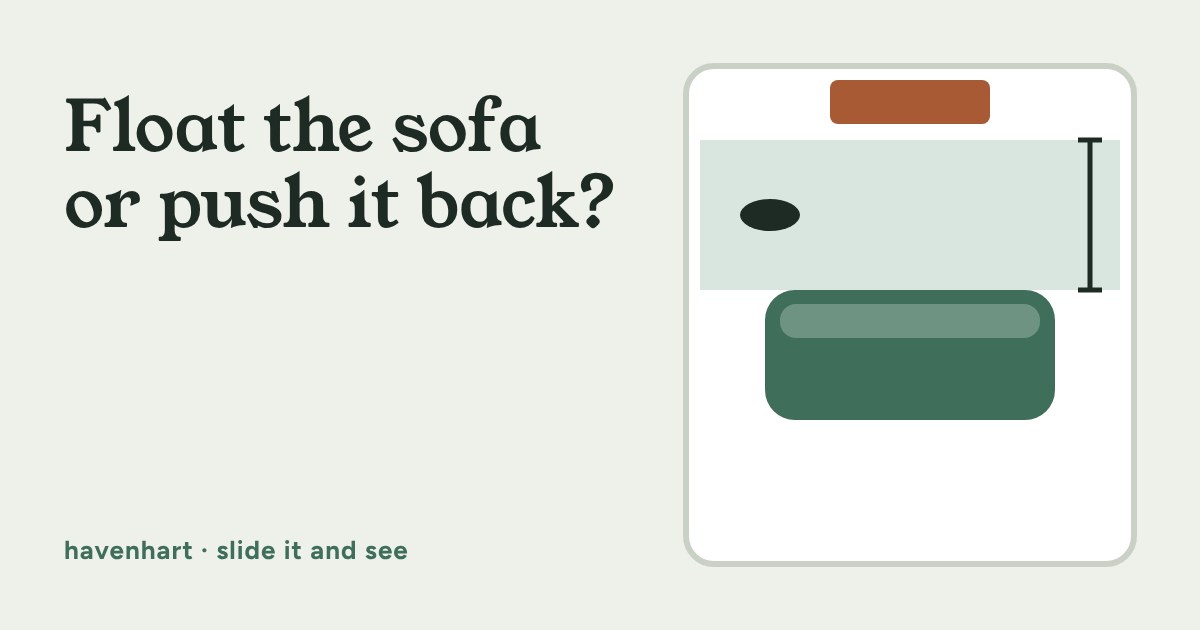
Pull a sofa a little way off the wall and a room often feels more like a room and less like a corridor with furniture. Push it back and you get floor space. Neither is "right"; the real question is how much space you are leaving behind it, and what that space has to do. Slide the sofa below and watch the gap behind it change from a crack to a walkway to a spot for a console table.
Why the gap matters more than the choice
A sofa against the wall does one job: it keeps the floor open. A sofa floating in the room does a different one: it marks where the seating area ends, which helps in open-plan rooms, studios and long, narrow living rooms. Both can look good. What goes wrong is the in-between: a sofa a hand's width from the wall looks like a mistake, and a sofa with a 50 cm gap behind it turns into an obstacle course.
A rule of thumb that appears in many layout guides is to leave around 5–10 cm between sofa and wall if you want it to read as "against the wall" (room for the skirting board, cushions and cables). For a path behind it, around 75–90 cm is comfortable for everyday use, and about 60 cm is tight but workable for occasional trips. Adult shoulders are roughly 45–50 cm across, so anything under about 55 cm means turning sideways. These are rules of thumb, not laws; the slider above lets you see them in your own room depth.
What goes behind a floating sofa
If you pull the sofa out far enough, the back becomes a surface and a line of sight. A few ideas that suit a small budget and what you already own:
- A console or narrow table. Shallow ones are often around 30–35 cm deep. Leave a few centimetres between it and the sofa, and add the depth to your walkway, so a 30 cm console plus a 75 cm path needs roughly 110 cm behind the sofa. Press "Add a console table" to see how fast that space goes.
- A rug that sits under the front legs. It does the "this is the seating area" job without any wall at all.
- A bookshelf, low and open. It divides a room without blocking light. Tall freestanding shelves should be fixed to the wall, which is another reason to keep the sofa near one.
- Nothing. A clear path is a good use of a gap. Check the back of your sofa: some are not finished to be seen, and a throw or a console softens that.
When to break the rule
In a small room, push the sofa back. Giving up 80 cm for a path you walk twice a week is a poor trade in a 3-metre-wide living room. The same goes if the sofa is the only place to sit in a rented studio: against the wall wins, and you can still zone with a rug and a lamp.
Floating makes most sense when there's a real route to protect (a door to the balcony, a way through to the kitchen) or when you want to keep a window or radiator clear. If you float it, don't run a cable across the walkway from a wall socket; use a cable cover or move the lamp to where a socket already is.
Measure before you move anything
Before you drag a heavy sofa, draw it on the floor with masking tape or newspaper and live with it for a day. Measure:
- The room depth, wall to the wall the sofa faces, in cm.
- The sofa's real depth, taken at the deepest point, back cushions included.
- Radiators, sockets and skirting boards on the wall behind it.
- Door swings and the route you actually walk, from the door to the kitchen, balcony or bedroom.
Then try it in the planner: enter your room depth and find the gap that leaves a path you'd use and enough floor in front. Moving furniture costs nothing, and you can often get a better room without buying a single thing.