Small Spaces · Explainer · 3 min ·
Does a drop-leaf table save space? Fold it and see
A drop-leaf table looks like a space saver, but whether it really helps depends on how much usable floor it gives back. Slide the leaf from folded to open, change the width of your room, and watch the gap to the far wall.
Rules of thumb behind it: about 60 cm for a narrow walkway, closer to 90 cm behind a seated person. Plus when a drop-leaf is the wrong answer and what to measure before you decide.
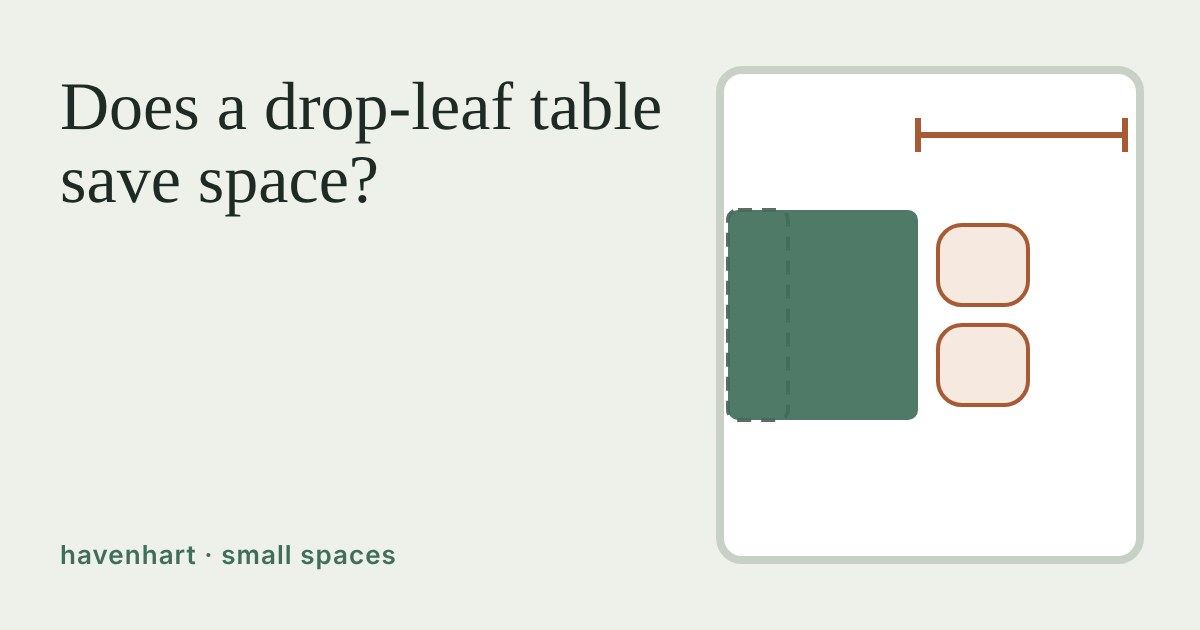
A drop-leaf table looks like a clever answer to a small room: fold the leaves down and it nearly disappears, lift them and you can seat people. But the question that matters is not "how small does it get?" It is "how much floor do I get back, and is that floor actually usable?" The picture below lets you see that for your own room width.
Fold it and see
What the picture shows
A fixed table is always as deep as it is when you use it. A drop-leaf has two shapes: a slim one for everyday life and a bigger one for meals. In a small room the slim shape is what you live with most of the day, so that is the number to judge it by. The slider shows the swap: every centimetre the leaf folds down is a centimetre of floor returned to the walkway, the doorway swing or the sofa.
Two rules of thumb sit behind the colours. A narrow walkway needs about 60 cm of clear floor. Behind a seated person you want closer to 90 cm, so the chair can slide out and someone can still get past. Both are comfort guidelines, not laws, but they explain why many small rooms feel fine with the leaf down and cramped with it up.
When a drop-leaf is the wrong answer
It helps only when the table is used some of the time. If you eat or work at it every day, you will leave the leaf up, and you have bought a normal table with extra hinges. A narrow fixed table or a shelf-style desk can then be the better fit, because it never needs to be unfolded to be useful.
Leaves also hang over the edge, so check what is underneath: knees, radiator valves, a window sill that stops the leaf from dropping flat. If you rent, a wall-mounted fold-down table needs fixing into the wall, so ask first. A freestanding gate-leg or drop-leaf table needs no drilling.
Measure before you decide
- Floor to the far obstacle. Measure from the wall where the table will stand to the opposite wall, sofa or door swing. Subtract the table's open depth to get the gap in the picture.
- Open and closed size. Look for both numbers. If a listing only shows the open size, ask the seller or check the product page before you commit.
- Chairs. Measure the chairs you already own. Folding or stackable chairs that hang on a wall hook are another way to give floor back.
- Doors and drawers. Swing every door and pull every drawer with a tape on the floor, or masking tape for the open footprint, and walk around it for a day.
You do not have to buy anything. A table you already own can often be pushed to a wall and used as a console most days, and second-hand drop-leaf and gate-leg tables are common and usually cheap. If you do buy, a rough budget range of around €80–300 covers many small folding and wall-mounted tables, with solid wood drop-leaf tables costing more.