Lumens belong to the lamp, lux belongs to your page
Most lamp boxes print a number in lumens. That is how much light the bulb gives off in total, in every direction. What your eyes care about is lux: how much of that light actually lands on the page in your hands. The same 400-lumen bulb can leave a book glowing or barely lit, depending on where you put it.
For reading, the usual guidance is somewhere around 300 to 500 lux on the page. For comparison, office lighting is commonly listed at 320 to 500 lux, while the ambient light in a typical living room can be far lower. That gap is why a room can feel cosy and still be hard to read in.
Distance does most of the work
Try dragging the distance slider from 70 cm to 35 cm while leaving the lamp alone. The page gets about four times brighter. Light spreads out as it travels, so halving the distance quadruples the light that reaches you. It is the same physics as a torch on a wall: close is a bright small circle, far is a dim big one.
So the cheapest way to get more reading light is often not a brighter lamp. It is moving the lamp you already have closer to the book, or lower, or onto the side of the sofa instead of across the room. Rearranging costs nothing.
Shades and beams decide where the light goes
A bare bulb sends light in all directions, and most of it goes to the walls and ceiling. A shade pointing down gathers some of that into a pool. A reading arm or directed head squeezes it further, so the same lumens give a stronger spot where you need it. This is why a small, well-aimed reading light can beat a bigger lamp that lights the whole corner.
The opposite is also true. A glowing lamp with a soft shade is lovely for mood and is not meant to be a reading light. Many homes do best with both: a soft lamp for the evening glow and one aimed light for reading.
Warm light is fine for reading
Reading light does not need to be cool or blue. Warm white at 2700 to 3000 K reads comfortably and keeps the room cosy. If the page feels dim, add brightness or bring the lamp closer before reaching for a cooler colour.
Measure before you buy
Sit where you actually read, in your usual posture, and measure:
- Lamp-to-page distance. Hold a tape from where the lamp head would be to the page. Many people end up between 40 and 80 cm.
- Table or floor space. Measure the side table's top, or the clear floor beside the chair, so the lamp base fits without crowding it.
- Height. A common rule of thumb is that the bottom of a shade should sit around your eye level when seated, so you do not look straight at the bulb. Measure from the floor to your eyes while seated, then subtract the side table height to find the lamp height you need.
- Ceiling and curtains. For a tall floor lamp, check the ceiling height and keep the head clear of curtains.
- Cord reach. Check the distance to the nearest socket, or choose a rechargeable lamp that needs none.
Stay inside the maximum bulb wattage printed on the lamp, keep bulbs away from fabric, and keep tall lamps on a stable base away from walkways. Fitting a ceiling light is a job for an electrician, but plug-in lamps need no wiring.
What to look for
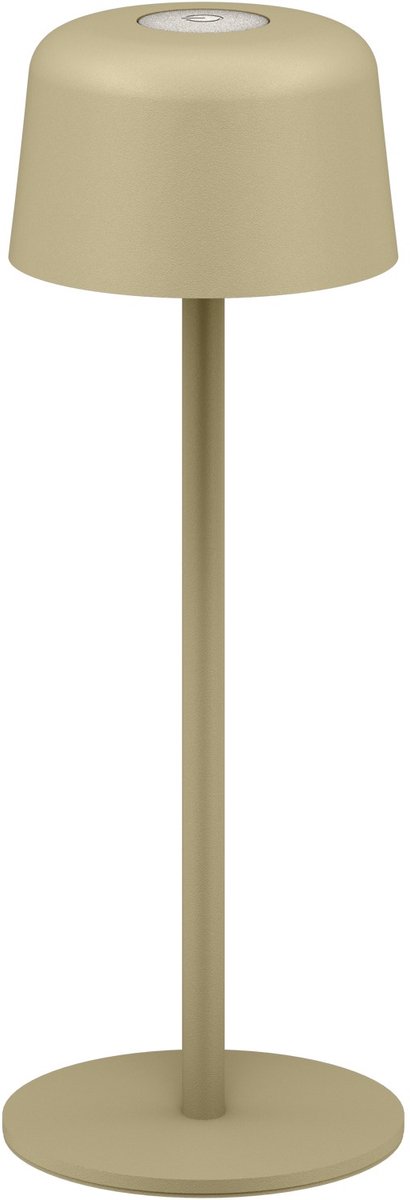
On a small budget: a warm 2700 to 3000 K light, a stable base, and the distance in mind. A small cordless lamp gives a soft glow rather than a proper reading light, so pair it with moving a lamp closer. Second-hand lamps are plentiful, and a new bulb often makes them feel new.
In the middle: a shade or directed head that aims light at the page, a dimmer or two brightness levels, and a height that suits your seat. Look for the lumens, not just the watts.
When you want to spend more: light you can adjust: dimming, a tilting head, a battery so the lamp can move between the sofa and the bed, or two light points in one lamp so ambient and reading light switch separately.