Where a floor lamp sits matters more than which one you buy
You can own a lovely lamp and still squint at your book. The usual cause is the spot, not the lamp: light that comes from the front glares, light from straight behind leaves your own head shadowing the page, and a lamp parked too far away barely reaches. Good placement costs nothing, and it works with the lamp you already have.
The spot that works: beside and a little behind
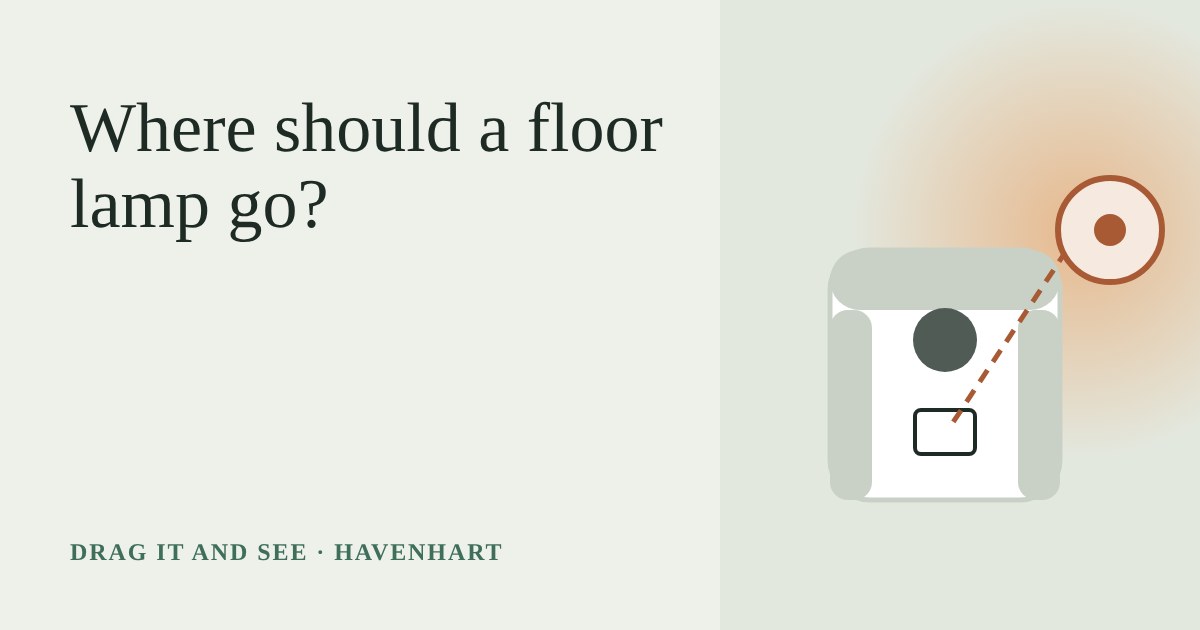
For a reading chair, the classic advice is to place the lamp at one side of the chair and slightly behind your shoulder, so the light falls over the shoulder and onto the page. Think of it as a diagonal: not from the front, not from straight behind. One design guide suggests keeping it roughly 30 to 50 cm out from the side of the armchair, close enough to light the page, far enough that you can still stand up without knocking it.
If you write or do crafts, put the lamp on the side opposite your writing hand. Otherwise your hand makes a shadow right where the pen is.
Why the diagonal wins
Light fades fast with distance: double the distance and the page gets about a quarter of the light. That is why a lamp three steps away feels dim even when it is a bright lamp. Slide the lamp out in the plan above and watch the bar drop. Bring it right up against the chair and the bar rises, but the lamp now blocks the arm, you have a hot spot on one side of the page, and you will bump it.
The angle matters as much as the distance. Straight ahead puts the bulb in your eyes. Straight behind puts your own head between lamp and book. Beside-and-behind is the one spot where the light lands on the page and the bulb stays out of view.
How tall should it be?
For a reading lamp, a total height of roughly 140 to 160 cm is a common recommendation, with the shade around your seated eye level so the bulb is hidden but the light still drops onto the page. Taller lamps, around 170 to 180 cm, are better as background light: they spread more widely and give less light on a small book. Move the height slider and see the pool of light widen as it rises while the page gets less of it.
Your seated eyes are lower than you may think. On a low sofa or armchair they sit roughly 110 to 120 cm above the floor, so a lamp that looks normal when you stand is already above your head when you sit.
Other good spots
A lamp in a corner, aimed up, bounces light off two walls and makes the room feel larger and softer. Next to the end of a sofa it doubles as a reading light for whoever sits there. Behind a chair against a wall it frames the seat and hides the cable. None of these needs a new lamp: try your existing one in three places for an evening each before you decide anything.
Measure before you buy, and stay safe
- The socket. Measure from the nearest wall socket to your chosen spot. A floor lamp cable is often only about 1.5 to 2 m, and an extension cable across a walkway is a trip hazard. Run cables along the wall.
- The footprint. Measure the space beside the chair: the base needs a clear patch, and you want to keep a comfortable path around the chair.
- The height. Check your ceiling height, and sit in your chair while a friend measures your eye height from the floor.
- Heat and fabric. Keep the bulb and shade away from curtains and the lamp stable where children or pets run. A heavy base beats a tall light one.
Cosy without buying
Before you shop, try moving a table lamp onto a stack of books or a sturdy side table beside the chair, or borrow a lamp from another room. Second-hand lamps are common and cheap, and a new fabric shade or a warm-white bulb often changes more than a new base.
What to look for
At a low budget: a standard E27 socket so you can fit any bulb, a base that stays put when you brush it, and a cable long enough to reach your spot. In the middle: a shade that hides the bulb from a seated position, and a finish you will not tire of. Higher up: a heavier base, a dimmer switch on the cable or a dimmable bulb, and an adjustable head. Whatever you pick, fit a warm-white bulb of around 2700 K for a cosy tone, and check whether a bulb comes with the lamp.