Lighting · Explainer · 5 min ·
Should a lamp shade sit at eye level? Slide it and see
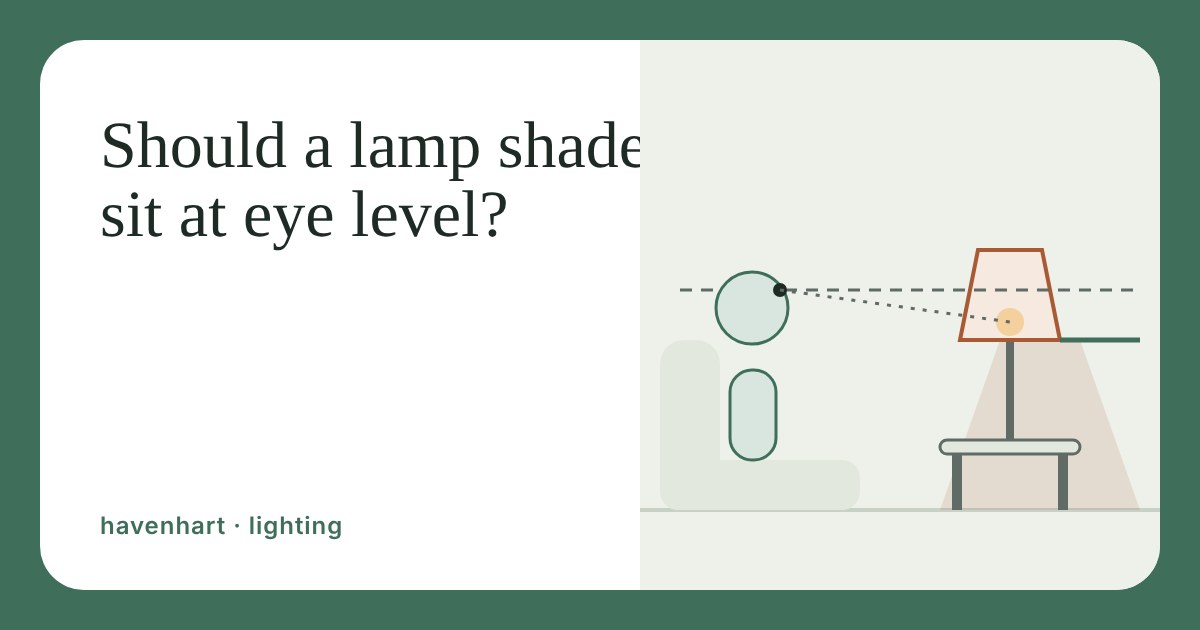
A table lamp beside the sofa can feel soft and warm, or like a small spotlight in your face. The difference is often its height. The rule of thumb is that the bottom of the shade sits at about seated eye level, or a little below.
Slide the table and the lamp up and down, set your own eye height, and watch the sightline: when it can slip under the shade and reach the bulb, that is glare. Then measure your own corner, and learn how to fix a lamp that is the wrong height without buying anything.
Where should the bottom of a lamp shade sit?
A table lamp beside the sofa can feel soft and warm, or it can feel like a small spotlight aimed at your face. The difference is often not the lamp itself but its height. The rule of thumb that designers repeat is simple: when you are sitting, the bottom edge of the shade should be at about eye level, or a little below it. It is a guideline, not a law, so the planner below lets you see why it works and where it stops working.
Why eye level is the line that matters
A bulb is the brightest thing in the lamp. A shade exists to hide it and spread its light softly. When the bottom edge of the shade is higher than your eyes, you look up into the opening and see the bulb itself. Your eyes then adjust to that bright spot and the rest of the room looks darker and more tired. When the shade bottom is at or just below your eyes, you see only the glowing shade, and the bulb stays out of sight.
The other direction is not a disaster, only a different feeling. A very low lamp pours its light onto the table and the floor around it. That can be lovely for a quiet corner, but it is weak for reading and it leaves the wall behind you dark. That is why the planner calls it "low" rather than "wrong".
What is your seated eye height?
You can measure it in a minute. Sit the way you normally sit on that sofa, relax, and ask someone to measure from the floor to your eyes. Published tables of average adult dimensions put seated eye level at roughly 115 to 125 cm from the floor on a seat about 44 cm high. A deep, low sofa lowers it and a firm dining-style chair raises it. People also sit differently from one evening to the next, so use a typical number and don't chase the last centimetre.
Measure before you buy or move anything
- Table or surface height. Floor to the top of the side table, shelf or windowsill where the lamp will stand.
- Lamp height. From the bottom of the base to the top of the shade, and separately the height of the shade itself. Shops often list only the total height.
- Space on the surface. The width of the base, and the widest part of the shade. A shade that overhangs the table edge is easy to knock.
- Cable reach. Distance to the nearest socket, so you don't need a cable running across the walkway.
The sum to do: table height plus lamp height minus shade height is where the bottom of the shade ends up. Compare it with your eye height. Aim for the same number, or up to about 20 cm lower.
Fixing a lamp that is the wrong height
You rarely need to buy anything. A lamp that is too tall can move to a lower table, a stool or the floor. One that is too short can stand on a stack of hardback books, a wooden box or a small tray. Make sure whatever you use is stable and can't tip, and keep a bulb in it that is within the maximum wattage printed on the lamp. Swapping the shade for a deeper or shallower one also changes where the bottom edge lands. Second-hand lamps and shades are a good place to experiment because the cost is small.
When to break the rule
The rule is written for a lamp you sit beside and glance at. For reading, you want the light to fall on the page, so an adjustable lamp or a lower shade pointed at your lap can serve you better. In a room where you mostly stand, such as a hallway or kitchen corner, a taller lamp is fine because nobody looks up into it. Shades with a closed top and bottom, or very deep shades, hide the bulb better than shallow ones. A dimmer or a softer, lower-lumen bulb takes the edge off a lamp that sits slightly high. If the lamp feels comfortable to you, it is the right height, whatever the number says.
If you are shopping for a lamp
Take your table height and seated eye height with you, or note them on your phone. Look for listings that give the shade height as well as the total height, check the socket type matches the bulbs you already own, and don't be afraid to ask a shop about a dimension that isn't listed. Cosy comes from a few warm light sources at different heights, and each of them can be a lamp you already have.