Living Room · Explainer · 4 min ·
How tall should a side table be next to your sofa? Match the arm and see
A side table at the wrong height is one you quietly stop using: too low and you reach down past the sofa arm, too high and every sip lifts your elbow.
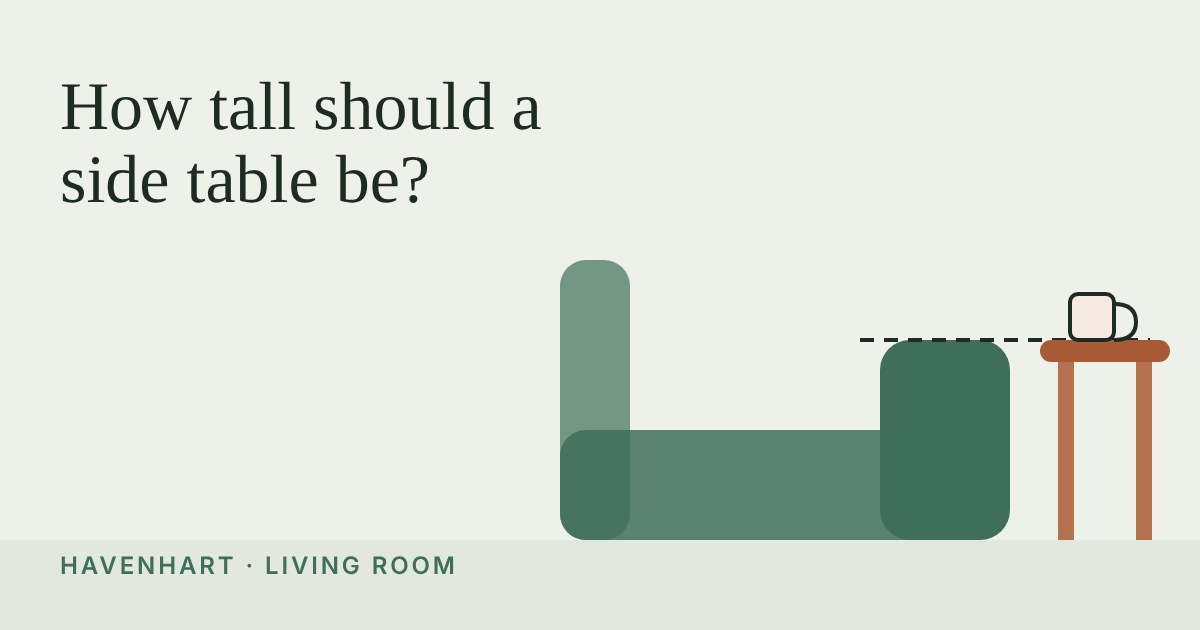
The fix is one comparison, the top of the table against the top of the sofa's arm. Many designers suggest staying within about 5 cm, level or a little lower. Set your own arm and table heights, switch between cups and a lamp, and watch the verdict change, then learn how to measure and when to break the rule.
How tall should a side table be next to your sofa?
A side table that is the wrong height is one you quietly stop using. Too low and you reach down past the arm of the sofa to find your tea; too high and the cup sits at shoulder level, so you lift your elbow every time you drink. Neither is dramatic, which is why people live with it for years.
The fix is one comparison: the top of the table against the top of the sofa's arm. Design writers commonly suggest keeping the table within about 5 cm of the arm height, ideally level with it or a little lower. Try it below with your own numbers.
Why the arm is the right thing to match
When you sit on a sofa, your forearm often rests on or near the arm. A table whose top is level with it puts a cup exactly where your hand already is, so you reach sideways instead of up or down. That is the whole idea, and it is why a table that looks right in a shop can feel wrong beside your sofa: sofa arms vary a lot, from low and slim to high and padded.
A typical side table is somewhere around 50–60 cm tall, which is why plenty of them work with a standard sofa and why some do not work with yours. The number on the product page matters less than the number on your tape measure.
When it is fine to break the rule
- A lamp. If the table mostly holds a lamp, a table slightly above the arm is fine, and some writers allow it to run a little higher. The lamp lights the room; you are not reaching for it as often as for a cup.
- A low, chunky arm. When the arm is very thick, a table that is a few centimetres lower can be easier to reach over than one that fights it.
- A pouf or tray as a table. A stool with a tray is usually lower than the arm by design. It works for a mug, less so for a laptop.
- Next to an armless sofa or a daybed. No arm to match, so use the seat: a table a little above the cushion height is easy to reach from sitting.
How to measure
Put the tape on the floor beside the sofa and read the height of the top of the arm. That is your target. If you are shopping, look for the table's total height in the specification and compare. If you already own the table, you can often adjust: furniture glides add a centimetre or two, and some tables have a screw-in foot.
Also check the width you can spare. A table should stand close enough to reach without leaning, but leave a clear route to walk past it. Rearranging a table you already have, or using a stack of sturdy books under a lamp, often does the job for free. Second-hand side tables are easy to find and easy to resize with new feet.
One safety note: a table that is much taller than the arm and narrow on top can tip when you lean on it. Keep tall, light lamps and hot drinks on a stable base, and don't use a wobbly table beside a child's play area.
If you do buy one
Most homes don't need a new table; they need the one they have to be moved or raised. If you do buy, measure the arm first, write the number down, and look for a table whose top lands within 5 cm of it, level or slightly below. Round tables are easier to walk around in tight rooms; a table with a shelf holds more without taking more floor space.