Lighting · Explainer · 4 min ·
What does a lampshade do to the light? Swap the shape and see
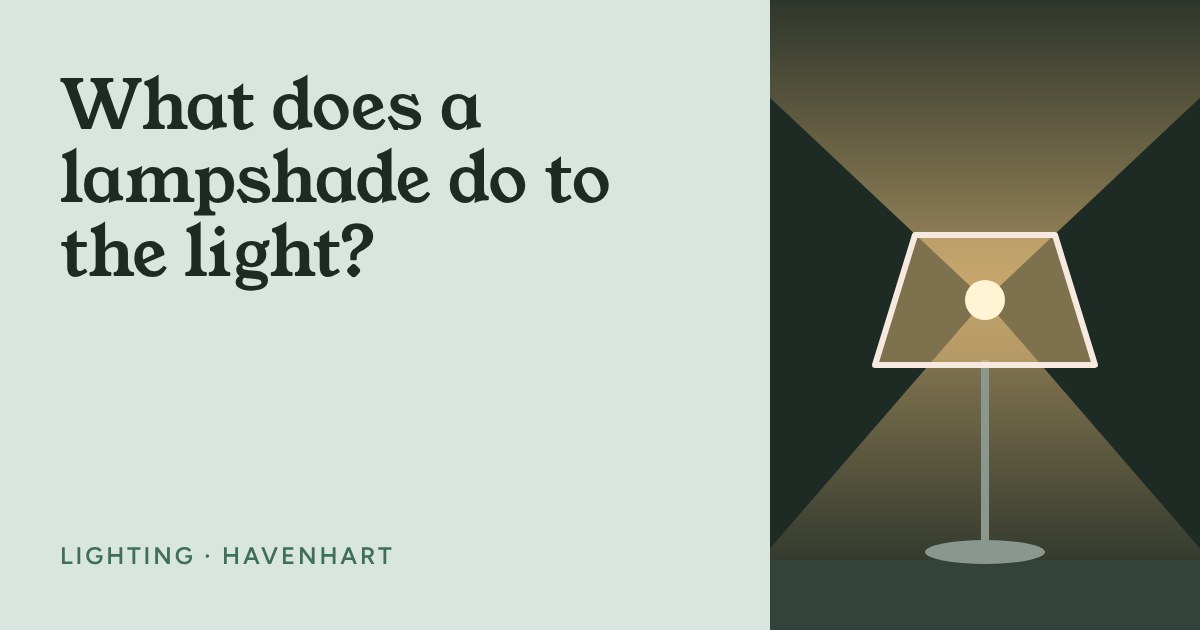
A lampshade is a stencil for light. Its top and bottom openings cut the bulb's light into an upward cone and a downward cone, and the fabric decides how much leaks through the sides.
Swap between drum, tapered, tall and wide shades, change the fabric from thin linen to thick lined, and slide the lamp towards or away from the wall. You'll see where the bright pools land and how big the dim band between them is. Plus what to measure before you swap a shade, and the safety basics.
A shade is a stencil for light
A bare bulb throws light in every direction. A lampshade decides where that light is allowed to go. Light travels in straight lines, so the shade's two openings, the one at the top and the one at the bottom, cut the light into an upward cone and a downward cone. Whatever hits the fabric either glows through it or stops dead.
That is why the same bulb can give you a soft room glow with one shade and two sharp pools with another. Three things set the result: the shape of the shade, the fabric, and how far the lamp sits from the wall behind it. Try them below. The left view is from the side, the right is the wall as you would see it.
How the shape sets the pools
Look at the dashed lines in the side view. Each one runs from the bulb, past the edge of an opening, and on to the wall. Light inside those lines escapes through the opening; light outside them hits the shade. So the opening's width sets the angle of the cone. A wide top opening gives a wide, shallow cone, and the upper pool starts lower on the wall. A narrow top squeezes the cone into a tight beam that only reaches high up.
The bottom opening works the same way. A shade that flares out at the bottom (tapered) throws the lower pool higher up the wall, while a shade that is the same width top and bottom (a drum) keeps the two pools evenly matched. The curved edge you see on the wall is simply where a cone of light meets a flat surface.
Try pulling the lamp away from the wall. The pools get taller and the band between them gets longer. Push it close and the pools shrink and curl tight around the shade.
What the fabric changes
Fabric decides how much of the light that hits the shade makes it through. Thin linen glows warmly and fills the room with soft light, which feels relaxed but means the lamp itself is bright to look at. A thick, lined shade hides the bulb and keeps your eyes comfortable, but it gives strong, crisp pools with a dark gap between them.
Colour matters too. A white lining keeps the bulb's colour, while a cream, gold or coloured fabric tints the light that passes through it. If you like the warm effect, a warm-white bulb under a pale shade does the job without extra help.
Choosing the effect you want
- A cosy, glowing corner: choose a lighter fabric and wide openings, and place the lamp a little away from the wall so the pools can blend.
- Reading or a task: choose a shade with a wide bottom opening so the light falls onto the page, and keep the lamp close to where you sit.
- Soft ceiling light: a shade with a wide top opening throws light upward, where it bounces back into the room.
- Stripy wall behind the lamp: if the bright-dark-bright pattern bothers you, move the lamp farther from the wall, or switch to a thinner fabric.
Before you swap a shade: measure and stay safe
You don't have to buy anything new. A shade from another lamp, a second-hand one, or a lamp you already own in a different room may be all you need. Measure the one you have first, and write down:
- the top and bottom diameter, and the slanted height, so you can compare it with another shade;
- the fitting: how the shade attaches (a clip on the bulb, a ring on a wire frame, or a ring that sits on the socket);
- how far the bulb sits from the fabric, so the shade does not touch it.
Keep fabric well away from the bulb and follow the maximum wattage printed on the lamp. An LED bulb runs much cooler than an old filament bulb, but a fabric shade should still never rest against it. Do not try to rewire or repair a lamp's electrics yourself unless you are qualified; take it to someone who is.
When to break the rules
None of this is fixed. A drum shade that throws a dark band is exactly what some people want behind a sofa, and a glowing linen shade in a bedroom can be perfect. The point is that you now know what each choice does, so you can pick the result you like and skip what you don't.