Living Room · Explainer · 4 min ·
How high should a sofa seat be? Match your knees and see
Everyone checks how wide a sofa is, but hardly anyone checks how high the seat is. It decides whether your knees end up level, above your hips or dangling, and how easy it is to stand up again.
Set your own knee height, move the seat height and the cushion softness, and watch where your thighs and feet land. Plus how to measure, when a low seat is the right call, and simple fixes if the sofa you own is a little off.
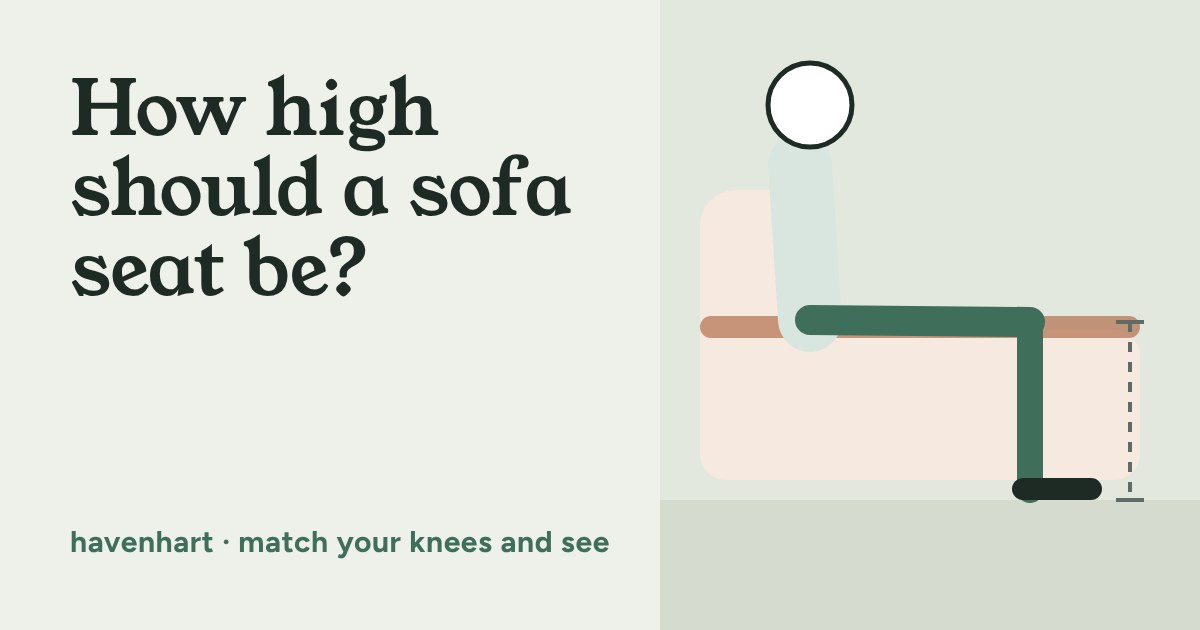
Everyone checks how wide a sofa is. Hardly anyone checks how high the seat is, yet it decides whether you sink into the cushions, sit with your knees up by your chin, or perch with your feet barely touching the floor. It also decides how easy it is to stand up again after a long film.
Try it: match the seat to your knees
Set your own knee height (floor to the back of your knee while sitting), then move the seat height up and down and watch where your thighs and feet end up.
Why the number matters
A sofa's seat height is measured from the floor to the top of the seat cushion. Shop listings and size guides usually show a range of roughly 40 to 50 cm, with low lounge styles around 38 to 43 cm and higher, easy-to-rise styles up to about 50 cm or a little more. Around 45 cm is the usual middle.
The useful comparison is with your own body. When you sit with your feet flat and your lower leg upright, the back of your knee is a certain height above the floor. If the seat is about that height, your thighs rest level and your weight spreads along them. A lower seat tips your knees above your hips, so standing up means lifting yourself out of a hollow. A higher one lifts your feet, and the front edge starts pressing into the back of your thighs.
Cushions change the answer
The number on the label is often the uncompressed cushion. A soft feather-and-foam seat can sink several centimetres once you sit, and an over-stuffed firm one barely moves. That is why the third slider is there: a 48 cm sofa with a 5 cm sink behaves like a 43 cm one. If you are choosing in a shop, sit down properly and have someone measure from the floor to the top of the cushion while you are on it.
When to break the rule
Matching your knees is a starting point, not a law. A low, deep sofa is wonderful for curling up, and taller people often like a slightly lower seat. If you have sore knees or hips, or you share the sofa with someone who does, a slightly higher, firmer seat with sturdy arms makes standing far easier. A footstool or pouffe quietly fixes a seat that is too high for a shorter person, and a firm cushion under the seat can lift one that is a little low.
If you already own the sofa, you do not have to replace it. Some sofas can take taller legs or furniture risers. Check that they are made for the weight, sit firmly, and cannot slip, and never stack makeshift blocks under a sofa. A second-hand sofa can be a good way to get the height you want, as long as you sit on it first.
Measure before you buy
- Your knee height: sit on a firm chair with your feet flat, then measure from the floor to the back of your knee, where the thigh meets the lower leg.
- The sofa seat: measure from the floor to the top of the seat cushion, and again while someone is sitting on it if you can.
- The room: note the width of the doorway and any stairs the sofa must travel through, and the space where it will stand, so the right height also fits.
What to look for
- A seat height close to your knee height once the cushion has sunk, within a few centimetres either way.
- Arms that are sturdy and not too low, if standing up needs a push.
- A cushion that is not so soft that it swallows you, since a deep sink makes a high seat act like a low one.
- Legs that are visible and solid, because they are the easiest part to change later.
Cosy is a feeling, not a shopping list. A sofa that fits your body and a throw you already own will do more for a room than a new one that is the wrong height.