Dining & Kitchen · Explainer · 4 min ·
What height should a dining chair be? Slide the seat under the table and see
A dining chair feels right or wrong because of one number: the gap between the seat and the underside of the table. Guides agree on roughly 25–30 cm.
Drag the seat and the tabletop in the side view, switch between sitting and chair pushed in, and see when thighs and armrests collide. Then learn how to measure your own table and what to do if your set is a few centimetres off.
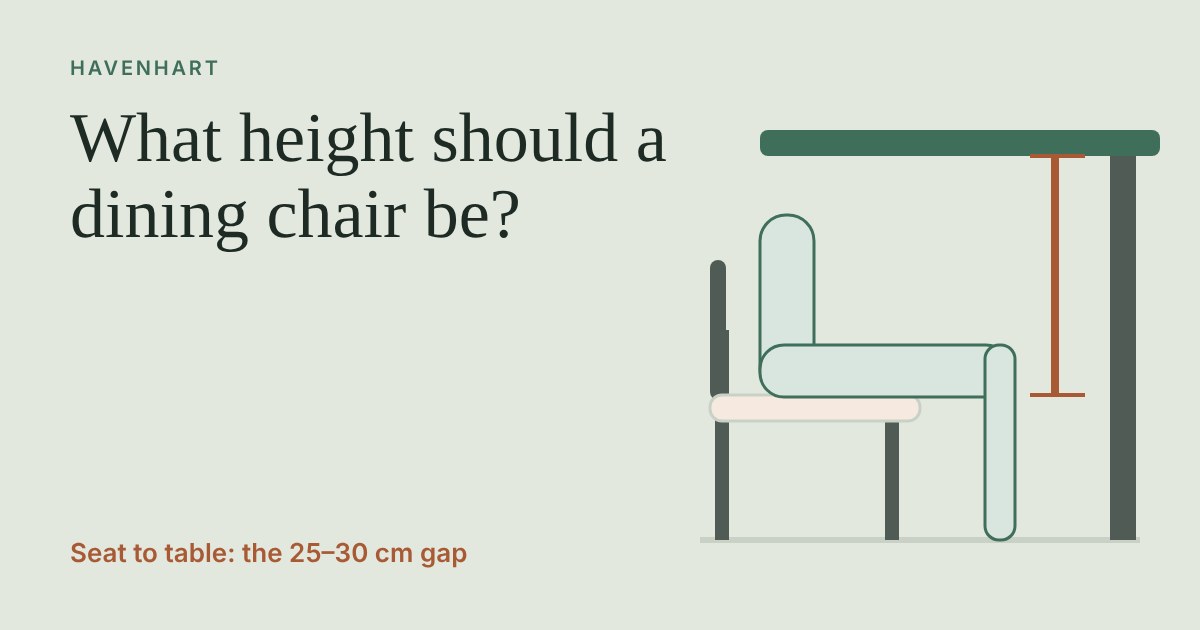
The gap that makes a dining chair comfortable
You can sit at a table that looks perfect in the shop and still spend every dinner with your knees pressed against the underside, or your chin level with your plate. The cause is rarely the size of the chair or the table on their own. It is the gap between them: how far the seat sits below the underside of the tabletop.
Most dining tables are about 70–75 cm high. Most dining chair seats are about 40–50 cm from the floor. Several furniture guides give the same rule of thumb for the space between the two: around 25–30 cm from the top of the seat to the underside of the table. Less than that and thighs get squeezed. A lot more and you sit low, reaching up to your food.
How to measure your own table and chairs
Use a tape measure and write the numbers down; the shop's listed sizes are a starting point, not a promise.
- Table height: floor to the top surface.
- Underside: floor to the lowest part you will have to slide your legs under. On many tables that is the frame or apron just beneath the top, not the tabletop itself. This is the number the gap rule uses.
- Seat height: floor to the top of the seat at the front edge. A soft cushion sinks when you sit, so measure it pressed down with your hand.
- Armrests: floor to the top of the arm. The chair only tucks under the table if this is lower than the underside.
Buying online, look for seat height in the listing. If it isn't there, ask the seller or pick a chair you can measure in person. Try to check one chair against your own table before ordering a full set.
When to break the rule
The 25–30 cm gap is a guide, not a law. Tall people often like a little more room; shorter people and children may want a seat pad or a lower table edge so their elbows aren't lifted to reach the plate. A chair you sit on for hours at a laptop deserves a bit more room than one you use for a quick breakfast.
If your set is a few centimetres off, you do not need new furniture. Some ideas that cost little or nothing:
- Swap chairs between rooms, or try the ones from your desk or hallway, to see which height suits you.
- Add a firm seat pad to raise a low chair. Check that it does not slide.
- Remove thick cushions from a tight set, or choose slimmer ones.
- Check second-hand chairs in person; heights vary a lot between styles, so the label alone tells you little.
- Table feet risers can lift a low table. They must be stable and sized for your table's weight, so only use ones that clearly fit your legs.
If armchairs are a must, check the arm height before you buy. Chairs that tuck under the table save floor space in a small room, and chairs whose arms stop short of the underside leave more space when a guest sits down.
What to look for, if you are shopping
Whatever your budget, three numbers matter: the table's underside height, the seat height, and the armrest height if there are arms. Compare them against the 25–30 cm gap before anything else, such as colour or fabric. A chair that looks right but sits wrongly will end up unused. The most useful step is free: measure what you already own, then take the tape measure with you.