Bedroom · Explainer · 5 min ·
Why does the bedroom feel stuffy by morning? Open the window and see
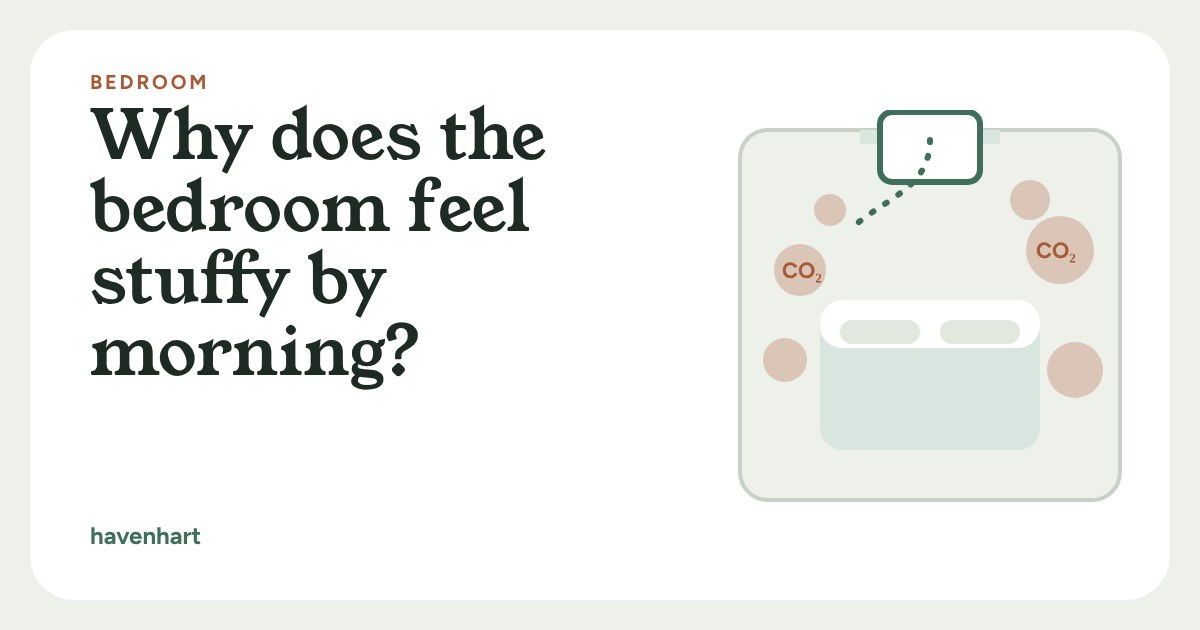
Bedrooms fill with the air we breathe out. This interactive models one night: set your room size, how many people sleep there, and whether the window and door are open, and watch carbon dioxide build up (or not).
A 2016 study found around 2,400 ppm with windows closed against about 835 ppm with a little fresh air, and better sleep with the fresher air. Learn the simple fixes that keep the room cosy too: airing before bed, tilting rather than flinging a window open, and dressing the bed instead of the room.
Why does the bedroom feel stuffy by morning?
You close the door, switch off the lamp, and fall asleep in a room that feels fine. Eight hours later it feels heavy, a little warm, a little flat. Nothing is broken. You have simply been breathing the same air all night.
What is actually building up
Every breath out carries carbon dioxide (CO₂). A sleeping adult gives off roughly 9 to 11 litres of it an hour; one study of older adults asleep measured an average of about 9 litres an hour. That is tiny next to the size of a bedroom, but a bedroom is small and the night is long. Outdoors, air holds around 400 to 420 parts per million (ppm) of CO₂. Indoors it only goes up from there unless fresh air gets in.
CO₂ is not poison at these levels. It is a handy stand-in: when it climbs, other things you breathe out and give off (moisture, odours) have been climbing too, and the room is not being refreshed. A common rule of thumb for a room that feels fresh is to stay under about 1,000 ppm.
Try it: one night in your room
The chart below is a simple model of one night, 23:00 to 07:00. Change the room, who is sleeping in it, and whether the window and door are open. The curve shows CO₂ building up and levelling off. The air-change numbers are illustrative assumptions, not measurements: real rooms vary with wind, temperature and how draughty the frame is.
What the research found
In a 2016 study in the journal Indoor Air, young adults slept in a bedroom twice: once with the windows closed and once with a small fan bringing in outdoor air. With windows closed, CO₂ averaged around 2,400 ppm overnight. With the fan on, it averaged around 835 ppm. In the better-ventilated nights the sleepers spent a larger share of their time in bed actually asleep, did better on a concentration test the next morning and said the air felt fresher. They also reported a drier mouth and skin, which is a fair trade-off to know about. It was a small study, so treat it as a strong hint rather than a promise.
Keeping it cosy while the air moves
Fresh air is the opposite of cosy if it means shivering. A few ways to get both:
- Air the room before bed. Ten to fifteen minutes with the window wide open, then closing it, resets the room to near outdoor levels. Cold air warms up faster than you expect, and your bed, walls and furniture hold most of the heat.
- Tilt, don't throw open. A window left tilted or a trickle vent gives a slow, steady flow. In the model above it beats a closed window by a lot for a small heat loss. Close the curtain loosely so any draught isn't aimed at the pillow.
- Use the door. Leaving the bedroom door ajar mixes your air with the rest of the home. It helps most if another room has a window open or a vent, and least in a small flat with everything shut.
- Dress the bed, not the room. A warmer duvet or a wool throw lets you sleep with a cooler, fresher room. Our tog guide shows how to match them.
- Cut what you can. Fewer sleepers and a bigger room both help the numbers. You can't change those, but it explains why a box room feels stuffier than a big one.
When to break the rule
If the bedroom is next to a busy road, a noisy neighbour or high pollen season, a fully open window can cost you more sleep than it gives. Then lean on the evening airing, a small gap, and the door. If you rent and the window is stiff or has no trickle vent, ask your landlord about a vent before reaching for anything that needs fitting. And if you ever feel unwell in a room with a gas or solid-fuel appliance, that is a different problem: get fresh air, leave, and have the appliance checked by a qualified engineer.
What to measure
You don't need to buy anything to start. Measure the room (length × width in metres, plus ceiling height) and plug it into the model above. If you are curious about the real number, a small CO₂ monitor will show it, but it is optional: noticing a heavy morning and trying the evening airing for a week costs nothing.