Bedroom · Tool · 4 min ·
Will your fitted sheet stay on? Measure the depth and see
A fitted sheet is sold by width and length, but it stays on because of depth: how far the corner pockets reach under your mattress and topper. Enter your own measurements, drag the pocket up and down, and see whether the corners wrap under, barely reach or sit too loose.
You also get a simple way to measure your bed, a rule of thumb for how much spare depth you need, and cheap fixes that don't mean buying new bedding.
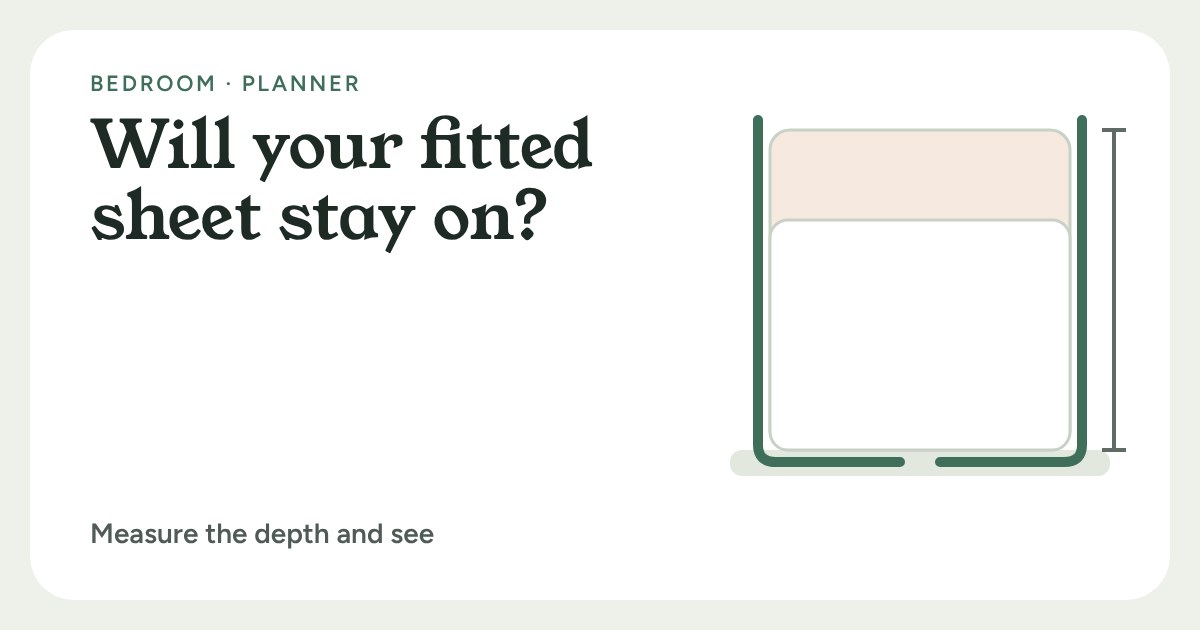
A fitted sheet is sold by width and length, and that is the part everyone checks. What decides whether it stays on is a number most people skip: how deep the corner pockets are compared with how thick your bed really is. Enter your mattress, add a topper if you have one, and pull the sheet's pocket up or down to see where the corners end up.
How to measure your bed
You need a tape measure and two minutes, and you should do it before you buy anything new.
- Strip the bed. Take off the sheet, protector and any loose layers so you are measuring the mattress itself.
- Measure the mattress thickness. Run the tape down the side, from the top seam to the bottom seam, at the thickest point, usually near the middle of the long side. Press the top lightly; soft mattresses spring back, so measure without squashing.
- Add any topper. A topper sits under the sheet, so measure it too, or measure the whole stack from the top of the topper to the bottom of the mattress.
- Write down the total in centimetres. That one number is what the pocket has to cover.
- Measure width and length once too. Many beds are 90, 140, 160 or 180 cm wide and 200 cm long, but older or imported mattresses can differ.
The rule of thumb behind the result
A fitted sheet has to go over the top, down the sides and then under the mattress, because the elastic gripping the underside is what holds it on. So the pocket depth should be a little more than the mattress and topper added together. Several bedding makers suggest roughly 5 cm of spare, and that is the line the planner uses. Below about 3 cm the corners tend to creep up as you move.
Break the rule when the fabric stretches a lot. A jersey sheet with elastane can cope with a snugger fit than a stiff woven cotton one, and the opposite problem is real too: a sheet that is far too deep bunches and pulls loose at the corners. Closer is better than huge.
Read the number, not the label
Makers use words like standard, deep and extra deep, but they do not agree on what those words mean. One brand's standard may cover mattresses up to around 25 cm, another's up to 35 cm. Look for the depth in centimetres (sometimes called the pocket, skirt or gusset height) and compare it with your own total. Some makers also state the maximum mattress and topper height the sheet will take. That is the same measurement the planner shows.
Width matters too, but it is more forgiving. A sheet size usually covers a small range of mattress sizes, so a 140 cm sheet often fits a 140 or a 160 cm mattress. Check the maker's own size table instead of assuming.
If your sheet doesn't fit
You do not have to buy new bedding because one corner keeps escaping. Try the cheap fixes first:
- Too shallow: take the topper off for a night to check it is the culprit, or use the sheet on a thinner mattress.
- Too deep: elastic sheet straps or clips across the underside pull the spare fabric tight. A knot in each corner works as well and costs nothing.
- Second-hand or spare sheets: an old sheet with a deeper pocket may fit your new topper. Check the number before you wash and fold it away.
What to look for when you do buy
- A pocket depth in centimetres that is about 5 cm more than your mattress and topper together.
- Some stretch in the fabric (jersey or a little elastane) if your fit will be snug.
- The right width and length for your mattress, checked against the maker's size table.
Cosy is not about owning more sheets. Measuring once, then keeping the number in your phone, saves you from guessing next time.