Lighting · Explainer · 4 min ·
Why is there a lamp on your TV screen? Move it and see
Ever noticed a lamp sitting on top of the picture when the TV is on? It is a mirror effect, and it depends on where the lamp is compared with where you sit, not on how bright the room is.
Drag a lamp and a viewer around a top-down living room and watch the reflection travel across the wall. See why lamps beside the screen are safe, why lamps by your seat are the risky ones, what a matte screen really changes, and the free fixes.
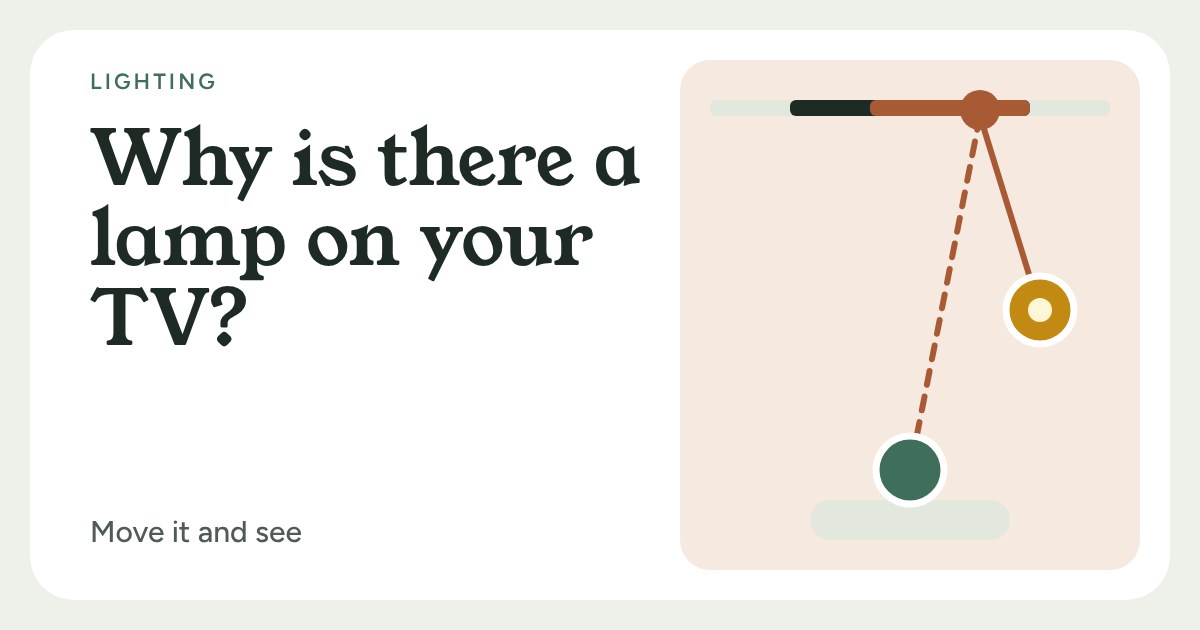
Why does a lamp show up in your TV?
A switched-off TV is a dark mirror. A switched-on one still is, just a weaker one. Light from a lamp (or a window) hits the glass and bounces off like a ball off a wall: it leaves at the same angle it arrived. If that bounced light travels to your eyes, you see the lamp sitting on top of the picture.
So glare is not about how bright the room is. It is about where the lamp is compared with where you sit. The same lamp can ruin a film from one seat and be invisible from the next.
Move the lamp and see
The rule behind it
Picture a mirror image of your lamp standing behind the TV wall, the same distance back as the lamp is in front. Draw a straight line from your eyes to that image. Where the line crosses the wall is where the reflection appears. If that point is inside the screen, you get glare. If it is outside, you do not.
Three things follow, and you can check each with the figure:
- Lamps beside the screen are safe. A lamp level with the TV, or just to one side, reflects at a point near itself on the wall, which is off the screen.
- Lamps beside or behind your seat are the risky ones. Light from them travels across the room, bounces off the glass and comes straight back to you.
- A bigger screen catches more. Slide the width up and a reflection that missed will land on the glass.
A glossy screen gives a sharp, bright image of the lamp. A matte or anti-reflection coating spreads that image out, so you see a dull haze that lowers contrast rather than a clear lamp shape. It helps, but it does not remove the effect. Which kind your TV has is usually in its specifications.
When to break the rule
The mirror line only covers the lamp itself. Pale walls, a shiny floor or a window opposite the TV also send light back, just more softly. And the rule is for one seat: a sofa has several, and each one sees a different reflection. If you can only fix one thing, fix the seat you use most.
It is fine to want a lit room while you watch. A small lamp beside or behind the TV, aimed at the wall, gives the room a soft glow and many people find it makes the picture look punchier. Just keep it where its reflection cannot reach you.
Fixes that cost nothing
- Move the lamp along the wall so it sits beside the screen, not across the room from it.
- Turn the lamp or its shade so the bulb is hidden from the screen, or lower the light with a dimmer or a warmer, softer bulb when you watch.
- Close curtains or blinds opposite the TV. A window behind your seat is the usual cause of an all-day reflection.
- Tilt or turn the TV a few degrees if it hangs on a bracket that allows it. That moves the reflection point.
- Swap seats on the sofa and watch where the glare goes.
Measure before you move or buy anything
Before buying a lamp or a new TV, measure the distance from your usual seat to the screen, the width of the screen, and how far each lamp and window is from the TV wall and from the sides of the room. Plug those into the figure above. That tells you if a change is worth it, and a quick rearrange costs nothing. If you want a new lamp, check that its shade hides the bulb from the screen’s side. Tall furniture or a wall-mounted TV should always be fixed with the right anchors for your wall, and any ceiling or wall wiring is a job for an electrician.