Living Room · Tool · 4 min ·
Left or right chaise? Flip it and see which side suits your room
A corner sofa comes as a left or a right version, and the wrong one points the chaise at the door or walls off a corner. Flip the chaise in a room plan and see which side keeps the walk from the door open, how much strip is left beside it, and what to measure first.
Includes how shops define left and right, when to break the "away from the door" rule and when a reversible chaise is worth it.
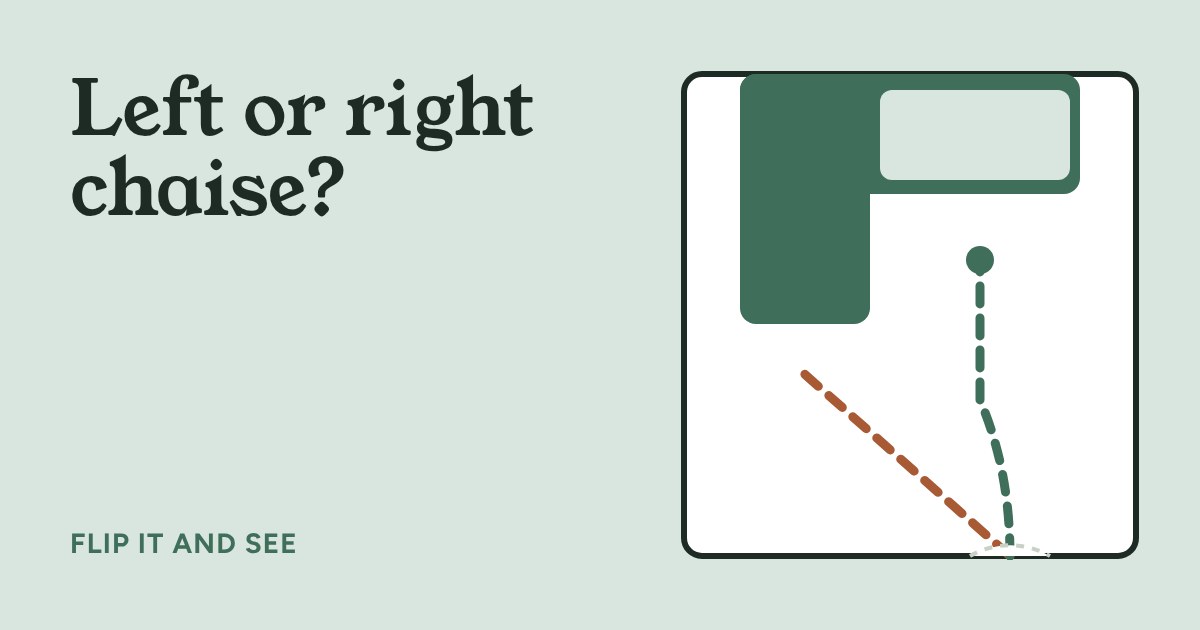
Left or right chaise? It is not a coin toss
A sofa with a chaise (the long, leg-up end) usually comes in two mirror-image versions. Pick the wrong one and the chaise points at the door, blocks the walk to the window, or leaves a dead strip against the wall that nothing fits in. The sofa is the same. Only the side differs.
Before you can choose, you need to know what "left" means. Most shops say left-hand when you stand in front of the sofa, facing it, and the chaise is on your left. Some describe it from the seat instead, which flips the answer, because sitting down you face the other way. Always check the maker's diagram, and never order by the word alone.
What the plan shows
Two things decide the side. The first is your route. Most people walk from the door to the seat, and a chaise that sticks out into that line forces a detour every time you sit down. Put the chaise on the side away from the door and the path stays open.
The second is the strip beside the chaise. If the sofa sits close to a side wall, the chaise can leave a gap too narrow to walk through. That gap is not wasted if you plan for it: a floor lamp, a plant or a small side table fits in a nook, and nobody has to squeeze past it.
When the rule is wrong
"Away from the door" is a starting point, not a law. Sometimes the chaise belongs on the door side: when a window, radiator or bookcase on the other side needs reaching, when the TV is angled, or when the only open corner is by the door. If you sit on the chaise to read, put it where the light comes from. Whichever way you go, look at where your feet end up and what they point at.
You can also avoid the choice. A reversible chaise, where the chaise unit can be moved to either end, keeps the option open if you move or rearrange. Check how the cushions and the arm are built before you assume a model is reversible, and ask the maker.
What to measure before you decide
- The wall the sofa will sit on, from corner to corner, and any radiator, socket or window sill on it.
- The room depth, so you know how much floor is left in front of the chaise tip.
- The side gap: the distance from the wall to where the chaise will stand. Anything under about 75 cm is a nook, not a path.
- Doorways, hallways and stairs the sofa has to come through. Many corner sofas come in sections, but check how the sections are joined and how long the longest piece is.
- Your door swing, so a door can open fully without hitting the chaise.
A cheap trick: lay painter's tape or newspaper on the floor in the sofa's footprint, both ways round, and walk the route a few times. If a sofa is too big for the room either way, a smaller one or a second-hand armchair and sofa pair may suit a rental better than a corner shape.
Corner sofas also take up more floor than they seem to on a showroom floor, so be honest about the space you have. A room that feels cosy is one you can walk through without thinking about it.