Plants & Balcony · Explainer · 5 min ·
Will a gust tip your balcony planter? Add the wind and see
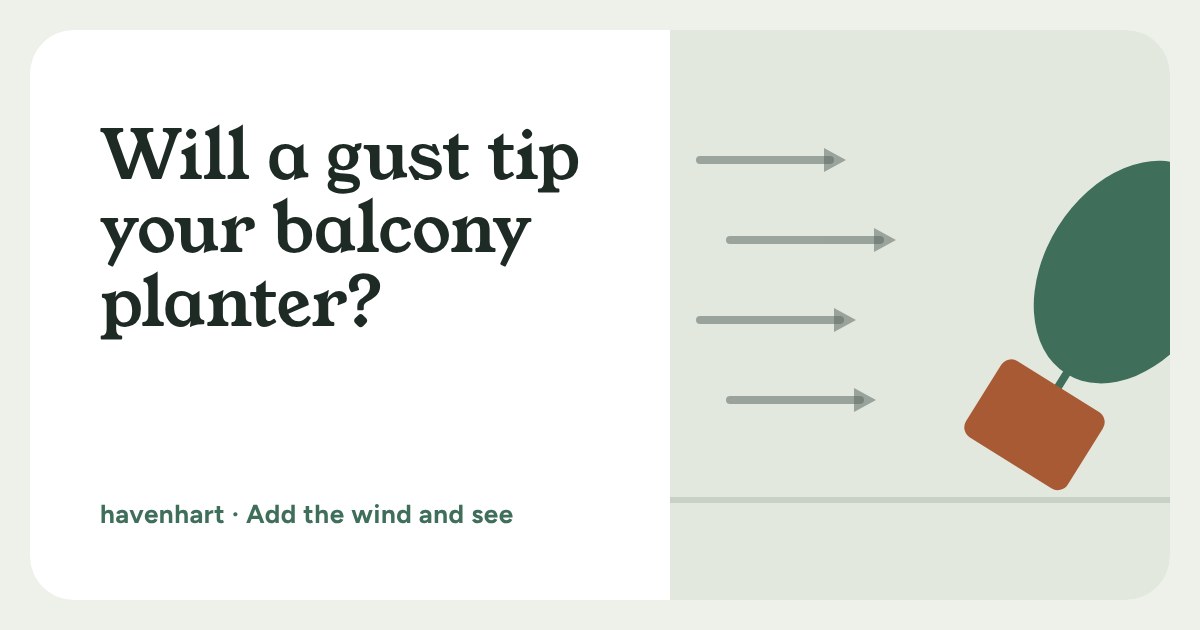
Why do balcony planters topple on a breezy day, long before a storm? A planter is a small seesaw: the wind pushes on the leaves high up, while the weight of the pot holds it down through half its width.
Set up your own pot, plant and weight, then turn up the wind to see the speed at which it goes over, and which changes help most. Includes the wind scale in plain words and low-cost fixes that need no shopping.
Why tall pots go over first
Most balcony planters that fall over do it on a day that is windy but not stormy. The pot looked steady when you set it down, and then a gust leaned on the leaves and over it went. Soil, a ceramic pot or a plastic one can all end up on the floor, and on an upper floor that is also a safety matter for whoever is walking below.
The reason is not mysterious. A planter is a small seesaw: the wind pushes on one side, the weight of the pot pushes back on the other, and whichever wins decides what happens. This guide lets you set up your own planter and turn the wind up until it loses.
A seesaw with a pot on one end
Wind pushes on the whole planter, but mostly on the plant, because leaves and stems are what catch it. That push acts high up, which gives it leverage, like pushing a door at the handle instead of near the hinge. Pushing at the top of the plant tries to roll the pot over its downwind bottom edge.
Holding it down is the weight of the pot, soil, water and plant, working through half the pot's width, because the pot pivots about its bottom edge. So tipping comes down to two comparisons:
- Push: how much plant is in the wind, and how high up it sits.
- Hold: how heavy the planter is, and how wide its base is.
The force of the wind grows with the square of its speed. Twice the wind speed is four times the push, which is why a pot that shrugs off a breeze can go over in a gust that only feels a bit stronger.
What the sliders show
Try the three presets, then change one slider at a time. A few patterns turn up quickly.
Plant size matters most. Spread and height are the push, and the push acts high on the lever. Shrinking a plant's spread, or trimming it before a windy spell, often does more than adding weight.
A wider base beats a taller pot. Widening the pot raises the hold directly. A tall, narrow pot has little leverage and its top catches the wind too.
Weight helps, but with diminishing returns. The tipping speed grows with the square root of the weight, so doubling the weight raises the tipping speed by only about 40%. That is useful, but it is not a cure on its own.
What the numbers feel like
Wind speeds are easier to judge on the Beaufort scale, which describes what the wind does to things around you. These are the bands that matter for pots.
| Wind | Speed | What you notice |
|---|---|---|
| Moderate breeze | 20–28 km/h | Loose paper lifts, small branches move |
| Fresh breeze | 29–38 km/h | Small leafy trees start to sway |
| Strong breeze | 39–49 km/h | Large branches move, umbrellas are hard to use |
| Near gale | 50–61 km/h | Whole trees move, walking into it is hard |
| Gale | 62–74 km/h | Twigs break off trees |
Two things push real balconies beyond the numbers in the table. Wind is usually stronger the higher up you are, and gusts are stronger than the average wind a forecast quotes. So a sensible aim is a planter that tips only well into the gale range, not one that just clears a breeze.
Low-cost ways to keep a planter upright
- Go lower and wider. Swap one tall narrow pot for a wide, shallow one, or plant tall species in the widest pot you have.
- Add weight at the bottom. A layer of stones, bricks or broken terracotta under the soil lowers the centre of gravity. Reusing what you already have works as well as buying anything.
- Group pots together. Pots pushed against each other, and against a wall or corner, shelter one another from the wind.
- Use the sheltered spot. Keep the tall plants against the wall side and the low ones on the exposed side.
- Tie it down. A strap or cord to a hook, rail or wall fixing stops a planter going over, if your building allows it.
- Soften the wind rather than blocking it. A semi-open screen usually slows wind better than a solid one, which tends to make it swirl.
- Lay tall pots down or move them indoors when a storm is forecast.
Measure and weigh before you trust it
To use the model on your own pots, measure the pot's width and height in centimetres, and the plant's height and widest spread. For the weight, stand on bathroom scales holding the pot, then subtract your own weight. Weigh it after watering, because wet soil is the heavy part.
A few safety points go with this. Heavy pots do not belong on a railing or ledge, and a pot that can fall is a hazard to people below, so check the rules for your building about railing planters and how much weight the balcony floor is meant to carry. Treat the tipping speed here as a rough comparison between setups. Real plants bend and shed some wind, gusts vary, and a pot may slide before it tips, so leave yourself a good margin.
Cosy balconies are not about more plants. A few well-anchored pots in the right spots give you the same green corner with less to worry about on a blustery night.