Textiles · Explainer · 3 min ·
Will your curtains shrink in the first wash? Wash them and see
A curtain that touches the floor today can hover a few centimetres above it after the first wash, because the yarn relaxes when it gets wet and warm.
Enter your rod-to-floor height, how far your curtains hang above the floor now and the fabric, then drag the shrink slider to see where the hem ends up. You also get a simple test square to find your own curtain's number, and ways to avoid the surprise.
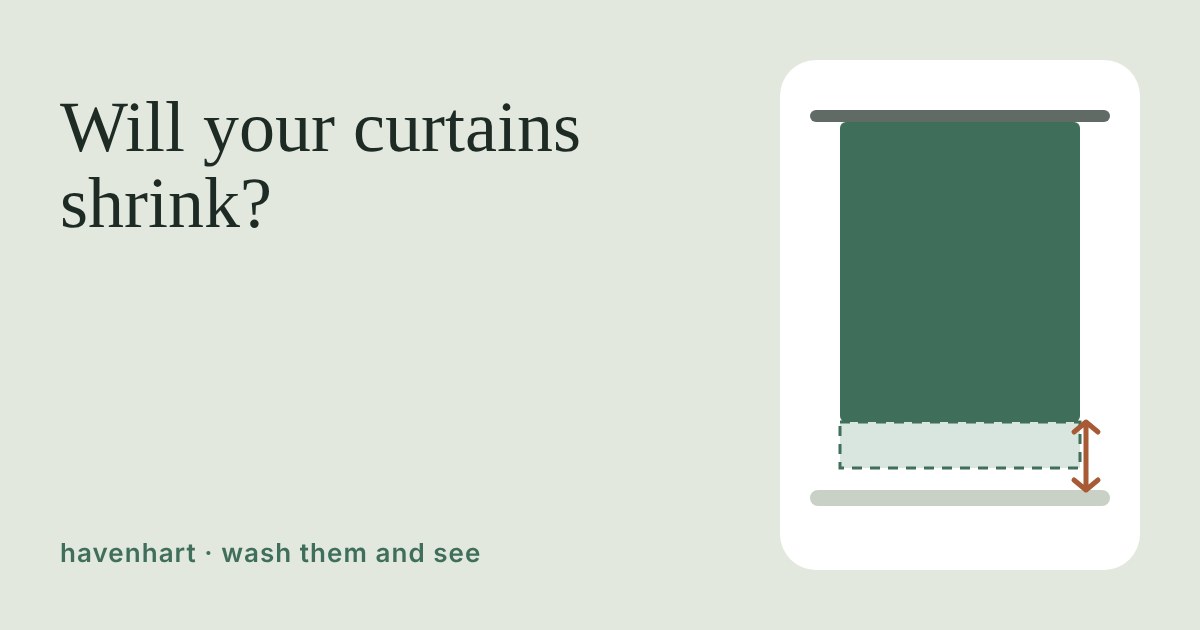
One wash can lift your curtains off the floor
Curtains that touch the floor on Saturday can hover a few centimetres above it after the first wash. Fabric is made of yarn, and yarn that was stretched while the cloth was woven relaxes back when it gets wet and warm. The cloth gets shorter and narrower, and you notice it most at the hem.
How much it shrinks depends on the fibre and the weave. The figures below are commonly quoted ranges, not promises. Two curtains with the same label can behave differently, so treat them as a way to see what is possible.
Roughly how much does each fabric shrink?
| Fabric | Typical first wash | What it means for curtains |
|---|---|---|
| Polyester and other synthetics | Under about 1% | Barely moves |
| Cotton | Around 2–5% | Pre-shrunk, firm weaves sit at the low end |
| Linen | Around 3–10% | Loose, soft weaves shrink the most |
| Viscose / rayon | Around 3–10% | Often shrinks unevenly |
Wool and wool blends are a special case: heat and rubbing can shrink them far more than gentle care does, so follow the care label closely.
Wash them and see
Enter the height from your rod to the floor, how far your curtains hang above the floor now, and pick a fabric. The slider starts at the middle of that fabric's range. Drag it to try a smaller or bigger shrink.
Check your own fabric with a test square
If you have spare fabric, or an inside hem you can sacrifice, a test square gives you your curtain's real number:
- Mark a square of about 20 × 20 cm with a few stitches or a fabric pen. Measure the top-to-bottom and side-to-side distances.
- Wash and dry it the way you will wash the curtains.
- Measure again. Shrink % = (before − after) ÷ before × 100. Length and width often differ, so work out both.
The first wash usually does most of the shrinking, so one test tells you most of what you need. Dry-clean-only or "do not wash" curtains are better left alone. Vacuum them and spot-clean instead.
Measure before you hem or buy
- Measure from the rod, or the top of the track, to the floor at both ends and in the middle. Floors are rarely level, so use the shortest measurement.
- Decide the gap you want at the end, such as a hair above the floor, and measure the final length from that.
- If the curtains will be washed, include the expected shrink in your plan. A 240 cm curtain that shrinks 5% loses about 12 cm.
Ways to avoid the surprise
- Wash gently. Cooler water, a short cycle and drying flat or on the line keep shrinking small.
- Rehang while still slightly damp. The weight of the fabric pulls it back a little, so some of the lost length returns.
- Keep a deep hem. A generous hem lets you drop the length later if the curtain shrinks more than expected.
- Pre-wash fabric before cutting if you are sewing your own, so the shrinking happens before you measure the hem.
- Consider second-hand. Curtains that have been washed for years have usually finished shrinking.
When to break the rule
If a curtain only ever gets vacuumed, shrinkage does not matter. For a synthetic curtain, the number is so small that the test square is not worth the trouble. A curtain that hovers on purpose, for example above a radiator, is fine as long as you chose the gap yourself.