Bedroom · Tool · 5 min ·
Will a bench fit at the foot of your bed? Slide it and see
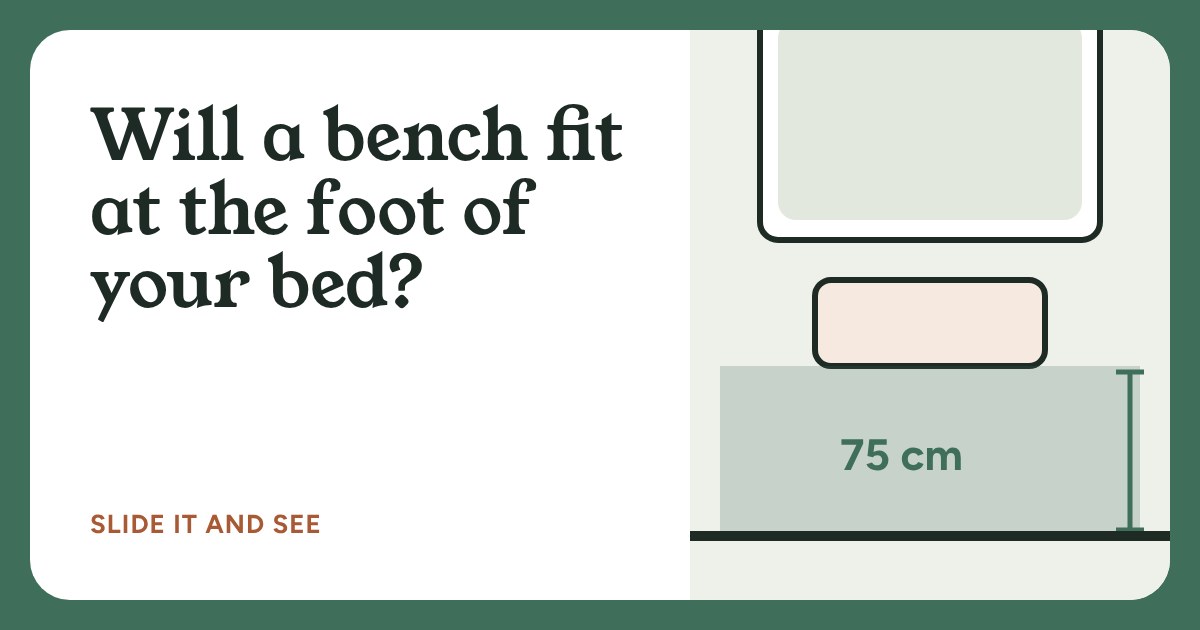
A bench at the foot of the bed is cosy, but it also sits in the stretch of floor you walk across every day. Slide a bench towards the wall in a top-down plan and watch the walkway shrink, with your own room, bed width and bench size.
You will see the usual comfort range for walking space, why a bench slightly shorter than the bed looks tucked in, and when it is fine to break the rule. Plus a cheap tape test, so you can check the plan before you buy anything.
A bench takes floor as well as space
A bench at the foot of the bed is a lovely idea: somewhere to sit and put your socks on, a landing spot for a folded throw, a tidy place for tomorrow's clothes. It also sits in the one stretch of floor you walk across every day. A bench 40 cm deep does not just use 40 cm. It shortens the path between the bed and whatever is on the far side, whether that is a wall, a wardrobe or the door.
In a big bedroom that costs nothing. In a small one it can turn an easy walk into a sideways shuffle. This guide lets you try it with your own numbers before you buy, or before you drag the old chest from the hallway.
Slide the bench and see
Below is a top-down view of the foot of a bed, with a bench in front of it and a wall at the bottom. Set the distance from the foot of the bed to that wall (or to a wardrobe, a radiator, a door swing, anything you walk up to). Then pick your bed width and the size of the bench. Drag the bench towards the wall, or use the arrow keys when it is focused, or the gap slider. The green band is the walkway that is left, and it turns terracotta when it gets tight.
The rule of thumb behind the numbers
Two sets of numbers matter: how big the bench is, and how much room you need to walk past it.
For the bench itself, a seat about 45 to 50 cm high (18 to 20 inches) lines up with most mattress heights, and a depth of about 35 to 45 cm is typical. Style guides suggest a length slightly shorter than the width of the bed, so it looks tucked in rather than crowding. Longer than the bed and it pokes into the walkways on each side.
For walking space, interior guides generally put the clear gap at the foot of a bed at somewhere between about 60 and 90 cm, depending on the size of the bed. One designer guide asks for about 60 to 90 cm between a bed and a bench or chair in the room. A single bed's foot can get away with less, and you only need to squeeze past occasionally, but a narrow gap you use daily wears on you. The planner calls 75 cm or more comfortable, 60 to 75 cm workable, and under 60 cm too tight, which is a rough comfort scale, not a law.
When to break the rule
If nobody ever walks across the foot of the bed, say because the wall is blank and the door is on the other side, a tight gap is fine. If the wardrobe doors or drawers open onto that stretch, give them priority over the bench. A drawer that cannot open is worse than no bench at all.
A bench does not have to sit against the bed. Pulling it a hand's width away makes it easier to sit and gives your shins room, but that hand's width comes straight out of the walkway. A shallower bench, or a narrow stool or ottoman, keeps most of the idea in half the floor. You can also skip the bench: a folded throw on the bed, a hook on the back of the door, or a chair in a corner does much of the same job at no cost.
Second-hand is a good way to try this. A small wooden bench, a blanket box or a sturdy trunk from a charity shop can all do the job, and if the plan does not work, you have not spent much.
How to measure before you buy
Measure from the foot of the mattress to the nearest thing in front of it: the wall, the wardrobe, the radiator or the swing of the door. Note the bed width too. Then check the bench's true depth and length, including legs that splay out, as these are often wider than the seat.
Try it with tape. Lay painter's tape on the floor in a rectangle the size of the bench, with the gap you plan, and walk past it a few times with a laundry basket. If you catch your hip, the answer is a shallower bench. Check the doorway and stairs too, if a bench has to travel through them.
If the bench has storage inside, remember the lid needs to lift, so check what is above it, such as a window sill or shelf. Do not stack heavy things on a bench that is meant to be sat on, and keep candles and heaters well away from any throws and textiles on it.