Textiles · Explainer · 4 min ·
Do sheer curtains give privacy? Switch day and night and see
A sheer curtain feels private in the afternoon and see-through once the lamps go on. The fabric hasn't changed: what matters is which side of the glass is brighter.
Slide from midday to night, change the lights inside and switch between a bare window, a sheer and sheer plus drapes, and watch what the street sees and what you see. Then learn what makes a sheer hide more, cheap ways to get evening privacy with what you own, and how to measure before you buy.
The curtain that works by day and fails at night
A sheer curtain feels like a privacy bargain. In the afternoon you can sit in your living room and nobody on the pavement can see you. Then it gets dark, you switch on a lamp, and the same curtain seems to have turned into a window display.
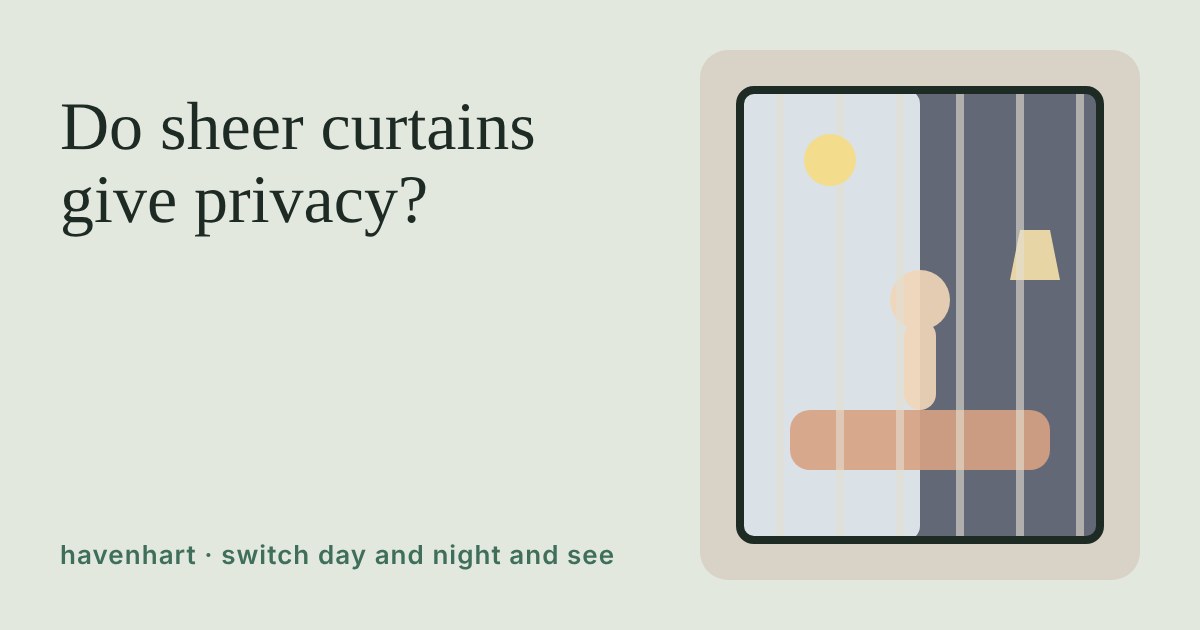
The fabric did not change. What changed is which side is brighter. A sheer lets light through in both directions and also bounces a little off its surface. Whichever side has more light wins: you see clearly toward the dim side, and the bright side sees mostly a glowing, reflective cloth. Try it below. Slide from midday to night, change the lighting inside, and switch the window treatment.
What the sliders show
At midday with one lamp on, the street sees a pale, bright curtain and almost nothing behind it, while you still see the street clearly through the weave. At night the picture flips. The lamp lights the room, the street is dark, and your furniture and your outline show through the sheer. From your sofa the glass and cloth now reflect the room back at you, so the view outside looks washed out.
That is why privacy advice for sheers is always about the evening. Sheers are good at softening harsh sun, hiding a view of clutter by day and making a room feel airy. They are not designed to hide you once the lights are on and it is dark outside.
What decides how much a sheer hides
Three things change the result, and none of them needs a big spend.
- Fullness. A sheer hung flat shows everything. Gathered into folds, the cloth overlaps itself and blocks more of the view. A common rule of thumb is a panel about 1.5 to 2 times as wide as the rail, so the folds stay generous even when the curtain is closed.
- Weave and colour. A tighter, slightly textured weave hides more than a very open voile, and a warm white or soft oatmeal hides a little more than pure white. Hold a sample up to a lamp at home: if you can read the shape of your hand clearly through it, so can the street.
- Distance and height. Ground-floor rooms near the pavement need more help than a room several floors up, where nobody is looking at eye level.
Cheap ways to get night-time privacy
You rarely need to replace a sheer. Most people simply add a second layer for the evening.
- Close the curtains or drapes you already own over the sheer once the lights go on.
- Hang a second rail, or a double rail, behind or in front of the sheer so you can use both layers independently. Check your wall type and weight limit first, and ask a landlord before drilling if you rent.
- Use a lined or thicker curtain only on the windows people can actually see into, such as the one facing the street.
- Move the brightest light away from the window and use lower, warmer lamps. The less light you throw at the glass, the less the street sees.
- Look second-hand for a pair of plain curtains before buying new; for a privacy layer, a plain colour is all you need.
Measure before you buy
If you do decide to add or change a curtain, measure first. Measure the window frame width from outside edge to outside edge, then decide how wide the rail will be: curtains normally extend 10 to 15 cm past the frame on each side, which also lets the open curtain clear the glass. Measure the drop from where the rail will sit to the floor, or to the sill if you prefer a shorter curtain. Then check the wall space above the window for brackets and, if you want a second layer, how far the rail needs to stand out from the wall so the two layers do not squash each other.
When to break the rule
If your window faces a hedge, a courtyard or only sky, a sheer on its own may be all the privacy you need, and keeping it light means more daylight for the room. If you love a lit-up window in the evening and do not mind being seen, leave it. The point is not that you must cover up, but that you can choose which side of the glass is brighter, and what you want the street to see.