Textiles · Explainer · 4 min ·
Will your door clear the rug? Slide the pile height and see
Why does a door drag over a new rug? Usually it comes down to one measurement most people skip: the gap under the door, set against how thick the rug really is once you add the backing and any pad.
Set your gap, pick a flat-weave, low, medium or shag rug and watch whether the door clears. You'll see how to measure both numbers, what to try if it catches, and why thick rugs belong away from the door's swing.
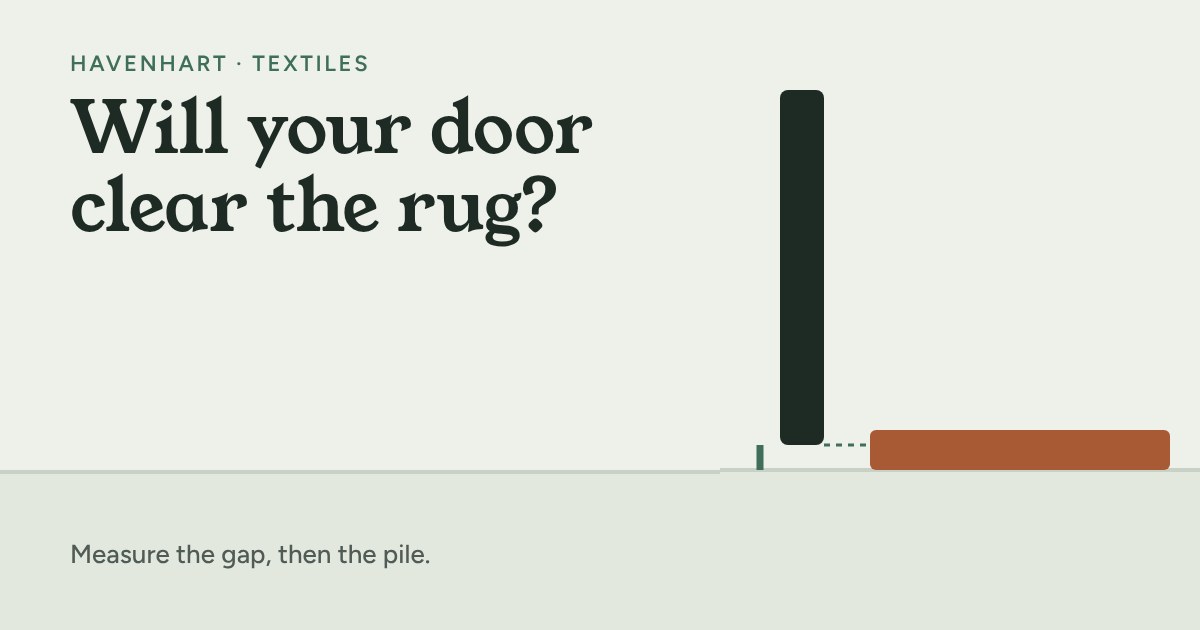
You find a rug you love, lay it by the bedroom door, and the door drags across it every time you open it. Or it squeaks, or it flips the rug's edge up. The rug was the right size and the right colour. What went wrong is a measurement most people never take: the gap under the door.
Two numbers decide it
A door doesn't touch the floor. Most interior doors are hung with a small gap beneath them so they can swing freely and air can move. That gap is usually somewhere around 5 to 15 mm, but it varies from home to home, and in older or sagging doors it can be much less on the handle side than on the hinge side. A rug only needs to be thinner than that gap, plus a little to spare, to pass under the door.
The other number is how thick the rug really is. "Pile height" is the length of the tufts or loops, but you also have to add the backing, any rug pad underneath, and the fact that a deep pile springs back up and doesn't lie flat. As a rough guide, flat-weaves and low piles are only a few millimetres thick, medium piles are around 6 to 13 mm, and shaggy high piles run beyond that. Makers draw the lines a little differently, so treat these as ballparks and read the product page.
How to measure it
With the door closed, slide a ruler or a folded stack of coins under it and read the gap. Do it in two places: near the hinges and near the handle. Use the smaller number. Then measure the rug itself: lay a ruler flat on the floor beside the rug's edge and read the thickness at the edge, not at the middle, because that is the part the door meets. If you're buying online, look for the pile height in the specification, add the pad thickness if you use one, and remember the backing adds a little more.
What you can do if it doesn't clear
You usually have more options than buying a new rug. The cheapest is a layout change: a rug only has to clear the door where the door sweeps. Slide it so its edge stops short of the arc of the door, or choose a size that sits a hand's width inside the swing. A thinner rug or a pad-free, grippy low-profile underlay can also win you a few millimetres.
If you own the home, a joiner can trim the bottom of the door or re-hang it, which is a quick job. If you rent, ask first and don't cut anything yourself. Either way, leave the door's gap alone for ventilation in rooms with fans or extractors, where air needs a path.
When thick is worth it
None of this means thin rugs are better. A deep pile is softer underfoot and feels cosy by a bed or sofa, where doors don't go. The point is to put the thick rug where nothing swings over it, and the flat one by the door. A runner in a hallway or an entry mat by the front door is usually the right place for low pile; a plush rug belongs by the sofa.
It's also fine to keep what you have. If a rug already catches, moving it a hand's width costs nothing and can be all it takes. Measure first, and let the gap under your own door decide how thick a rug you can bring home.