Plants & Balcony · Tool · 5 min ·
Will your plants fit on the windowsill? Line them up and see
Plants on a windowsill rarely fit the way they look in your head: the saucer is wider than the pot, leaves need a little air, and the window handle still has to move. Measure the sill by eye and a pot ends up hanging over the edge.
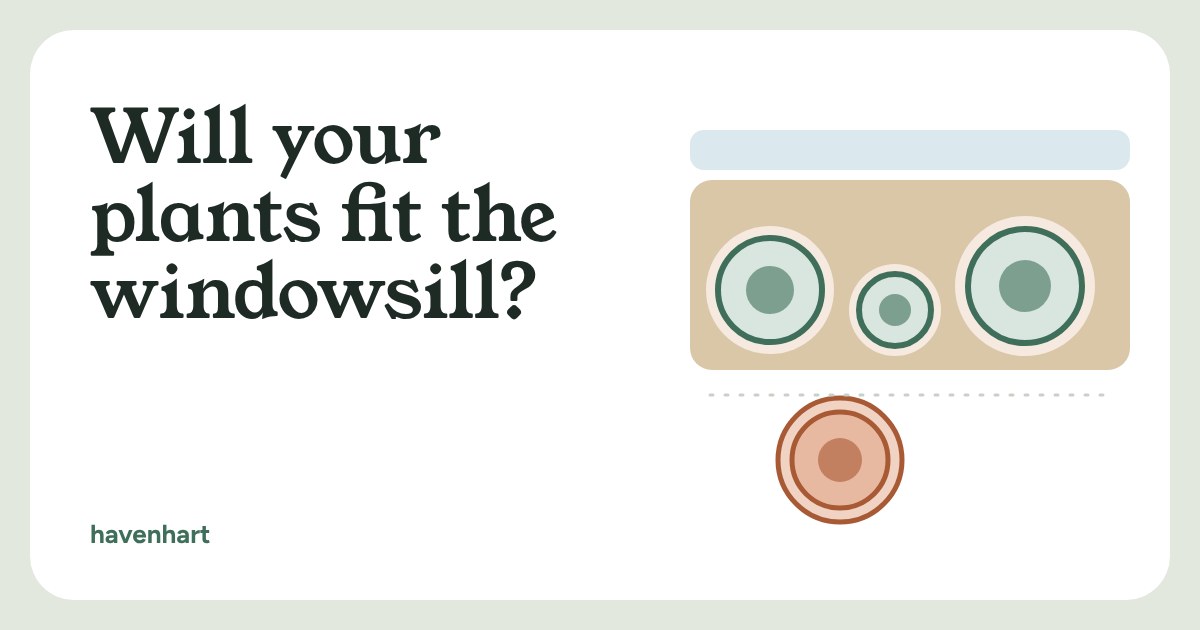
Set your own sill length and depth, add small, medium and large pots, and drag them into order to see what fits and what does not. You get the saucer rule of thumb, when to break it (radiators, tilt windows, curtains), free fixes first, and what to measure before you buy a shelf or stand.
Why do plants on a windowsill keep tipping off or crowding each other?
A windowsill looks like a simple shelf: put the plants on it. Then the saucer hangs over the front edge, two pots push each other's leaves flat, and the window handle can no longer move. The reason is that you measured the plants by eye and the sill by habit, and neither tells you the one number that matters: how much of the sill's depth and length each pot really takes up.
This guide gives you that number. Put in your own sill, add pots, drag them into the order you like, and see what fits before you buy a single new pot.
Try it: line the pots up on your sill
The rule of thumb behind it
Each pot takes up its widest part, which is usually the saucer, not the pot. A pot that is 12 cm across at the rim often sits in a saucer a couple of centimetres wider. So the footprint of one pot is its saucer diameter, and the length a row needs is the sum of those footprints plus a small gap between each pair.
For depth, the useful starting point is that the widest saucer should sit fully on the sill with a little to spare. Aim for a centimetre or two of sill showing in front of it. That margin is what stops a bump from your sleeve turning into a fall. The planner shows the spare depth behind the widest pot, and it turns terracotta if a saucer hangs over the front edge.
The gap matters for the plant, too. Leaves that press against each other or against the glass stay damp and get crushed. A few centimetres between pots gives air and room to grow. It is a starting point, not a law. Tall plants with narrow leaves can sit closer, and a big-leaved plant may want more.
When to break the rule
Real sills are messier than the picture. Here is what to adjust for.
- Window handles and tilt windows. Leave the swing of the handle and the opening sash clear. A pot that blocks the window gets knocked every time you ventilate.
- Radiators under the sill. Warm, dry air rises past the glass in winter, and the glass itself can be cold at night. If a radiator sits right below, give plants a bit of distance from both, and check the soil more often because it dries faster.
- Curtains and blinds. Pull them closed in your head: do they squash the leaves or knock pots? If so, leave a gap at the side the curtain moves.
- Weight. A watered ceramic pot is heavy. Keep the heavy ones near the middle of a firm sill and the light ones at the ends.
- Outside ledges. The guide is for inside sills only. Never put pots on an outer ledge of an opening window, where one could fall on someone below.
Free fixes if the pots will not fit
Before buying anything, try the cheap options first.
- Swap one large pot for two smaller plants at different heights, or the other way round.
- Drop the saucers for a single shallow tray under a few pots. It saves several centimetres of length and catches drips in one place.
- Move the thirstiest or tallest plant to a nearby table, shelf or the floor in the same light, and keep the sill for small plants.
- Rotate which plants live on the sill with the seasons. Many plants like the winter light but not the summer glare.
- Look for a second-hand narrow shelf or plant stand before buying new. A used one does the same job for much less.
What to measure before you buy
If the sill is too small and you decide to add a stand, shelf or narrower pots, measure first. Use a tape measure and write the numbers down.
- Sill length from side to side, at the narrowest point if the wall is uneven.
- Sill depth from the glass or window frame to the front edge, not the whole board if part of it sits under the frame.
- Clearance above: the height from the sill to the window handle, curtain rail or blind box, so a tall plant has somewhere to go.
- Each pot's widest point, measured with its saucer, not the number on the label.
What to buy, if anything
Maybe nothing. Many sills are already enough once the pots are arranged and the saucers are swapped for a tray. If you do buy, a narrow tray or a slim, wall-fixed shelf that matches the numbers above is a better choice than another large pot. Check with the measurements first.
For a shelf or plant stand fixed to a wall, the fixings depend on your wall and the weight. Ask a professional if you are unsure, and keep anything tall and heavy well anchored.