Dining & Kitchen · Explainer · 4 min ·
Will the table legs get in the way? Seat everyone and see
Two tables of the same length can seat different numbers of people, because the legs, frame or base sit under the edge where knees want to go. Corner legs take little space, legs set in from the corners take more, and a trestle can swallow the end seats.
Pick a base, set your table length and the space each person needs, and watch seats appear or vanish. You get the rule of thumb behind it, what to measure before you buy a table, and free fixes if your legs already get in the way.
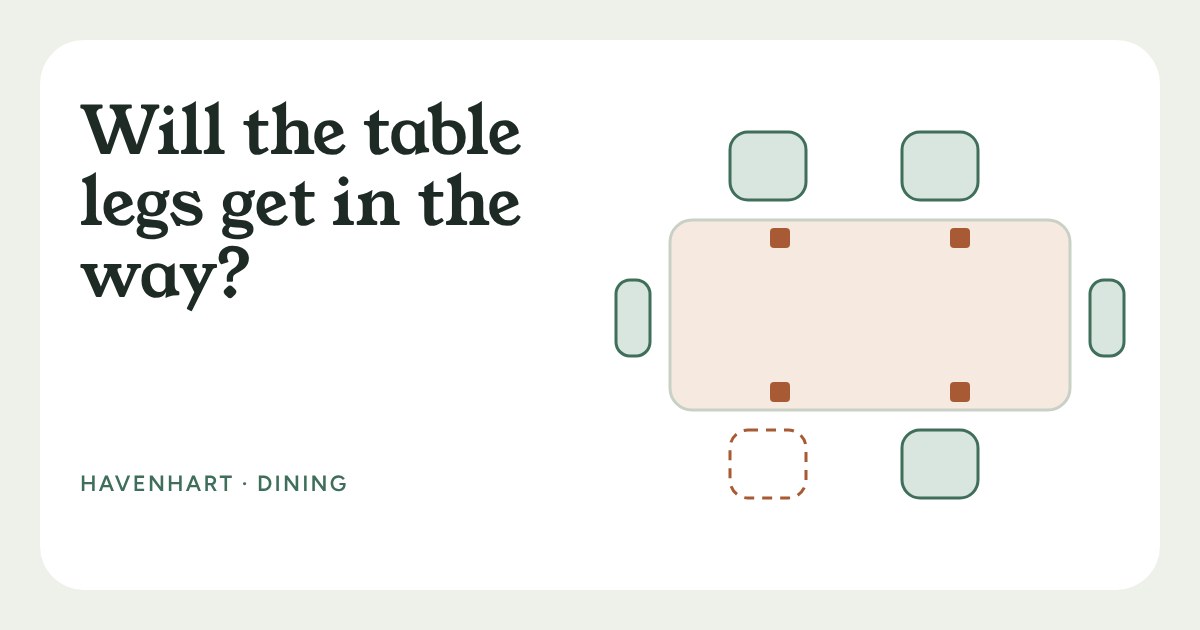
The legs decide who gets a seat
Most guides say a diner needs about 60 cm of table edge, so a 180 cm table seats three along each side. That sum assumes the whole edge is free. It never is: the legs, the frame or the base sit somewhere under that edge, and a person can't tuck their knees around a leg.
That is why two tables of the same length can seat different numbers. Furniture shops' own guides describe the pattern in similar terms: legs at the very corners take only a few centimetres of the edge, legs set in from the corners take more, a trestle frame can swallow the seats at each end, and a pedestal frees the edges but still needs room for feet. The planner below lets you try each base on a table the size of yours.
What the planner shows
On a 180 cm table with legs at the corners, three people fit along each side and one at each end: eight in all. Move the legs 25 cm in and a corner seat can no longer tuck its knees in, so each long side drops to two comfortable seats unless the people shuffle along. Switch to a trestle and the end seats go as well. A pair of pedestals can look the tidiest of all and still leave a dead zone by each base.
Two things matter more than the table's length: how far each leg sits from the corner and how wide the base is. A retailer's tip is to be wary of any corner leg set in much more than 10 cm, and to look at the spacing between pedestals as well as the table's length. Those numbers vary by maker, so treat them as a starting point and use your own measurements.
Measure before you buy
A listing's "seats six" is a guess about legs you can't see. Before you buy, or before you choose where to put a table you already have, measure these:
- From the corner to the inside of the nearest leg, at both ends. Under about 10 cm is easy to live with.
- The width of the base or frame where it meets the floor, not just where it meets the top. Feet can stick out further than the top suggests.
- The width of your chairs. A slim chair can squeeze into less than 60 cm; a broad armchair needs more.
- How much room you have around it. A common guide is about 90 cm between the table edge and a wall or other furniture where people pull chairs out and pass behind them.
If you can, sit at a table in a shop or a friend's home and notice where your knees go. Pictures hide this.
Free fixes before you spend
If your table already has awkward legs, you don't need a new one. Turn it ninety degrees so the clear edge faces the people who stay longest. Put a stool or slim chair on the side with a leg, and give the best-placed seats to guests who sit for hours. Use the end of the table for an extra person: it is often the roomiest seat. A second-hand table is fine too; just measure the legs first, using the list above.
When to break the rules
The knee zone in the planner is deliberately cautious. Children, slim stools and people who sit side-on can all share a leg's patch of edge. A bench has no arms, so it can overlap a leg in a way chairs can't. And for a table used by two people most days, leg position hardly matters: what matters is the clear edge where you actually sit. Plan for the busiest evening you really have, not for the one you imagine in a catalogue.