Small Spaces · Tool · 4 min ·
Does your sofa bed leave room to sleep? Unfold it and see
A sofa bed looks like a neat box against the wall, but the bed half can reach well over a metre into the room. This planner lets you drop in your room's measurements and the maker's closed and open sizes, drag the sofa along its wall and slide the bed open to see how much floor is left at the foot and beside it.
You get a plain verdict (comfortable, tight or doesn't work), the rule of thumb behind it, and when it's fine to bend it. Plus cheaper ways to find the space first: rearranging, moving small furniture, and second-hand.
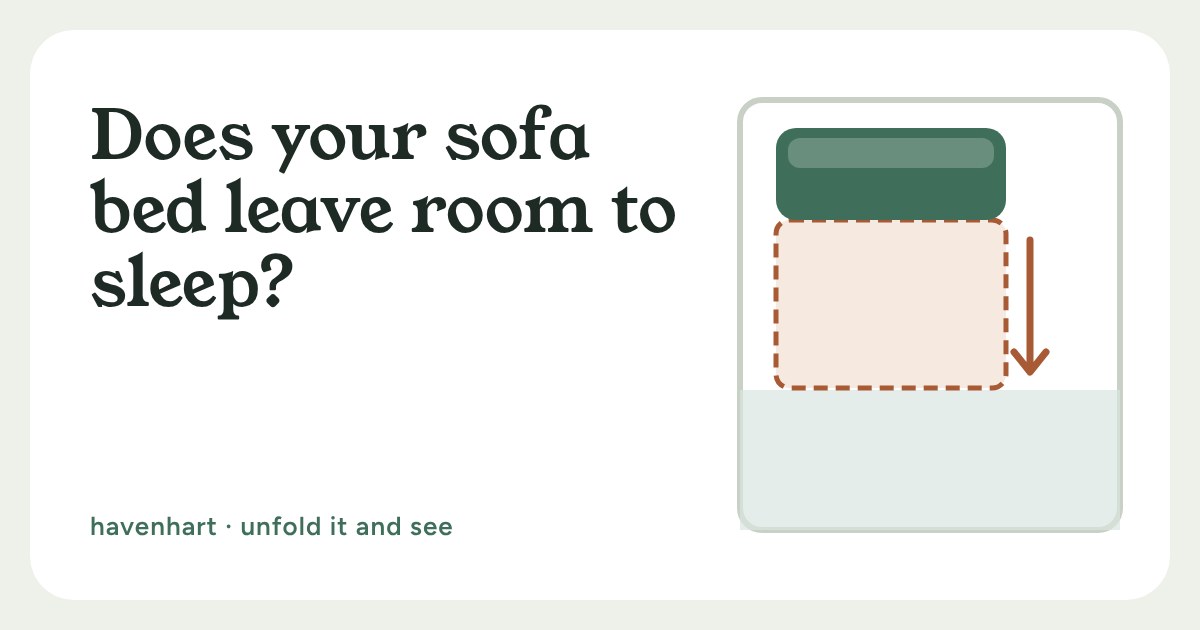
A sofa bed is a clever trade: one piece of furniture, two jobs. The catch is that it only works if the bed half has room to exist. In a photo, the sofa is a neat box against the wall. At night, it can reach more than a metre and a half into the room. Plenty of people only find that out once it is delivered.
The footprint changes, not just the size
Most sofa beds fall into two families. A click-clack (or "bi-fold") sofa has a backrest that drops flat and a seat that stays put, so the bed sits roughly where the sofa already was and needs little extra floor. A pull-out or fold-out sofa hides a mattress frame inside the seat, and that frame unfolds or slides forward into the room. That is the type that surprises people.
Product pages list this as the "bed" or "open" depth. Typical figures sit somewhere around 150–200 cm for pull-out types, on top of a closed sofa depth of roughly 90–110 cm. Makers differ, so treat those as a starting point and always use the numbers from the page you are looking at.
Try it in your own room
Enter your room's inside measurements in centimetres, the sofa's closed size, and how far the bed reaches forward. Drag the sofa along its wall, then slide the bed open.
The rule of thumb behind the result
The sum is simple: closed sofa depth + how far the bed reaches + clear floor at the foot must fit in the room's depth. For the sides, you need room to climb in and out. A common planning figure is at least 60 cm along the side you get in from, and around 75 cm feels comfortable rather than merely adequate. Below about 50 cm on a side someone uses every night, it quickly gets awkward.
The planner checks exactly that: how much floor is left beyond the foot of the open bed, and the wider gap beside the sofa. The answer is the weaker of the two.
When to break the rule
If the bed is for the occasional guest, a tighter fit is fine. Most guests will happily shuffle past a coffee table that has been pushed aside for the night. The numbers matter more if you sleep on it yourself, because then you will fight that squeeze every day.
Also remember what the plan cannot see: radiators, door swings, skirting boards, a low window sill, or a rug the frame can snag on. Mark those on the floor before you decide, and remember the bed needs to clear them while open, not just closed.
Cheaper ways to find the space
- Rearrange first. Turning the sofa to sit along the longer wall often gives a deeper clear strip than you expect. Try it before you buy anything.
- Move the small stuff. A light coffee table or pouffe that slides away costs nothing and gives the bed its runway.
- Consider second-hand. Sofa beds are bulky, so they turn up often on local marketplaces. Measure the doorway and stairs on the way in as well, since they are a bigger obstacle than the room.
- Think about a different bed. If the unfolded depth is the problem, a click-clack type, a daybed or a floor mattress stored in a cupboard may suit the room better.
What to measure before you buy
Measure the room's inside width and depth at floor level, from skirting to skirting. Measure the doorway, hall and any stairs the sofa must pass through, and compare them with the packed size. Then take the maker's closed depth and bed depth, and enter them above. Write the numbers down once, so you are not guessing in the shop.
What to look for
- Open depth, not just closed size. It tells you the real footprint at night.
- How the bed opens. A bed that slides out needs a clear runway, while one that drops flat needs very little.
- The mattress, if you will sleep on it often. A thin mattress is fine for guests; a regular sleeper deserves a thicker, more supportive one.
- Whether it lifts open easily. Try it in a shop if you can, because a stiff mechanism gets ignored fast.