Colour & Walls · Explainer · 4 min ·
Should the ceiling match the walls? Swap the colours and see
Should the ceiling be white, or match the walls? Move between bright white, same-as-walls and a lighter tint in a small room and watch two things change: how much light the surfaces bounce back, and how sharp the line at the top of the walls looks.
The guide explains what a paint's light reflectance value (LRV) means for a ceiling, why matching softens corners and feels cosy, which finish suits ceilings and trim, and when a plain white ceiling is still the better call. Includes how to test a sample overhead before you buy.
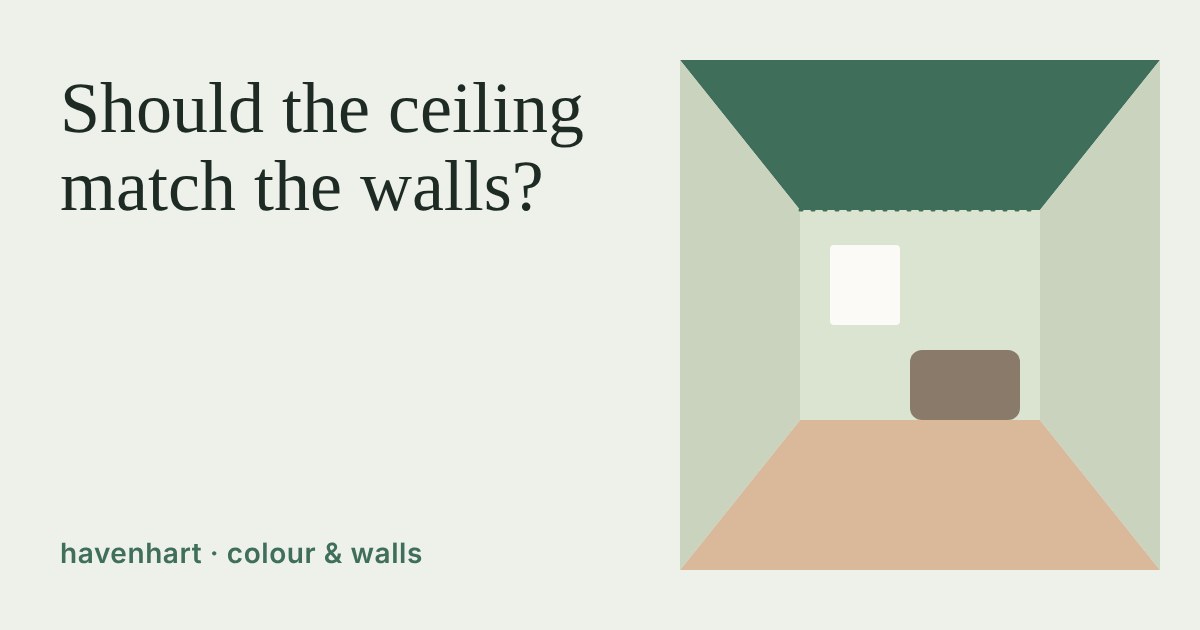
Most of us paint the ceiling white without thinking about it. It is the default, the tin is cheap, and nobody asks the ceiling what it wants. But the ceiling is the biggest single surface in the room that nothing is leaning against, and the colour you pick for it changes how bright the room is, how sharp its corners look and how snug it feels.
This guide is about one question: should the ceiling match the walls? Try it in the room below, then read why it behaves the way it does.
What the ceiling does with light
Every paint has a light reflectance value, or LRV, a number from 0 (absorbs everything) to 100 (reflects everything). Real paints sit in between: a bright white ceiling paint is usually in the high 80s, a mid-tone around 30 to 50, and a deep colour under 15.
A room is lit by light that bounces from surface to surface, and the ceiling is a big part of that bounce. Lighting designers describe a room by the average reflectance of all its surfaces, weighted by area. That is the first number in the figure above. A deep green ceiling over deep green walls pulls it down a lot, because the walls and ceiling together make up most of the room.
The practical effect is gentle. The room does not go dark. It just needs a bit more lamp light to feel as bright in the evening, which is why dark, enveloping rooms are usually paired with several low, warm lamps rather than one bright ceiling light.
What matching does to the corners
A white ceiling over coloured walls draws a clean line around the top of the room. Match the ceiling to the walls and that line fades. Designers often describe fully matched rooms as feeling like a snug cocoon, because the eye has no edge to stop at. Others point out that a contrasting ceiling pulls the eye upward, which can suit a low room that needs to feel taller. Neither is wrong; they are two different moods.
Try it with the second pair of buttons: pick Same as walls and watch the contrast number drop to zero, then try Lighter tint for a middle path. A tint of the wall colour keeps the cosy wrap but lets some extra light bounce back down.
Finish matters more than colour
Whatever you choose, ceilings are usually painted matt, because a flat finish hides roller marks and small bumps. If you carry the colour over doors, skirting and frames, many designers suggest a slightly shinier finish such as eggshell or satin on the woodwork, since it copes better with knocks and gives the colour a little depth. Painting the trim the same colour also means less fiddly cutting-in at the ceiling edge, which is kind to anyone doing it themselves.
When to break the idea
- A very small, dark room that already struggles for daylight may feel better with a light tint overhead.
- A rental usually needs the ceiling returned to white. Check your lease before you pick up a roller.
- Stained or uneven ceilings are easier to hide in a matt mid-tone than in bright white, which shows every flaw under a lamp.
- Very high ceilings can take a deep colour without feeling heavy; very low ones need more care.
Before you commit
Measure the ceiling height with a tape from floor to ceiling in a couple of places, since old rooms are rarely even, and estimate the paint from the wall and ceiling areas together. Then paint a large sample, at least an A3 sheet, and tape it to the ceiling as well as the wall. The same paint looks different overhead, in daylight and under lamps, so look at it morning and night before you buy a full tin. No new furniture or decor is needed: it is one tin of paint and an afternoon.