Small Spaces · Tool · 5 min ·
How much rail do your clothes need? Hang them and see
A wardrobe usually runs out of rail length long before it runs out of space. Every garment on a hanger needs a few centimetres of rail, and a rail only has so many.
Enter your wardrobe's inside size, how many shirts, coats, dresses and trousers you hang, and how much rail one garment takes. The planner draws the rail filling up and tells you what fits, how much is spare, and how much room short clothes give back when you hang them two-deep. It also shows what to measure first and how to get more rail without buying a bigger wardrobe.
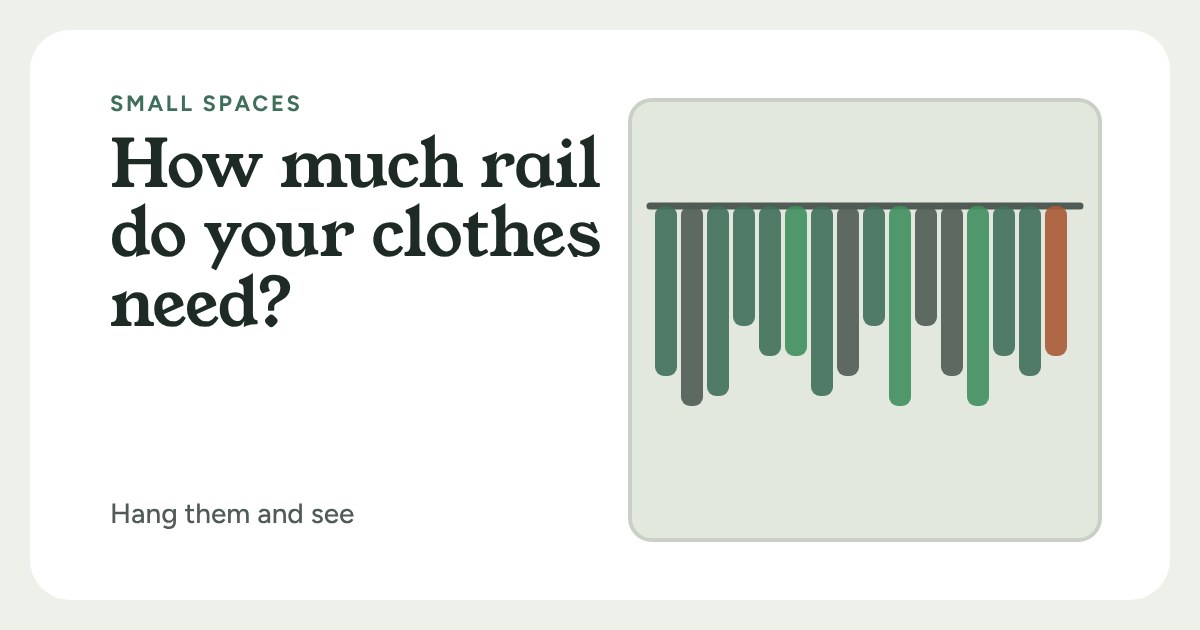
A wardrobe can look huge and still run out of room the moment you hang the winter coats. That is because the thing that runs out is not volume, it is rail length: every garment on a hanger needs a few centimetres of rail to itself, and a rail only has so many centimetres. Count the clothes you actually hang, and you can tell in a minute whether they will fit, before you buy a new wardrobe or give up and start piling things on a chair.
Hang your clothes and see
Put in the inside size of your wardrobe, how many of each kind of garment you hang, and how much rail space one garment takes. The drawing shows the rail filling up. Turn on double hanging to see how much room short clothes give back.
How the planner works
The sum is simple: garments × rail space per garment = rail length. A thin shirt on a slim hanger takes only a few centimetres, a padded winter coat takes much more, so the slider is yours to set. The best way to find your number is to bunch ten of your own clothes on the rail, measure the stretch they take up, and divide by ten.
The "drop" is how far a garment hangs below the rail. Common planning guides give a rough idea: shirts and blouses around 80 cm, trousers on hangers around 60 to 70 cm, jackets and coats around 100 cm, short dresses around 120 cm, and very long dresses or coats up to about 190 cm. Treat those as starting points and measure your longest items from hanger hook to hem.
Double hanging works like this: two rails, one above the other, with the lower one hung just below the hem of the upper clothes. It only works for garments whose drop is less than about half the usable height, which in the planner means the height minus about 10 cm for the rail and hanger hook. In a 200 cm wardrobe that is shirts, blouses, trousers and folded-over items, not coats or dresses. Used well, it can take about half the width the short clothes would otherwise need.
Measure before you decide anything
Measure the inside of the wardrobe, not the outside: side panels and doors take a few centimetres you cannot hang anything in. Then measure three more things.
- Inside width between the side panels, at rail height. Check that the rail itself is not shorter than that, since some have a post or a bracket in the middle.
- Height from the floor to the underside of the top shelf or ceiling, and note where the rail sits. A rail set very high wastes the space below it, and a rail set very low means long clothes meet the floor.
- Depth. Hangers sit sideways, so the clear depth must be wider than your widest hanger plus a little room for sleeves. Many wardrobes are around 55 to 60 cm deep; shallower ones need hangers that turn to face the doors, which is why shallow cupboards often hold fewer clothes than their width suggests.
If the wardrobe is tall and freestanding, fix it to the wall with the anchor that suits your wall. Tall furniture can tip when the doors are open and the rail is heavy on one side. In a rental, ask your landlord what is allowed.
Getting more rail without buying more wardrobe
Cosy does not mean owning more, and a crowded rail is often a sign of clothes you no longer wear. Before you spend anything, try these in order.
- Fold what folds. Knitwear and t-shirts hang badly and take rail space away from clothes that really need it. As a rough guide, about ten folded t-shirts need around 25 cm of shelf, and ten folded sweaters about 30 cm.
- Rotate by season. Moving heavy winter coats out in summer, and light summer dresses out in winter, can cut the rail you need by a fifth or more.
- Use matching slim hangers. They make each garment take less width and stop clothes sliding off the rail. Mixing bulky and thin hangers wastes space.
- Add a second rail. Some hang from the existing rail and need no drilling, which suits renters. Check the weight limit, and remember it only helps if the clothes above and below are short enough.
- Look second-hand. A used wardrobe or a freestanding rail is often cheaper and just as good. Measure the room and the doorway first, so it can actually get in.
When to break the rule
If you wear the same fifteen things all week, you do not need rail for fifty. Plan for what you use, and keep the rest somewhere less precious. If your clothes are mostly bulky knitwear and coats, set the slider higher than the starting 4 cm; if they are mostly thin shirts, go lower. And if the planner says it just about fits, trust the slack: a rail with no gaps makes clothes crumple and makes getting dressed harder, which is the opposite of cosy.