Small Spaces · Tool · 4 min ·
How much fits under your bed? Set the clearance and see
The space under your bed is often the biggest spare storage in a small home, but whether it works depends on three measurements: the gap under the frame, the floor beside the bed, and your box height.
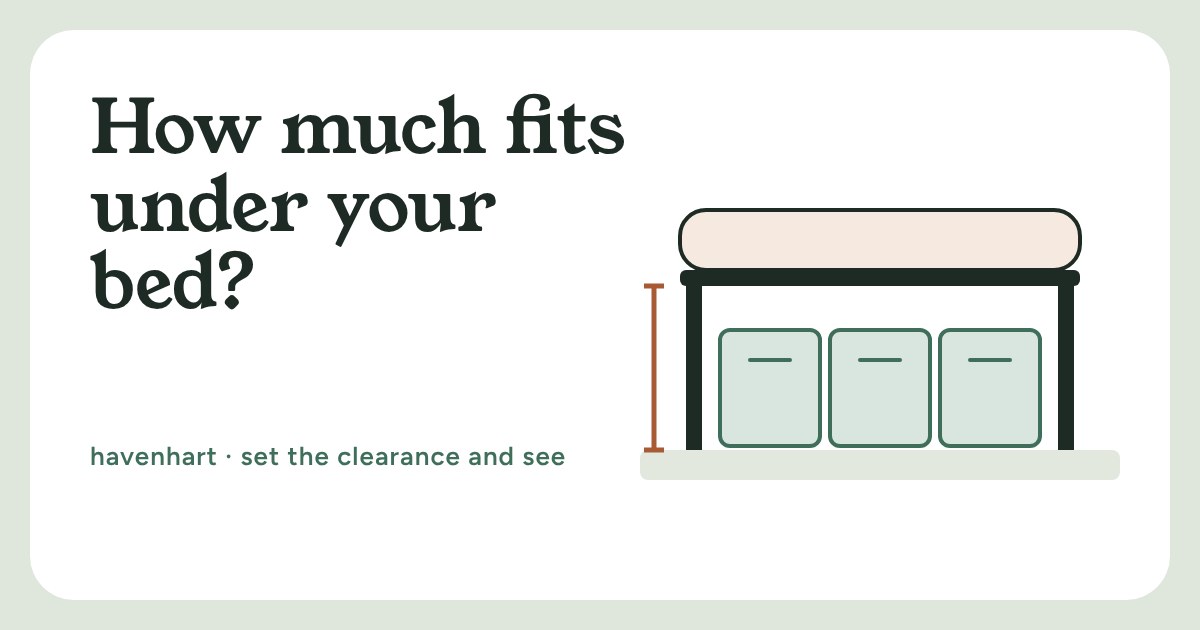
Set your bed size and clearance in the planner and see how many boxes slide in, with a rough litre count. Plus how to keep the mattress breathing, and when to leave a low bed alone.
The floor under your bed is already a wardrobe
A bed takes up the biggest patch of floor in a bedroom, and in a small flat the space under it is often the only spare storage you have. Whether it works comes down to three numbers: how high the frame sits off the floor, how much floor you have beside the bed to pull things out, and how tall your boxes are. You can measure all three in two minutes, with no shopping first.
The planner below does the sums. Set your own bed and clearance and pick a box height, and it shows how many boxes slide in and roughly how many litres that holds.
Step one: measure the gap, not the bed
Stand a tape measure on the floor and measure straight up to the lowest part of the frame or slats. That is your clearance. Measure in a couple of places, because slats, side rails and a centre support can all sit at different heights. Use the smallest number. Then measure the floor beside the bed: a box has to come out as far as it is long, or you will only ever reach the front half.
If your clearance is a few centimetres short for the box you want, bed risers (small blocks that lift the legs) can add height. Check that the legs sit firmly in them and that the bed doesn't wobble. If the bed has a solid base with no legs, you can skip this idea.
Boxes that slide beat boxes that sit
A box that you can pull out with one hand gets used. A box you have to crawl under a bed to find stays shut. Wheels, handles and a flat, slightly slippery base all help, and so does a lid that doesn't catch on the frame. Fabric bags with zips are fine for blankets and out-of-season clothes, and they squash down when you need the room back. Hard boxes keep dust off and let you stack the lightest thing on top.
The planner counts boxes in one or two layers. Two layers only works if the clearance is about twice the box height, and the lower box then needs something you don't mind digging for. Winter duvets, spare bedding and shoes you wear twice a year are good candidates.
Keep the mattress able to breathe
A mattress releases moisture while you sleep, and it needs somewhere for that to go. A slatted base lets air move through it, while a closed or solid base can hold damp against the underside. If you add boxes, don't fill every inch under a slatted base with fabric. Leave a gap along the edges, and store dry things only: clean, fully dry bedding and clothes, never anything damp, and no food. If you spot a musty smell or spots on the underside of the mattress, lift it and air it out.
Also keep boxes clear of radiators and heating pipes, and don't block a vent or a floor outlet. Under-bed storage is a handy place to store things, not a place to hide a hazard.
What to look for
- Low budget: what you already own. Shoe boxes and flat suitcases work, as does a spare drawer from a chest you no longer use. Second-hand drawers and crates are easy to find, and a bit of felt on the bottom helps them slide on a hard floor.
- Mid budget: flat boxes with a lid, handles and wheels in the height you measured, so you aren't paying for space the frame can't hold.
- If you are buying a whole bed: a bed with drawers can hold more, but it is heavy to move and you will need the floor space beside it to open them. A bed on legs with boxes underneath is more flexible, especially for renters who move often.
When to ignore the numbers
If your bed sits low, with a couple of centimetres of clearance, don't force it. A low bed can look calm and spacious, and storage can live elsewhere: a shelf above the door, a bench at the foot of the bed, a rack inside a wardrobe. And if you rarely clear out what's already under there, the best storage step is a tidy-up before you buy a single box.