Small Spaces · Tool · 5 min ·
Will a desk fit your nook, and your chair? Move it and see
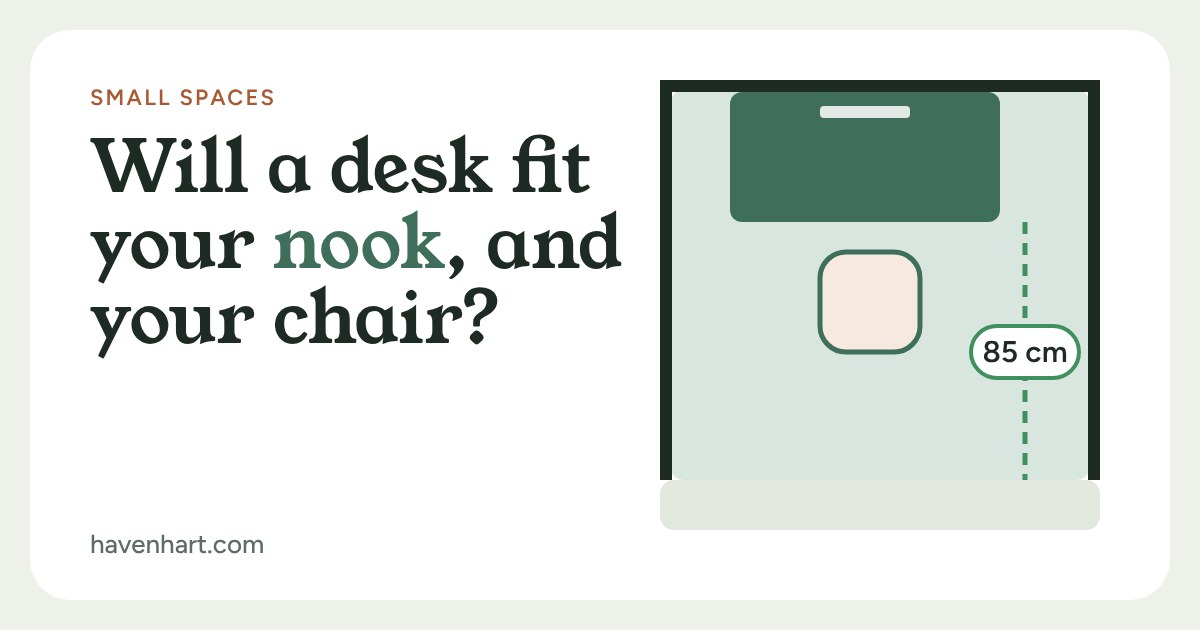
A desk nook is really a chair problem. Put in the width and depth of your corner, pick a desk size, and slide the desk along the wall to see how much room is left behind it to sit down, push back and stand up.
The guide gives simple rules of thumb for desk depth, desk width and the space behind the chair, shows when to break them, and lists free fixes to try before you buy anything, plus what to measure first.
The desk is the easy part
When people squeeze a work corner into a bedroom or living room, they measure the desk. It looks like a rectangle, so it feels like the only thing that needs to fit. But a desk is only useful with a person sitting at it, and a person needs a chair, and a chair needs room to move. That space behind the desk is what usually decides whether a nook feels calm or cramped.
So this guide does the opposite of the usual shopping list. You put in the size of the corner you have, and you move a desk around it to see what is left over for the chair.
Four numbers that matter
These are rules of thumb, not laws. They come from how big a body and a chair are, and from basic workstation guidance, which says you should sit at least about 50 cm from a screen.
| What | Rule of thumb | Why |
|---|---|---|
| Desk depth | 60 cm for a laptop, 70 cm for a monitor | Your eyes should be at least 50 cm from the screen, and a monitor takes up some of the surface |
| Desk width | 100 cm for a laptop, 120 cm for a monitor | Room for elbows, a notebook and a mug without stacking things |
| Behind the desk | 85 cm to sit down and stand up | A chair is about 50 cm deep, and you push it back about 35 cm to stand |
| Behind the desk, shared space | 100 cm or more | Someone can edge past while you are seated |
Notice that depth does double duty. A deeper desk is better for your eyes, but every extra centimetre of desk comes out of the space behind it. In a tight corner, a 60 cm laptop desk with comfortable room behind it beats an 80 cm desk you cannot get out from.
Move the desk and see
What you will notice
Try the defaults first: a 120 × 60 cm desk in a nook with 150 cm between the wall and the bed. That leaves 90 cm, which is enough to sit and stand but not to pass. Now make the desk 80 cm deep, the kind that holds a monitor happily. The chair stops fitting. This is the trade you are making in a small room, and it is easier to see on a plan than to feel in a showroom.
Then slide the desk along the wall. Where the desk sits matters less for the maths and more for everything else: a desk beside a window gets daylight on the screen's side rather than in your eyes, and a desk next to a socket saves a trailing lead across the floor.
When to break the rules
If the nook is only ever yours, the 100 cm "pass behind" figure does not apply at all. Stand-up room is what counts. If you work on a laptop for short stretches, a 50 cm deep shelf-desk is fine as long as you accept the screen is closer.
Drawers are the other thing the plan does not show. Under-desk drawers cut into knee space; the guidance for workstations is to keep the area under the desk clear so your legs can sit in more than one posture. A plain table with open legs often works better in a small room than a desk with built-in storage.
If it does not fit
Before you buy anything, there are free fixes worth trying. Turn the desk to the side wall so the chair has the long way of the room behind it. Swap the desk for a shallower shelf along a wall and use a lap tray for the rest. Borrow the dining table for the working day and pack it away at the end. A fold-down wall desk, hung on fixings made for your type of wall, uses almost no floor when it is closed; check your lease before drilling, and have someone help you hang it level.
Second-hand is a good place to look here. Plain tables and desks in standard sizes turn up all the time, and you can check the real dimensions with a tape in a minute.
Measure before you commit
- Nook width at desk height, wall to wall, not at the skirting board. Radiators, pipes and window frames can take 5 to 10 cm.
- Depth from the wall to the nearest thing on the other side: the bed, a sofa arm, a door swing. Measure at the widest point of that object.
- Sockets and the window. A desk in front of a socket needs a lead you can reach; a desk under a window needs a sill low enough to clear it.
- The chair you already own. Measure its depth and width and put those numbers in your head before you assume 50 cm is right for you.
A strip of masking tape on the floor, the size of the desk, will tell you more than a catalogue. Sit on your chair and push it back. If you can stand without moving the tape, you have found the spot.