Small Spaces · Explainer · 6 min ·
Will a chest of drawers tip? Open the drawers and see
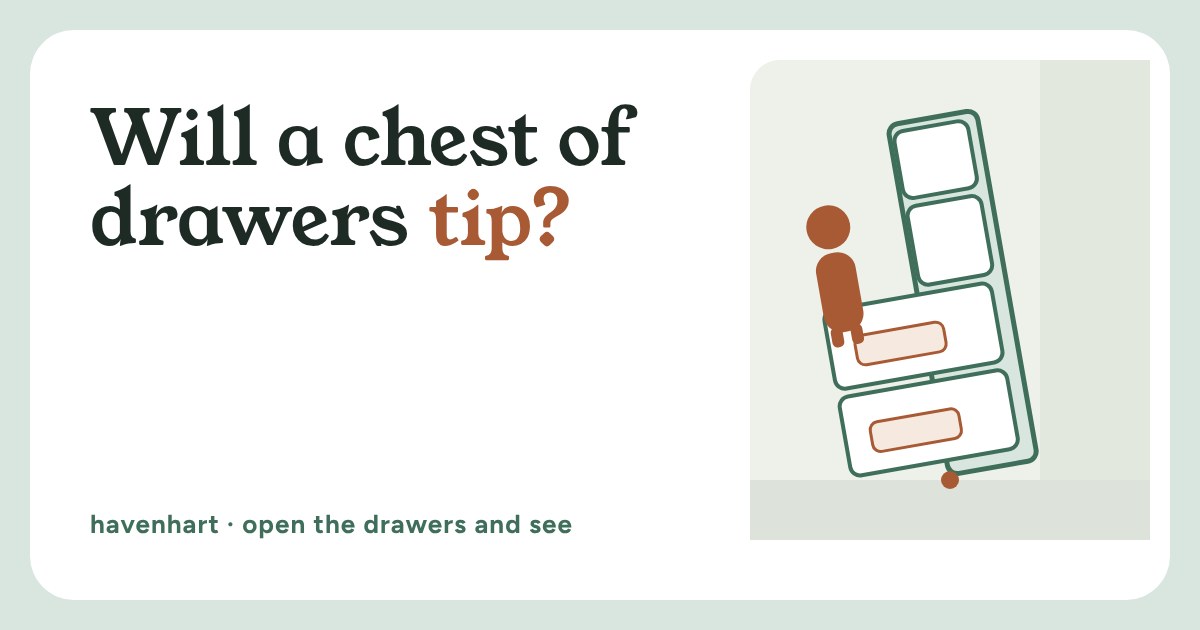
A tall chest of drawers does not tip about its middle. It tips about its front feet, and an open drawer, its clothes and a climbing child all hang in front of them. Set the height, depth, weight and load of a chest, pull drawers open from the bottom, and watch the balance flip in a side-on model.
The guide explains why a light, tall piece gives little warning, what to do for free (heavy things low, one drawer at a time), how a wall fixing works, how to ask a landlord, and what to measure before you buy.
It is not the weight, it is where the weight sits
A tall chest of drawers looks solid. It is full of clothes, it stands flat on the floor, and it has never moved. So it is easy to miss that a piece like this can go over, and that the thing that makes it go over is usually one of its own drawers being open.
This guide shows why, with a side-on model you can change. You set the size of the piece, how heavy it is and how much is in each drawer, then open drawers one by one and see where the balance goes. It matters most in small homes, where tall storage is the sensible way to use a wall and children, pets and walkways are all close by.
How a chest of drawers tips
Furniture does not tip about its middle. It tips about its front feet, the line where the front edge touches the floor. Whether it stays up comes down to a simple tug of war around that line:
- Behind the front feet, weight holds it down. The frame, the closed drawers and everything in them sit over the footprint, so they all help.
- In front of the front feet, weight pulls it over. An open drawer, its contents, and anyone standing or hanging on it all hang out beyond the edge.
Each side is a weight multiplied by how far it is from that line. Closed, everything is behind the line and the chest is very steady. Open a full drawer and its clothes move forward, past the line, and now they pull against you instead of helping. Add a child standing on that drawer and the pull grows quickly, because a child's weight sits right at the far end, where it has the most leverage.
That is also why a light frame is the risk: the same open drawer and the same child pull just as hard on a 25 kg chest as on a 70 kg one, but there is far less weight behind the line to answer back. And a tall, shallow piece leans over after only a small tilt, so there is little warning.
Open the drawers and see
What to try
Start with the defaults: a 130 cm tall, 40 cm deep chest weighing 25 kg, with two drawers open and a toddler on top. It stands. Now drag Drawers pulled open up to the top and watch the bar flip. Then try the same thing with a heavier, deeper piece, or with the toddler switched off, and notice how much the margin changes.
Two things usually stand out. First, depth and weight are your friends, but only up to a point: a heavy chest with its top drawers crammed full is much less steady than it looks. Second, a child makes a much bigger difference than the clothes do. For scale, a typical two-year-old weighs around 12 kg, and that weight lands at the very front of the open drawer.
Making it safer, cheapest first
Safe storage does not mean buying more. Start with what you already own:
- Put the heavy things low. Heavy items in the bottom drawers keep the centre of gravity down. Keep the top drawers and top shelves for light things.
- Open one drawer at a time. Push each one back before you pull out the next, and shut them all when you leave the room.
- Keep tempting things low. Toys and favourite items out of reach on top give children a reason to climb.
- Move it. Tall, light pieces are best away from places where small children play or sleep.
- Add a wall fixing. A strap or an angle bracket from the top of the piece into the wall is the fix that works even when everything else goes wrong. Safety bodies recommend it for tall free-standing furniture, especially anywhere a child could climb, and the same goes for televisions on units.
For the fixing itself, follow the instructions that came with the piece or the strap, and pick screws and plugs that suit your wall. Plasterboard, brick and concrete each need something different, and a hardware shop can advise. Check for hidden pipes and cables behind the spot before you drill, and if you are not sure, ask a professional.
In a rented home, ask first. Explain why you want to fix the piece, offer to fill the small holes when you leave, and get the answer in writing. A couple of tidy screw holes are easy to repair, and most landlords would rather have those than a fallen wardrobe.
What to measure first
If you are thinking of getting a tall chest, bookcase or wardrobe, measure before you buy:
- The footprint and the pull-out space. Add the drawer depth to the depth of the piece to find how much floor you need in front of it, and leave room to stand beside the open drawer.
- The gap behind it. A skirting board holds the piece a little way off the wall. Measure it, since the fixing has to bridge that gap.
- The route in. Doorways, stairs and corners, and the ceiling height if you are going tall.
When you compare pieces, look for a deep footprint, a heavier build, drawer stops so a drawer cannot come right out, and a fitting kit for the wall in the box. Second-hand pieces are often heavy and deep, and cost less than new, but check the drawers still slide properly, and add your own fixings.
The idea in one line: a piece tips when more weight is in front of its feet than behind them. Open drawers do that, and a fixing to the wall is what stops it.