Small Spaces · Tool · 5 min ·
How far apart should coat hooks be? Hang the coats and see
Hooks are usually quoted as one spacing number, but a puffer jacket takes far more room on a hook than a thin jacket. Put four coats on the wrong spacing and every coat ends up wearing the next one.
In this guide you drag hooks along a rail, choose what hangs on each, and watch where coats overlap. You get the usual starting points for spacing, height and depth, when to break them, and what to measure before you drill.
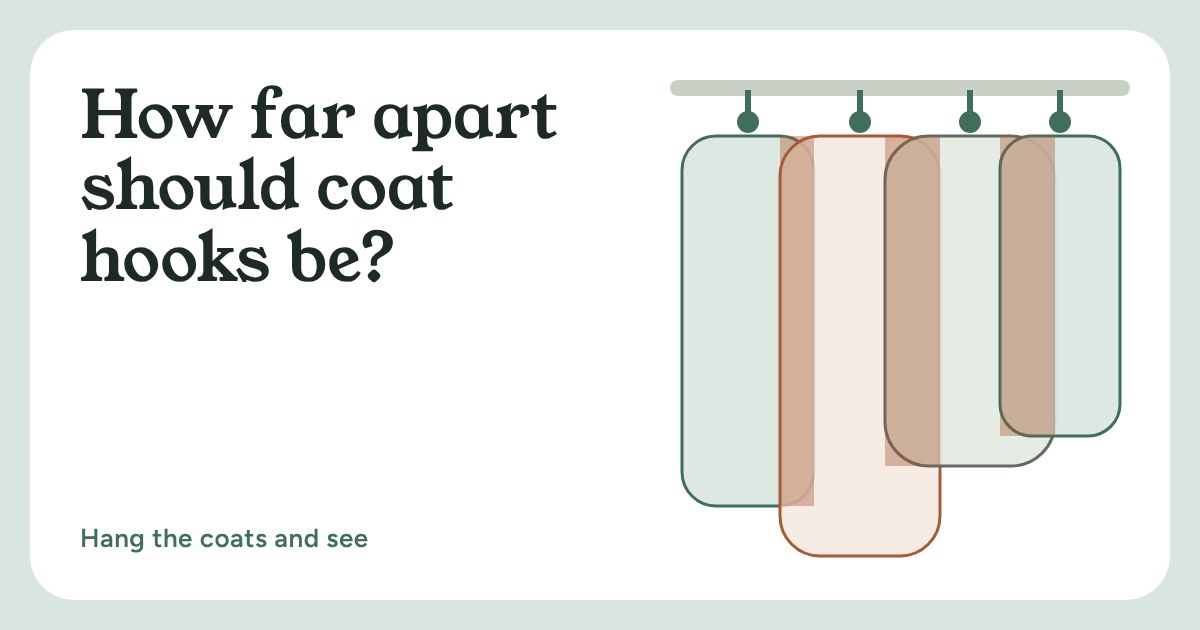
Coat hooks look simple: screw a few into the wall, hang coats on them. Then winter arrives, the puffer jacket goes up next to the wool coat, and suddenly every coat is wearing every other coat. Taking one down means moving three.
The fix is mostly about spacing, and spacing depends on what you actually hang. A coat on a hook is wider than the hook, and a bulky one is much wider than a thin jacket. Below you can drag the hooks along a rail, pick what hangs on each, and watch where the coats start to overlap.
A hung coat takes more room than its hook
On a hanger a coat keeps its shoulders. On a hook, hung by its loop or collar, it slumps and spreads. A light jacket stays fairly slim. A wool coat is wider and heavier. A padded puffer balloons outwards, both sideways and away from the wall.
That matters because hook spacing is usually quoted as one number, when the real question is "wide enough for my coats". The planner below uses rough, illustrative widths for three kinds of coat. Yours will differ, so treat the numbers as a starting point and check them against a real coat.
Spacing, height and depth: the usual starting points
Common guidance puts hooks about 25 to 40 cm apart, measured from the centre of one hook to the centre of the next. The tighter end works for light jackets and kids' coats. The wider end suits winter coats and puffers.
For height, a typical suggestion is around 150 to 165 cm from the floor for adults, and roughly 90 to 105 cm for young children, so they can reach their own hook. If you need to fit more hooks than the wall allows, a second row works, but leave a generous vertical gap between the rows, around 50 cm or more, so the upper coats do not sit on the lower ones.
Depth is the one people forget. A coat hanging flat on a hook still sticks out from the wall, and a puffer can take up a hand's width or more. In a narrow hallway that comes straight off the walking space.
What to try
Start with four hooks in 120 cm and the default mix of coats. With even spacing you get about 30 cm between hook centres, which is plenty for light jackets but too tight for a wool coat next to a puffer, so a few shaded overlaps show up straight away. Tap "All puffers" and watch the overlaps appear. Then drag a hook away from its neighbour: you can usually fix one pair by taking space from a pair that has some to spare.
Next, go to three hooks. It often looks like a loss, but three hooks that each hold a coat cleanly beat four hooks that hold a pile. The coats you wear every day get a hook of their own; the rest can live in a wardrobe or on a hanger rail.
When to break the rule
Spacing is a guide, not a law. A few honest exceptions:
- Stagger the heights. Alternating a high hook and a low hook lets coats overlap sideways without hanging on top of each other. It also suits a mix of adults' and children's coats.
- Use a hanger rail for bulky coats. A rail with coats on hangers lets you slide them sideways, so the spacing sorts itself out.
- Keep scarves, bags and hats on separate small hooks so they do not take up a coat's place.
- Reuse what you have. A row of hooks on the back of a door, an old peg rail from a second-hand shop, or a spare clothes rail may all do the job without a new purchase. Cosy does not mean buying more.
Measure before you fix anything to the wall
Before you drill or stick anything, measure a few things:
- The wall space. Measure the free width in centimetres, from the door frame or corner to the next obstacle, with a tape measure along the wall at hook height.
- Your widest and deepest coat. Hang it on any hook, step back, and measure how wide it spreads and how far it sticks out from the wall. Use those numbers instead of the sketch's.
- The hallway width. Measure from the wall to the opposite wall or furniture, then subtract the depth of your deepest coat. What is left is the space people can walk through.
- Which way the door opens. A door that swings onto a coat will pin it against the wall.
If you rent, check your lease before drilling. Adhesive hooks are an option, but they carry a stated maximum load, so read the pack and remember that a wet winter coat weighs more than a dry one. For screws, choose a wall plug that suits your wall type, whether brick, concrete or plasterboard. If you are not sure what is behind the wall, ask someone who is.
Cosy begins at the front door. A few well-spaced hooks and a clear path make coming home feel calmer, and you can often get there just by moving what is already on your wall.