Living Room · Tool · 4 min ·
How much room does a recliner need? Tilt it back and see
A recliner needs far more floor when you lean back than it does sitting upright, and that is where most "it doesn't fit" stories begin.
Set your chair's depth, reclined length and back clearance, then tilt it back in a top-down plan to see where the footrest ends up. You get the rule of thumb behind the result, a tape-on-the-floor way to measure your room before you buy, and what to try if it won't fit.
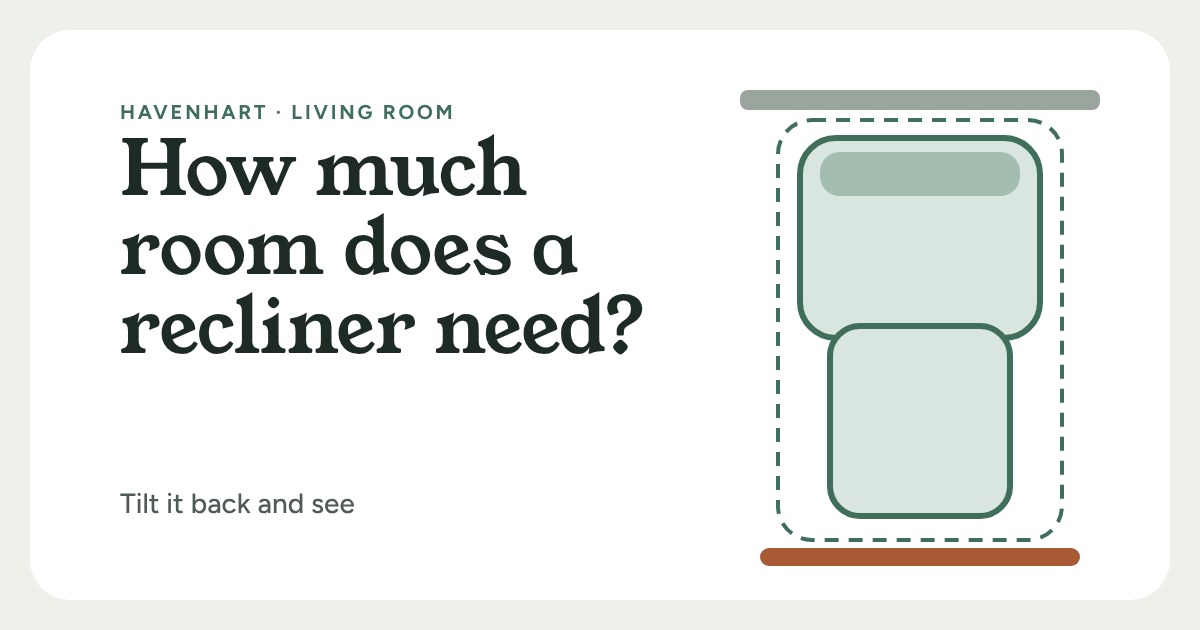
A recliner looks like an armchair until the moment you lean back. Then the back swings towards the wall, the footrest rises, and the chair suddenly needs far more floor than it did a second ago. Most "it doesn't fit" stories come from measuring only the chair sitting upright.
Three numbers decide it
Every recliner has an upright depth, a reclined length and a back clearance. The upright depth is how far it sticks out into the room when it is closed, usually somewhere around 80 to 105 cm. The reclined length is the whole chair from back to footrest tip when fully tilted, often around 150 to 185 cm. The back clearance is how much space the maker wants between the wall and the chair so the backrest can move.
That last one depends on the mechanism. A classic recliner swings its back backwards, so makers ask for a generous gap behind it, often several tens of centimetres. A "wall-hugger" (also sold as wall-away or space-saver) slides the seat forward as you tilt, so it can sit much closer to the wall, often around 5 to 15 cm, though some of them still ask for more. The trade is that a wall-hugger travels forwards into your room instead. Sources disagree on the exact figures, so treat the defaults below as typical and use the numbers on your chair's spec sheet.
Reading the plan
The chair drawn at 0% tilt is how it lives most of the day. At 100% you see its worst case, and the dashed outline marks everything it will ever touch. If the footrest tip lands on the coffee table, a radiator or the opposite wall, the chair either won't recline fully or will bruise your furniture. Try the classic chair with a 30 cm gap, then switch to the wall-hugger and shrink the gap to 10 cm. The back stops moving, but the footrest finishes in about the same place, or a little further out.
The rule behind the result is simple: space needed = back position at full tilt + reclined length + a small margin in front. The reclined length is what the maker lists, so hold their spec sheet next to this page rather than trusting a showroom memory.
Measure before you buy
Use a tape measure and mark the floor with masking tape or a few sheets of newspaper, which costs nothing and peels off cleanly in a rental.
- Measure from the wall to the nearest thing in front of the chair: coffee table, TV unit, radiator, door swing. That is your "wall to what's in front" number.
- Tape the upright footprint, then tape a second outline at the full reclined length from the wall. Stand in the gap and check you can still walk past; a comfortable walkway is commonly given as roughly 75 to 90 cm.
- Measure the width too, including the arms, and add a hand's width each side if there is a wall or a lamp there.
- Measure doorways, stairs and corners on the way in. Recliner frames are rigid and heavy, and many cannot be tilted like a sofa to get through a door.
Keep the power lead of an electric recliner out of the walkway, and follow the maker's instructions for the mechanism; keep small fingers and pets clear of it while it moves.
If it won't fit
You have more options than buying a smaller chair. Slide the coffee table out of the way, or swap it for a nesting table or a pouf you can pull aside when the footrest rises. Turn the chair a quarter turn so it reclines along a wall instead of towards the room. A second-hand chair is also a fair way to try a size, as long as the mechanism works smoothly and you have measured its numbers rather than guessed them. Sometimes the cosiest answer is a good armchair and a footstool you already own.
What to look for
- Maker's clearance figures. A listing that gives back clearance and reclined length lets you check the fit properly; one that gives neither makes it a guess.
- Mechanism type. If the chair must sit near a wall, look for wall-hugger and then read the actual gap it asks for.
- Footrest style. A shorter or retractable footrest saves floor space in a small room.
- Size and weight. Check the width and the packed size against your doorways, and whether it ships in parts.